
Discrete Random Variables: Advanced multi-part DRV — HCI 2025 H2 Math Prelim Paper 2
What this question tests
Question
In each round of a treasure hunt game, a player randomly selects a spot from a large number of predefined treasure locations on an island. Each spot uncovers one outcome, and a score \(x\) is awarded based on the outcome. The table below shows all the possible outcomes in a round and the corresponding scores. Each round is independent and the game resets after every round, so that the probabilities remain unchanged.
| Outcome | Cursed trap | Small trap | Mystery box | Gold chest |
|---|---|---|---|---|
| Score, \(x\) | \(-3\) | \(-0.3\) | \(p\) | \(5\) |
| \(\mathrm{P}(X=x)\) | \(0.2\) | \(p\) | \(q\) | \(0.1\) |
(a) Show that \(\mathrm{E}(X)=-0.1+0.4p-p^{2}\).
(b) Hence find the maximum and minimum possible values of \(\mathrm{E}(X)\).
(c) The treasure hunt game is played for \(30\) rounds. If \(p=0.4\), find the probability that the player's mean score exceeds \(0\).
(d) The treasure hunt game is played for \(10\) rounds. Given that the probability of finding more than 3 Small traps in these \(10\) rounds is \(10\%\), find the value of \(p\).
(e) Over a long period of time, it is observed that the number of Small traps found in \(10\) rounds of the game follows a bimodal distribution, with one of the modes being \(3\). Find the two exact possible values of \(p\), showing your working clearly.
Show full worked solution▾
(a) Since probabilities sum to \(1\): \[ 0.2+p+q+0.1=1 \quad\Longrightarrow\quad q=0.7-p. \] \[\begin{aligned} \mathrm{E}(X) &= (-3\times 0.2)+(-0.3\times p)+(p\times q)+(5\times 0.1) \\ &= (-0.6)+(-0.3p)+p(0.7-p)+0.5 \\ &= -0.1+0.4p-p^{2}. \end{aligned}\]
(b) Enter \(Y=-0.1+0.4p-p^{2}\) into GC to find maximum point.
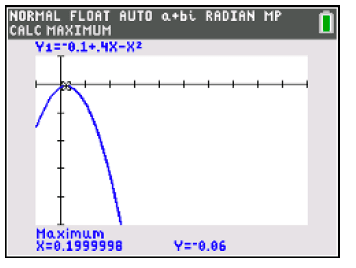
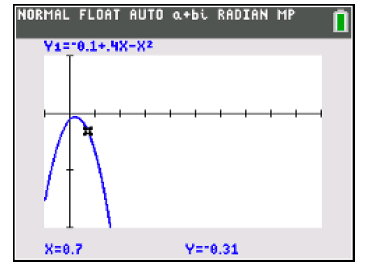
\(p\ge 0\) and \(q\ge 0\Rightarrow 0.7-p\ge 0\Rightarrow p\le 0.7\).
When \(p=0.7\):
(c) Method 1
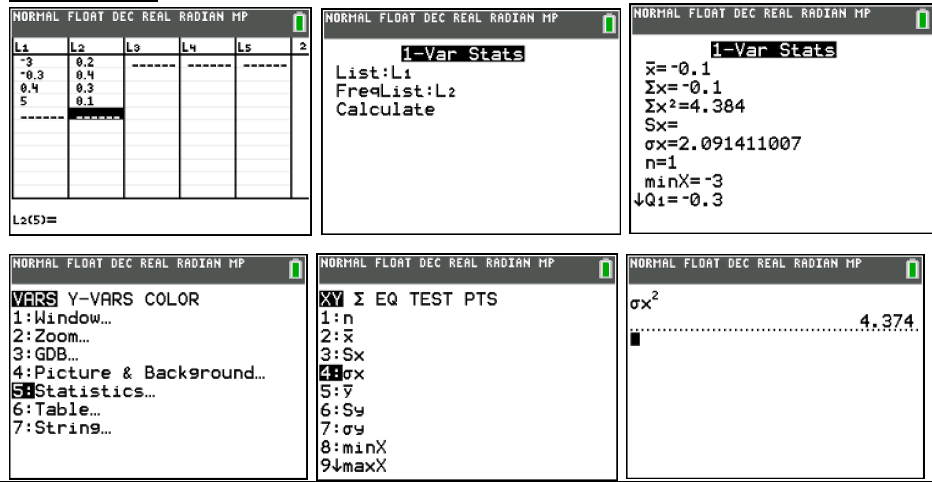
Method 2 \[\begin{aligned} \mathrm{E}(X) &= -0.1+0.4(0.4)-(0.4)^{2}=-0.1 \\ \mathrm{E}(X^{2}) &= (3^{2}\times 0.2)+(0.3^{2}\times 0.4)+(0.4^{2}\times 0.3)+(5^{2}\times 0.1) \\ &= 4.384 \\ \mathrm{Var}(X) &= 4.384-(-0.1)^{2}=4.374. \end{aligned}\]
\[ \bar X=\frac{X_{1}+X_{2}+\cdots+X_{30}}{30} \]Since \(n=30\) is large, by the Central Limit Theorem, \[ \bar X\sim\mathrm{N}\!\left(-0.1,\ \frac{4.374}{30}\right)\text{ approximately}. \] \[ \mathrm{P}(\bar X\ge 0)=0.39670\approx 0.397\ (\text{to 3 s.f.}). \]
(d) Let \(Y\) be the number of small traps, out of \(10\) rounds. \(Y\sim\mathrm{B}(10,p)\). \[\begin{aligned} \mathrm{P}(Y>3)=0.10 &\Longleftrightarrow 1-\mathrm{P}(Y\le 3)=0.10 \\ &\Longleftrightarrow \mathrm{P}(Y\le 3)=0.9. \end{aligned}\]
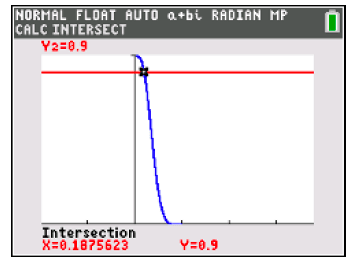
\(\therefore\ p=0.188\) (to 3 s.f.)
(e) For a \(\mathrm{B}(10,p)\) distribution to be bimodal with modes including \(3\), the other mode must be \(2\) or \(4\) with \(\mathrm{P}(Y=3)\) equal to the neighbour.
\(\mathrm{P}(X=2)=\mathrm{P}(X=3)\): \[\begin{aligned} {}^{10}C_{2}p^{2}(1-p)^{8} &= {}^{10}C_{3}p^{3}(1-p)^{7} \\ \text{Since }(1-p)>0,\ p>0:\quad 45(1-p) &= 120p \\ p &= \frac{3}{11}. \end{aligned}\]
\(\mathrm{P}(X=4)=\mathrm{P}(X=3)\): \[\begin{aligned} {}^{10}C_{4}p^{4}(1-p)^{6} &= {}^{10}C_{3}p^{3}(1-p)^{7} \\ 210p &= 120(1-p) \\ p &= \frac{4}{11}. \end{aligned}\]
\(\therefore\ p=\dfrac{3}{11}\) or \(p=\dfrac{4}{11}\).