Free practice / Secondary 4 E Maths
Sec 4 E Maths: Prime Factors, HCF, LCM and Approximation, practice questions & worked solutions
Prime factors, HCF, LCM and approximation questions selected from 2023 to 2025 Singapore school E Maths prelim papers, each with the school’s full worked solution.
About this topic & key methods
Prime factorisation, HCF and LCM, rounding and estimation start in Sec 1, and E Maths prelims test them in short questions, often with a twist such as a perfect cube or an unknown index. These questions all come from Paper 1, where this topic is set.
Attempt each question on paper before opening its worked solution. The solutions are the schools’ own marking schemes, so some steps are brief.
Key methods for prime factors, HCF and LCM
- Write a number as a product of primes in index form, such as
- HCF: take each common prime with its lowest power; LCM: take every prime with its highest power
- Use the product of the two numbers
- A number is a perfect square when every index is even, and a perfect cube when every index is a multiple of 3
- Read HCF from "greatest number that shares equally" and LCM from "next time together"
- For bounds, add or subtract half the unit of rounding, then choose the bound that makes the answer largest or smallest
- Round only the final answer, keeping full calculator values in between
For lessons that build these methods week by week, see our E Maths tuition for Sec 3 and Sec 4.
Prime Factors, HCF, LCM and Approximation questions with worked solutions
Unless the question specifies otherwise, give non-exact answers to 3 significant figures and angles in degrees to 1 decimal place.
Calculator work and significant figures, Anglo-Chinese School (Barker Road), 2023 Prelim P1 Q2
Calculate .
Write down the first five digits of your answer. [1]Write your answer to part (a) correct to 2 significant figures. [1]
Show worked solution▾
(a)
(b)
Answer: (a) (b)
Lowest common multiple of two flashing intervals, Anglican High School, 2025 Prelim P1 Q5
Mr Chan is looking at Deepavali decorations. There are two lights, one green and one red, flashing at different intervals. The green light and the red light flash at intervals of 6 seconds and 8 seconds respectively. If the two lights start flashing at the same time, how long will it take for the two lights to next flash simultaneously? [2]
Show worked solution▾
It will take 24 s for the two lights to next flash simultaneously again.
Answer:
HCF and LCM by prime factorisation, Geylang Methodist School (Secondary), 2024 Prelim P1 Q2
Find the lowest common multiple (LCM) of 108 and 140. [1]
Find the highest common factor (HCF) of 108 and 140. [1]
Show worked solution▾
(a)
By Prime Factorisation,
| 2 | 108 | 140 |
| 2 | 54 | 70 |
| 3 | 27 | 35 |
| 3 | 9 | 35 |
| 3 | 3 | 35 |
| 5 | 1 | 7 |
| 7 | 1 | 1 |
(b)
By Prime Factorisation,
| 2 | 108 | 140 |
| 2 | 54 | 70 |
| 27 | 35 |
Answer: (a) (b)
Lower bound of a mass from a rounded diameter, Cedar Girls’ Secondary School, 2025 Prelim P1 Q2
The diameter of a solid sphere is 7.12 cm, measured correct to 3 significant figures.
Its density is 2.2 g/cm.
Find the smallest possible mass of the sphere. [2]
Show worked solution▾
Mass
Answer:
Highest common factor in a sharing problem, Chung Cheng High School (Main), 2024 Prelim P1 Q4
A group of students won $226 in a competition and shared the amount equally, leaving $4 leftover. Competing for a second time, the same group of students won $296. They shared the $296 along with the $4 left over from the first competition equally, with no amount remaining.
Assuming that each student received a whole number of dollars in both distributions, find the greatest possible number of students in the group. [2]
Show worked solution▾
HCF is 6. There are 6 students.
Answer: students
Estimating by rounding to 2 significant figures, Crescent Girls’ School, 2025 Prelim P1 Q3
The density of gold is 19.32 g/cm.
The mass of a gold bracelet is 37.51 g.
By rounding these numbers correct to 2 significant figures, find an estimate of the volume of the gold bracelet.
Show the numbers you use. [2]
Without doing any further calculation, explain why the actual volume of the gold bracelet is less than the answer to part (a). [1]
Show worked solution▾
(a)
(b)
The mass is rounded up to a larger value
The density is rounded down to a smaller value
Volume is found by dividing a larger mass by a smaller density
The actual volume is less than the estimated volume
Answer: (a) cm (b) A larger mass is divided by a smaller density.
Finding a number from its HCF and LCM, Ahmad Ibrahim Secondary School, 2023 Prelim P1 Q3
Express 4680 as a product of its prime factors, giving your answers in index notation. [1]
The HCF and LCM of 120 and are 12 and 4680 respectively.
Given that , find the value of . [2]
Show worked solution▾
(a)
(b)
| HCF | |
| LCM |
Answer: (a) (b)
Two numbers from a given HCF and LCM, Chung Cheng High School (Yishun), 2025 Prelim P1 Q2
Express 252 as a product of its prime factors. [1]
The highest common factor (HCF) of two numbers is 21.
The lowest common multiple (LCM) of the two numbers is 252.
Both numbers are less than 100.
Find the two numbers. [2]
Show worked solution▾
(a)
(b)
The two numbers are 63 and 84.
Answer:
Perfect squares and perfect cubes from prime factors, Swiss Cottage Secondary School, 2024 Prelim P1 Q21
Use prime factors to explain why is a perfect square. [3]
Write down the greatest integer that will divide both 56 and 126 exactly. [1]
The number is a perfect cube.
Find the smallest positive integer value of . [2]
Show worked solution▾
(a)
Since the powers of all prime factors are even, is a perfect square.
(b)
(c)
Answer: (a) ; every index is even, so it is a perfect square (b) (c)
Unknown prime factors from an LCM, then an HCF problem, Bukit Merah Secondary School, 2025 Prelim P1 Q26
Find the prime factors of 2600, giving your answer in index form. [2]
Two integers, and , can be written as products of prime factors.
The lowest common multiple of and is 2600.
Find the value of and of . [2]
A charity group plans to distribute rice and oil that it has to senior citizens.
The number of packets of rice that the charity group has is , where .
The number of bottles of oil that the charity group has is , where .
The charity group plans to distribute packets of rice and bottles of oil equally and benefit the greatest possible number of senior citizens. Each senior citizen will receive the same number of packets of rice and the same number of bottles of oil.
Find the number of packets of rice and bottles of oil each senior citizen will get. [2]
Show worked solution▾
(a)
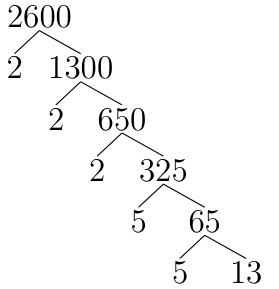
(b)
(i)
LCM of and
(ii)
HCF of and
Number of packets of rice
Number of bottles of oil
Answer:
More practice related to prime factors, HCF and LCM
Sec 1 Maths: Factors, Multiples, HCF and LCM
Sec 1 Maths: Approximation and Estimation