
Sec 1 Maths: Primes, Factors & Multiples (HCF / LCM) — practice questions & worked solutions
Primes, factors and multiples questions from Singapore Secondary 1 examination papers, each with a full worked solution that shows the prime factorisation and every step — the way marks are actually awarded.
About this topic & key methods
Primes, factors and multiples are the foundation of Secondary 1 Mathematics. Nearly every question below starts the same way — express each number as a product of prime factors in index notation — and then reads off the answer: take the lowest powers of the common primes for the highest common factor (HCF), the highest powers of all primes for the lowest common multiple (LCM), and adjust indices to make a number a perfect square, perfect cube, square root or cube root.
These skills turn up everywhere: cutting a block into the largest identical cubes (HCF), finding when repeating events coincide (LCM), and “smallest k” perfect-square / perfect-cube problems. Each worked solution below shows the full prime factorisation and the reasoning at every line. For a structured programme that builds this number sense from the ground up, see our Secondary 1 Maths tuition.
Key methods
- Prime factorisation — write a number as a product of primes, e.g. .
- Index notation — express repeated prime factors as powers and keep answers in index form.
- HCF (highest common factor) — multiply the lowest power of each common prime.
- LCM (lowest common multiple) — multiply the highest power of every prime that appears.
- Perfect square — every prime index must be even; multiply or divide to fix odd indices.
- Perfect cube — every prime index must be a multiple of 3.
- Square & cube roots — halve each even index for ; divide each index by 3 for .
- Word problems: “largest identical pieces / bags” use the HCF; “least common length / when events coincide” use the LCM.
Questions & worked solutions
Smallest p for a perfect square & cube
State the smallest positive value of such that is both a perfect square and a perfect cube. Leave your answer in index notation.
Show worked solution▾
For a perfect square and a perfect cube, every index must be a multiple of .
For : index is , need , so multiply by .
For : index is , need , so multiply by .
Prime factors, HCF condition & perfect cube
Express and as product of prime factors.
The HCF of , and is . Find the two smallest possible values of .
Write down the smallest positive value of a whole number if is a perfect cube. Express your answer in index notation.
The numbers and have an LCM of . State the LCM of and .
Show worked solution▾
(a)(i) Prime factorisation
(ii) Two smallest values of
. Since and already share , must contribute exactly as the common factor. The smallest such values are
(iii) Smallest for a perfect cube
. For to be a perfect cube each prime power must be a multiple of :
(b) LCM of and
Since is a multiple of , the LCM of and is
Index form HCF, LCM & cube root
Find the prime factors of and , giving your answers in index form.
Using the answers obtained in part
state the following, leaving your answers in index form.
highest common factor of and
lowest common multiple of and .
Write down the smallest positive integer value of such that is a whole number.
Show worked solution▾
(i) Prime factorisation
(ii)(a) HCF — lowest power of each common prime
(ii)(b) LCM — highest power of each prime
(iii) Smallest for a whole number
For to be a whole number, every prime power in must be a multiple of .
Check: , and .
HCF, LCM, perfect cube & remainder problem
The numbers , and written as a product of their prime factors, are , , . Find
the greatest whole number that divides all three, leaving your answer in index form
the lowest common multiple of all three, in index form
the smallest positive integer such that the product of and the LCM is a perfect cube.
Ruhua has between to sweets. If he divides his sweets into groups of , he will have sweets left. If he divides his sweets into groups of , he will have sweets left. Find the number of sweets left if he divides his sweets into groups of .
Show worked solution▾
(a)(i) Greatest whole number that divides all three (HCF)
HCF takes the lowest power of each common prime.
(a)(ii) LCM
LCM takes the highest power of each prime.
(a)(iii) Smallest so is a perfect cube
For a perfect cube each index must be a multiple of .
Need : (add ); : already a multiple of ; : (add ).
(b) Sweets left in groups of
Leaving from groups of and from groups of means the number is short of a multiple of both and , so is a multiple of .
For : gives , so .
Remainder .
HCF of 1470 and 300
Find the HCF of and .
Show worked solution▾
Taking the lowest power of each common prime factor:
Least packs via LCM
Paperclips are sold in packs of . Thumbtacks are sold in packs of . Beatrice buys the same number of paperclips as thumbtacks for her office. Find the least number of packs of paperclips that she could have bought.
Show worked solution▾
The least equal number is the LCM of and :
Least number of packs of paperclips:
Cube root of A×B & perfect-square divisor
The numbers , and , written as a product of their prime factors, are given below, where , and are positive integers. , , . Using the prime factors given above, find
the cube root of
the smallest integer, , such that is a perfect square.
Show worked solution▾
(i) Cube root of
(ii) Smallest so is a perfect square
For to be a perfect square, every prime power must be even. , so remove and :
Perimeter of a square via prime factorisation
The area of a square is . Using prime factorisation, find the perimeter of the square.
Show worked solution▾
Length of side:
Perimeter:
Cube edge, HCF, perfect square & LCM
It is given that , correct to 3 significant figures. Find, without the use of a calculator, the length of an edge of a cube which has a volume of .
The numbers 36 and 56, written as the products of their prime factors, are and .
Find the highest common factor of 36 and 56.
Find the smallest positive integer such that is a perfect square.
Ash, Misty and Brock are each given a rope of length cm. Ash cuts his rope into pieces of length 36 cm, Misty into pieces of 56 cm, Brock into pieces of 54 cm. If there is no rope leftover, find the smallest possible value of .
Show worked solution▾
(a) Edge of the cube
(b)(i) HCF of 36 and 56
Common prime factors: .
(b)(ii) Smallest so is a perfect square
. To leave a perfect square, divide out .
(b)(iii) Smallest (LCM of 36, 56 and 54)
Prime between 75 and 81, factor equation & cube root
A prime number, , is greater than 75 but less than 81.
State the value of . It is given that can be expressed as a product of and , where is a positive integer.
Find the value of , showing your working clearly.
Express as a product of its prime factors.
Hence find the largest possible value of and the corresponding value of , where is a positive integer.
Show worked solution▾
(a)(i) Value of
The only prime between 75 and 81:
(a)(ii) Value of
Since is prime, the factors and must be and . As :
Check: and .
(b)(i) Prime factorisation of
(b)(ii) Largest cube root and
For the cube root to be largest, must be the largest perfect cube that divides it.
The largest perfect cube of the form dividing is , giving cube root . Then:
Largest value , with .
Largest cube to fill a tank, HCF
A rectangular tank measures 48 cm by 72 cm by 252 cm. If it is to be filled completely with small identical cubes, find
the greatest possible volume of each cube
the least possible number of cubes required.
Show worked solution▾
(i) Greatest possible volume (cube edge = HCF)
Greatest possible volume:
(ii) Least possible number of cubes
Common remainder (LCM) & goodie bags (HCF)
Find the smallest possible value of a whole number if it leaves a remainder of when divided by , or .
For a charity event, a group of student leaders has to pack bread rolls and packets of biscuit equally into identical goodie bags with no leftover. Find the largest possible number of goodie bags that can be packed.
Show worked solution▾
(a) Smallest whole number
The number is more than a common multiple of , and .
(b) Largest number of goodie bags (HCF)
Largest number of goodie bags .
Prime factorisation, perfect cube & cubes from a block
Find the prime factorisation of .
Find the smallest positive integer value of such that is a perfect cube.
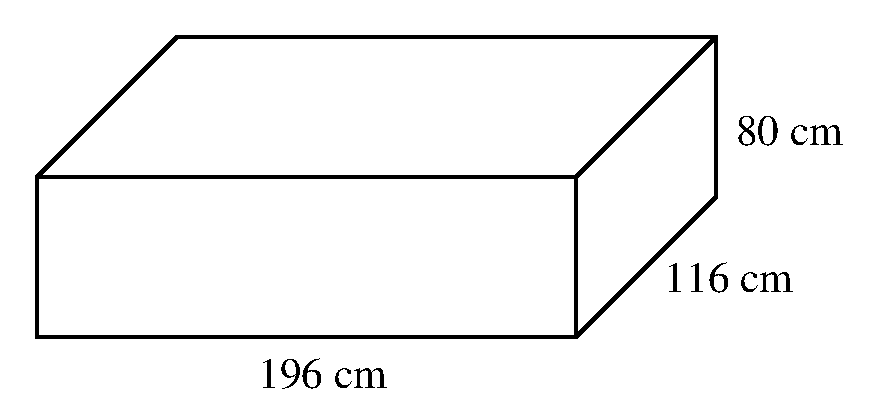
A rectangular block of wood has dimension cm by cm by cm. Find the smallest number of identical cubes John can cut from the block of wood such that no wood is left.
Show worked solution▾
(a)(i) Prime factorisation of
(a)(ii) Smallest for a perfect cube
For a perfect cube each prime index must be a multiple of :
(b) Smallest number of identical cubes
For the largest identical cube use the HCF of the dimensions:
Number of cm cubes:
Index values, largest cube number & kth multiples
Written as the product of its prime factors, . Find the value of and .
Ander has 785 one-centimetre cubes. He makes the largest cube possible using some of the 785 cubes. How many cubes does he have left?
The th multiple of 5 and th multiple of 7 has a difference of 2022. Find the value of .
Show worked solution▾
(a) Values of and
.
(b) Cubes left over
Largest cube number not exceeding 785 is .
(c) Value of
HCF, perfect square & multiple condition
The numbers and , written as the product of their prime factors, are and .
Find the highest common factor of and .
Find the smallest positive integer such that is a perfect square.
Find the smallest positive integer such that is a multiple of .
Show worked solution▾
(a) HCF
(b) Smallest for a perfect square
(c) Smallest so is a multiple of
For to be a multiple of :
Smallest multiplier for a multiple & perfect square
It is given that and .
Find the smallest positive integer for which is a multiple of .
Find the smallest positive integer for which is a whole number.
Show worked solution▾
(a) Smallest so is a multiple of
must contain . From , it already has and one ; it lacks and .
(b) Smallest so is a whole number
. For a perfect square, each prime power must be even. Need an extra and an extra .
Largest cube length & number of cubes
A rectangular tray of brownie measures cm by cm by cm. It is to be cut into small cubes of identical size such that there is no leftover.
Find the largest possible length of each cube.
Hence, find the total number of cubes obtained.
Show worked solution▾
(a) Largest cube length = HCF(48, 20, 8)
(b) Total number of cubes
HCF & smallest multiplier for a perfect cube
It is given that and .
Find the highest common factor of and .
Find the smallest positive integer such that is a perfect cube.
Show worked solution▾
(a) HCF of and
Take the lowest power of each common prime:
(b) Smallest for a perfect cube
. For a perfect cube each index must be a multiple of :
When do three alarms coincide? (LCM)
Three alarms sound at regular intervals of seconds, seconds and seconds respectively. If all three sound together at am, find the total number of times they will sound together by am.
Show worked solution▾
, , :
From am to am is min:
Including the first time at am:
our Secondary 1 Maths programme — prime factorisation, index notation and every method behind these questions, taught step by step.