
Complex Numbers: conjugate-root factorisation, modulus-argument & cosine rule on the Argand diagram — ACJC 2025 H2 Maths Prelim Paper 1
What this question tests
Question
Do not use a calculator in answering this question.
(a) One of the roots of the equation \(\omega^4-2\omega^3+10\omega^2+p\omega+q=0\), where \(p\) and \(q\) are real, is \(2+3\mathrm{i}\). Find the values of \(p\) and \(q\) and the other roots of the equation.
(b) The complex numbers \(u\) and \(v\) are such that \(u=-\sqrt{2}+\mathrm{i}\sqrt{2}\), and \(|v|=3\) and \(\arg v=\theta\), where \(0<\theta<\dfrac{\pi}{4}\). The points \(A\), \(B\) and \(C\) represent \(u\), \(v\) and \(u+v\) respectively on an Argand diagram.
(b)(i) Find the modulus and argument of \(u\).
(b)(ii) Sketch the points \(A\), \(B\) and \(C\) on an Argand diagram.
(b)(iii) By finding the angle \(OAC\) in terms of \(\theta\) or otherwise, show that \(|u+v|^2 = a + b\cos(\theta+K)\), where \(a\), \(b\) and \(K\) are constants to be determined.
Show full worked solution▾
(a) Find \(p\), \(q\) and the remaining roots
Real coefficients force complex roots to occur in conjugate pairs, so pair the known quadratic factor against an unknown one and compare coefficients.
Since the coefficients are all real, complex roots occur in conjugate pairs. Therefore \(2-3\mathrm{i}\) is also a root.
\[ \omega^4-2\omega^3+10\omega^2+p\omega+q = \bigl(\omega-(2+3\mathrm{i})\bigr)\bigl(\omega-(2-3\mathrm{i})\bigr)(\omega^2+a\omega+b) = (\omega^2-4\omega+13)(\omega^2+a\omega+b) \]Comparing coefficients:
\[ \begin{aligned} \omega^3: &\quad -2 = -4+a \implies a = 2\\ \omega^2: &\quad 10 = -4a+13+b = 5+b \implies b = 5 \end{aligned} \]So \(\omega^4-2\omega^3+10\omega^2+p\omega+q = (\omega^2-4\omega+13)(\omega^2+2\omega+5)\).
\[ \begin{aligned} \omega^1: &\quad p = -20+26 = 6\\ \omega^0: &\quad q = 13\times 5 = 65 \end{aligned} \]The other two roots from \(\omega^2+2\omega+5=0\):
\[ \omega = \frac{-2\pm\sqrt{4-20}}{2} = \frac{-2\pm\sqrt{-16}}{2} = -1\pm 2\mathrm{i} \](b)(i) Modulus and argument of \(u\)
Compute the modulus directly, then place \(u\) in the second quadrant to fix its argument from the basic angle.
\[ |u| = \sqrt{(-\sqrt{2})^2+(\sqrt{2})^2} = \sqrt{2+2} = 2 \] \[ \text{Basic angle} = \tan^{-1}\!\frac{\sqrt{2}}{\sqrt{2}} = \frac{\pi}{4}\,. \quad u\text{ is in the 2nd quadrant, so } \arg u = \pi - \frac{\pi}{4} = \frac{3\pi}{4}\,. \](b)(ii) Sketch on the Argand diagram
Plot \(A\) and \(B\) by their moduli and arguments, then take \(C=u+v\) as the fourth vertex of the parallelogram.
\(A\) is at distance 2 from the origin at argument \(\dfrac{3\pi}{4}\) (second quadrant). \(B\) is at distance 3 from the origin at argument \(\theta\) (first quadrant, \(0<\theta<\dfrac{\pi}{4}\)). \(C\) represents \(u+v\), forming a parallelogram \(OACB\).
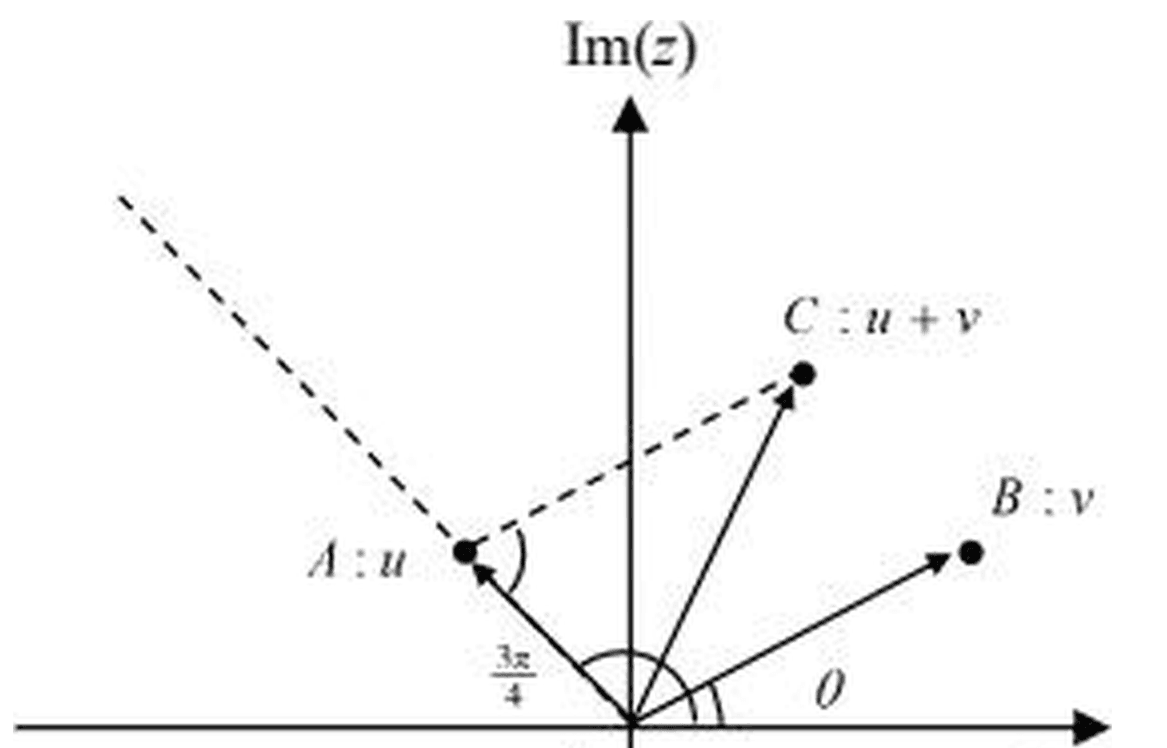
(b)(iii) Express \(|u+v|^2\) as a single cosine
Use the parallelogram to get angle \(OAC\) in terms of \(\theta\), then apply the cosine rule in triangle \(OAC\).
\[ \angle AOB = \frac{3\pi}{4} - \theta\,,\qquad \angle OAC = \pi - \angle AOB = \pi - \frac{3\pi}{4}+\theta = \theta+\frac{\pi}{4}\,. \]Applying the cosine rule on \(\triangle OAC\) (\(OA=|u|=2\), \(AC=|v|=3\), \(OC=|u+v|\)):
\[ \begin{aligned} |u+v|^2 &= 2^2 + 3^2 - 2(2)(3)\cos\!\left(\theta+\frac{\pi}{4}\right)\\ &= 13 - 12\cos\!\left(\theta+\frac{\pi}{4}\right) \end{aligned} \]Hence \(a=13\), \(b=-12\) and \(K=\dfrac{\pi}{4}\).