
Complex Numbers: locus on an Argand diagram, modulus & argument, quadratic roots — DHS 2025 H2 Maths Prelim Paper 1
What this question tests
Question
A complex number \(z\) varies with \(t\) such that \[ z = 2\cos t + \mathrm{i}(3\sin t), \quad \text{where } 0 \leq t < 2\pi. \]
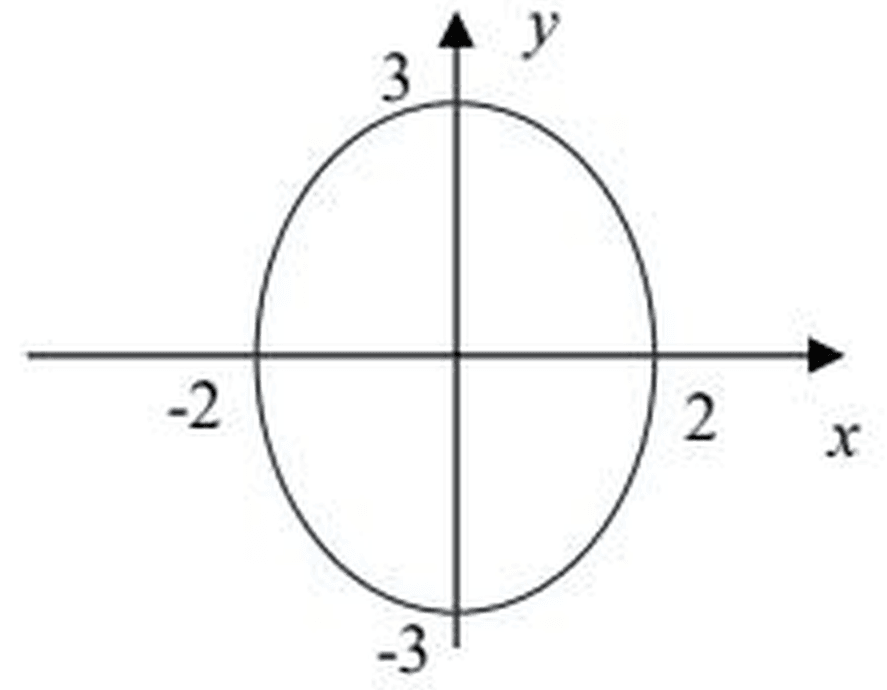
(a) By taking \(x = \mathrm{Re}(z)\) and \(y = \mathrm{Im}(z)\), sketch on an Argand diagram the curve that shows the positions of the points representing the complex number \(z\). Find the Cartesian equation of this curve.
(b) Two complex numbers \(z_1\) and \(z_2\) for two distinct values of \(t\) are such that \(|z_1| = |z_2|\) and \(0 < \arg(z_1) < \dfrac{\pi}{2}\). By referring to the Argand diagram in part (a), find the possible values of \(\arg(z_1 + z_2)\).
(c) It is given further that \(z_1\) and \(z_2\) are roots to the quadratic equation \(z^2 + \alpha z + \beta = 0\). Explain whether it is necessary for \(\alpha\) to be real.
(d) Given that \(\alpha\) is not real and \(|z_1| = |z_2| = \dfrac{\sqrt{26}}{2}\), find the values of \(\alpha\) and \(\beta\).
Show full worked solution▾
(a) Cartesian equation and sketch
Read off the real and imaginary parts as parametric coordinates and eliminate \(t\) using \(\cos^2 t + \sin^2 t = 1\).
With \(x = \mathrm{Re}(z) = 2\cos t\) and \(y = \mathrm{Im}(z) = 3\sin t\):
\[ \cos t = \frac{x}{2},\quad \sin t = \frac{y}{3} \implies \left(\frac{x}{2}\right)^2 + \left(\frac{y}{3}\right)^2 = 1 \]Cartesian equation: \(\dfrac{x^2}{4} + \dfrac{y^2}{9} = 1\) (an ellipse with semi-axes \(a=2\), \(b=3\)).
(b) Possible values of \(\arg(z_1+z_2)\)
Equal moduli put both points on the same ellipse equidistant from the origin, so symmetry fixes \(z_2\) at one of three reflected positions of \(z_1\).
Since \(|z_1| = |z_2|\), both points are equidistant from the origin on the ellipse. With \(z_1\) in the first quadrant (represented as \((a,b)\), \(a,b>0\)), there are three possible positions for \(z_2\):
(1) \(z_2 = (-a, b)\): then \(z_1 + z_2 = (0, 2b)\), so \(\arg(z_1+z_2) = \dfrac{\pi}{2}\)
(2) \(z_2 = (-a,-b)\): then \(z_1 + z_2 = 0\), so \(\arg(z_1+z_2)\) is undefined
(3) \(z_2 = (a,-b)\): then \(z_1 + z_2 = (2a,0)\), so \(\arg(z_1+z_2) = 0\)
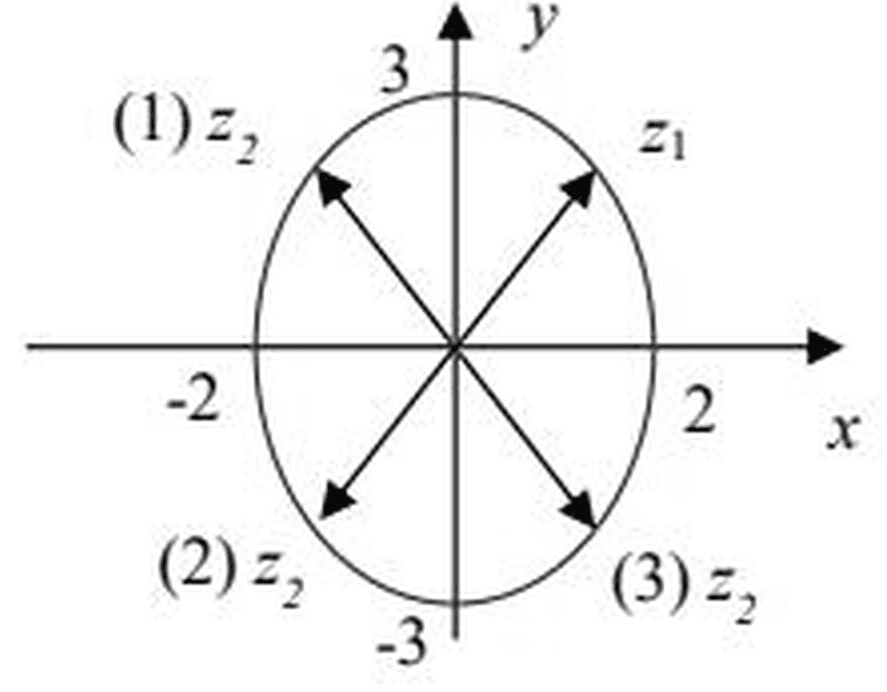
\(\arg(z_1+z_2)\) is either undefined, \(0\), or \(\dfrac{\pi}{2}\).
(c) Is \(\alpha\) necessarily real?
Form the quadratic from its roots and compare coefficients, then test a position where \(z_1,z_2\) are not conjugates.
From the diagram, if \(z_2\) is at position (1), \(\alpha\) will not be real.
\((z-z_1)(z-z_2) = 0 \Rightarrow z^2 - z(z_1+z_2) + z_1z_2\)
Compare with \(z^2 + \alpha z + \beta = 0\), coefficient of the \(z\) term is \(\alpha = -(z_1+z_2)\).
If \(z_1 = a+\mathrm{i}b\), then \(z_2 = -a+\mathrm{i}b\), so
\[ \alpha = -(z_1+z_2) = -\mathrm{i}2b \]Hence \(\alpha\) need not be real. It is not necessary for \(\alpha\) to be real, since \(z_1\) and \(z_2\) need not be complex conjugates.
(d) Find \(\alpha\) and \(\beta\)
Use the given modulus together with the ellipse equation to solve for \(a\) and \(b\), then apply sum and product of roots.
Given \(|z_1| = \dfrac{\sqrt{26}}{2}\), and \(z_1 = (a, b)\) on the ellipse:
\[ a^2 + b^2 = \frac{26}{4} = \frac{13}{2}, \qquad \frac{a^2}{4} + \frac{b^2}{9} = 1 \]Solving simultaneously: from the second equation \(9a^2 + 4b^2 = 36\). Combined with \(a^2+b^2 = \frac{13}{2}\) (multiply by 4: \(4a^2+4b^2=26\)):
\[ 5a^2 = 10 \implies a = \sqrt{2}, \quad b = \frac{3\sqrt{2}}{2} \](Taking \(a, b > 0\) since \(z_1\) is in the first quadrant.)
With \(\alpha\) not real, take \(z_2 = (-a, b) = \left(-\sqrt{2},\, \tfrac{3\sqrt{2}}{2}\right)\):
\[ \alpha = -(z_1+z_2) = -\left(0 + 3\sqrt{2}\,\mathrm{i}\right) = -3\sqrt{2}\,\mathrm{i} \] \[ \beta = z_1 z_2 = \left(\sqrt{2}+\tfrac{3\sqrt{2}}{2}\mathrm{i}\right)\!\left(-\sqrt{2}+\tfrac{3\sqrt{2}}{2}\mathrm{i}\right) = 2\!\left(1+\tfrac{3}{2}\mathrm{i}\right)\!\left(-1+\tfrac{3}{2}\mathrm{i}\right) = 2\!\left(-1-\tfrac{9}{4}\right) = -\tfrac{13}{2} \]