
Complex Numbers: modulus, argument and Argand-diagram geometry — NJC 2025 H2 Maths Prelim Paper 2
What this question tests
Question
Do not use a calculator in answering this question.
The complex number \(w\) is such that \(w = \mathrm{i} - \sqrt{3}\).
(i) Find \(|w|\) and \(\arg(w)\) in exact form.
(ii) Represent \(w\), \(-w\) and \(2-w\) in the same Argand diagram, illustrating clearly the geometrical relationship between them.
(iii) Hence, find \(\arg(2-w)\) exactly.
Show full worked solution▾
(i) Modulus and argument of \(w\)
Use \(|x+y\mathrm{i}|=\sqrt{x^2+y^2}\); since \(w\) lies in the second quadrant, take \(\arg(w)=\pi\) minus the acute reference angle.
\[ \begin{aligned} |w| &= |\mathrm{i} - \sqrt{3}| = \sqrt{(-\sqrt{3})^2 + 1^2} = 2\\[4pt] \arg(w) &= \pi - \tan^{-1}\!\left(\tfrac{1}{\sqrt{3}}\right) = \pi - \tfrac{\pi}{6} = \tfrac{5\pi}{6} \end{aligned} \](ii) Argand diagram
Plot the three points; all have the same modulus, so they lie on one circle, and reflecting \(w\) places the relevant points symmetrically.
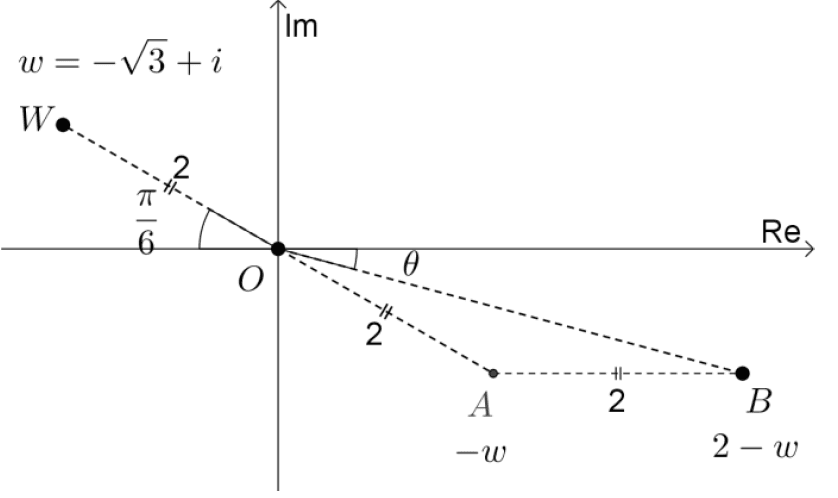
\(|w| = |-w| = |2-w| = 2\), so \(O\), \(A\) (representing \(-w\)) and \(B\) (representing \(2-w\)) all lie on a circle of radius 2 centred at the origin. Since \(AB\) is parallel to the real axis, triangle \(OAB\) is isosceles.
(iii) Argument of \(2-w\)
In the isosceles triangle the two base angles are equal, so split the known apex angle into two equal parts to read off the required argument.
Since \(|w|=2\), triangle \(OAB\) is isosceles with \(AB\) parallel to the real axis, so \(\angle AOB = \angle ABO = \theta\).
\[ \begin{aligned} 2\theta &= \frac{\pi}{6}\\[4pt] \theta &= \frac{\pi}{12} \end{aligned} \]Hence \(2-w\) makes an angle of \(\dfrac{\pi}{12}\) below the real axis, giving \(\arg(2-w) = -\dfrac{\pi}{12}\).