
Complex Numbers: Argand geometry — NYJC 2025 H2 Math Prelim Paper 1
What this question tests
Question
The points \(P\), \(Q\) and \(R\) representing the complex numbers \(p\), \(q\) and \(r\) on an Argand diagram are such that \(\arg(p) = \alpha\) and \(\arg(q) = \beta\), where \(0 < \alpha < \beta < \dfrac{\pi}{2}\), \(\beta > 2\alpha\) and \(r = p + q\).
(a) If \(|p| = |q|\), describe the shape of the quadrilateral \(OPRQ\). Hence find \(\arg(r)\) in terms of \(\alpha\) and \(\beta\).
(b) The point \(Q'\), representing the complex number \(q'\), is the reflection of the point \(Q\) in \(OP\). State the angle \(POQ'\).
By leaving your answers in terms of \(\alpha\), \(\beta\) and \(|q|\) where applicable, hence, or otherwise,
(i) find the argument of the complex number \(q'\),
(ii) find the real and imaginary parts of \(q'\) and write down \(q'\) in \(a + \mathrm{i}b\) form.
Show full worked solution▾
(a) If \(|p|=|q|\), then \(OPRQ\) forms a rhombus. \[ \arg(r) = \tfrac{1}{2}(\beta-\alpha)+\alpha = \tfrac{1}{2}(\alpha+\beta) \]
(b)
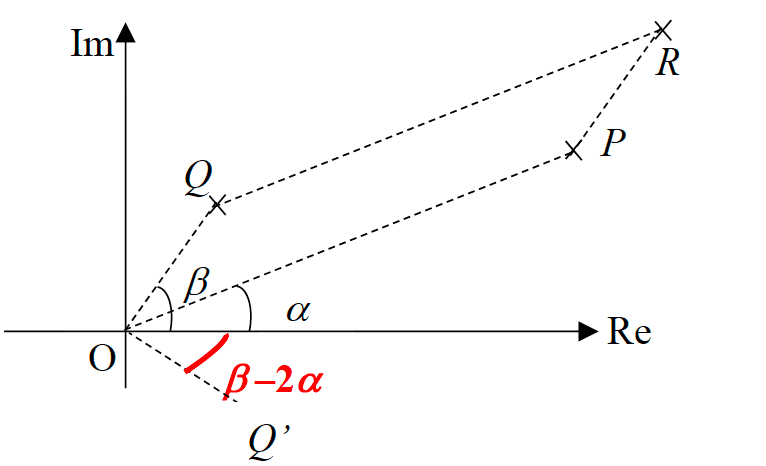
(b)(i)
Method 1: \(\arg(q') = -(\beta - 2\alpha) = 2\alpha - \beta\) (since \(\beta > 2\alpha\), \(q'\) is below the real axis)
Method 2: \(\arg(q') = \alpha - (\beta-\alpha) = 2\alpha - \beta\)
(b)(ii) \(|q'| = |q|\). Let \(F\) be the foot of perpendicular from \(Q'\) to the real axis.
Real part of \(q' = |q|\cos(-\beta+2\alpha)\) (adjacent side of \(\triangle OQ'F\))
Imaginary part of \(q' = |q|\sin(-\beta+2\alpha)\) (opposite side of \(\triangle OQ'F\), and negative)
\[ \therefore\; q' = |q|\cos(\beta-2\alpha) - \mathrm{i}|q|\sin(\beta-2\alpha) \]