
Complex Numbers: argument under scaling & rotation, geometry of \(\mathrm{f}(z)=z^2-2z\) — RI 2025 H2 Maths Prelim Paper 1
What this question tests
Question
Do not use a calculator in answering this question.
(a) The diagram below shows an Argand diagram, with the point \(P\) lying in the first quadrant.
The point \(P\) on the Argand diagram represents the complex number \(w\) given by \(w = u + \mathrm{i}v\), where \(u\) and \(v\) are real and positive.
(a)(i) Explain algebraically why \(\arg(kw) = \arg(w)\) for any real constant \(k > 1\).
(a)(ii) Points \(Q\) and \(R\) represent the complex numbers \(kw\) and \(\mathrm{i}kw\) respectively, where \(k\) is a real constant and \(k > 1\). On the same Argand diagram in the Printed Answer Booklet, plot the points \(Q\) and \(R\). Show clearly the geometrical relationship between the points \(P\), \(Q\) and \(R\).
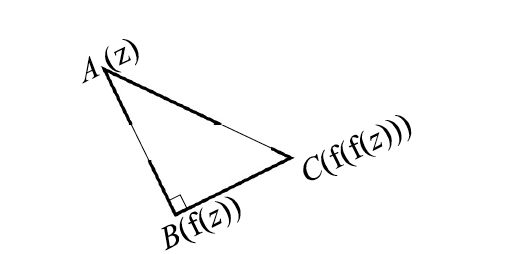
(b) In another Argand diagram, the points \(A\), \(B\) and \(C\) represent the complex numbers \(z\), \(\mathrm{f}(z)\) and \(\mathrm{f}(\mathrm{f}(z))\) respectively, where \(\mathrm{f}(z) = z^2 - 2z\).
It is given that \(ABC\) is a right-angled triangle, described in an anticlockwise sense, with a right angle at \(B\), and \(BC = mBA\), where \(m\) is a positive real constant.
(b)(i) Show that \(\mathrm{f}(\mathrm{f}(z)) - \mathrm{f}(z) = z(z-2)(z-3)(z+1)\).
(b)(ii) By considering \(\dfrac{\mathrm{f}(\mathrm{f}(z))-\mathrm{f}(z)}{\mathrm{f}(z)-z}\), or otherwise, show that \((z-2)(z+1) = m\mathrm{i}\).
(b)(iii) In the case where \(z = x + 2\mathrm{i}\), where \(x\) is a positive real number, find \(x\) and \(m\). Hence obtain the complex number represented by the point \(B\).
Show full worked solution▾
(a)(i) Argument is unchanged by positive scaling
Scaling by \(k>1\) multiplies both real and imaginary parts equally, so the ratio defining the argument is fixed.
Since \(w = u + \mathrm{i}v\) with \(u > 0\) and \(v > 0\), we have \(kw = ku + \mathrm{i}kv\) with \(ku > 0\) and \(kv > 0\). Therefore
\[ \arg(w) = \tan^{-1}\frac{v}{u}, \qquad \arg(kw) = \tan^{-1}\frac{kv}{ku} = \tan^{-1}\frac{v}{u} = \arg(w). \](a)(ii) Plotting \(Q\) and \(R\)
\(Q\) is \(P\) stretched outward along the same ray; \(R\) is \(Q\) turned a quarter-turn anticlockwise.
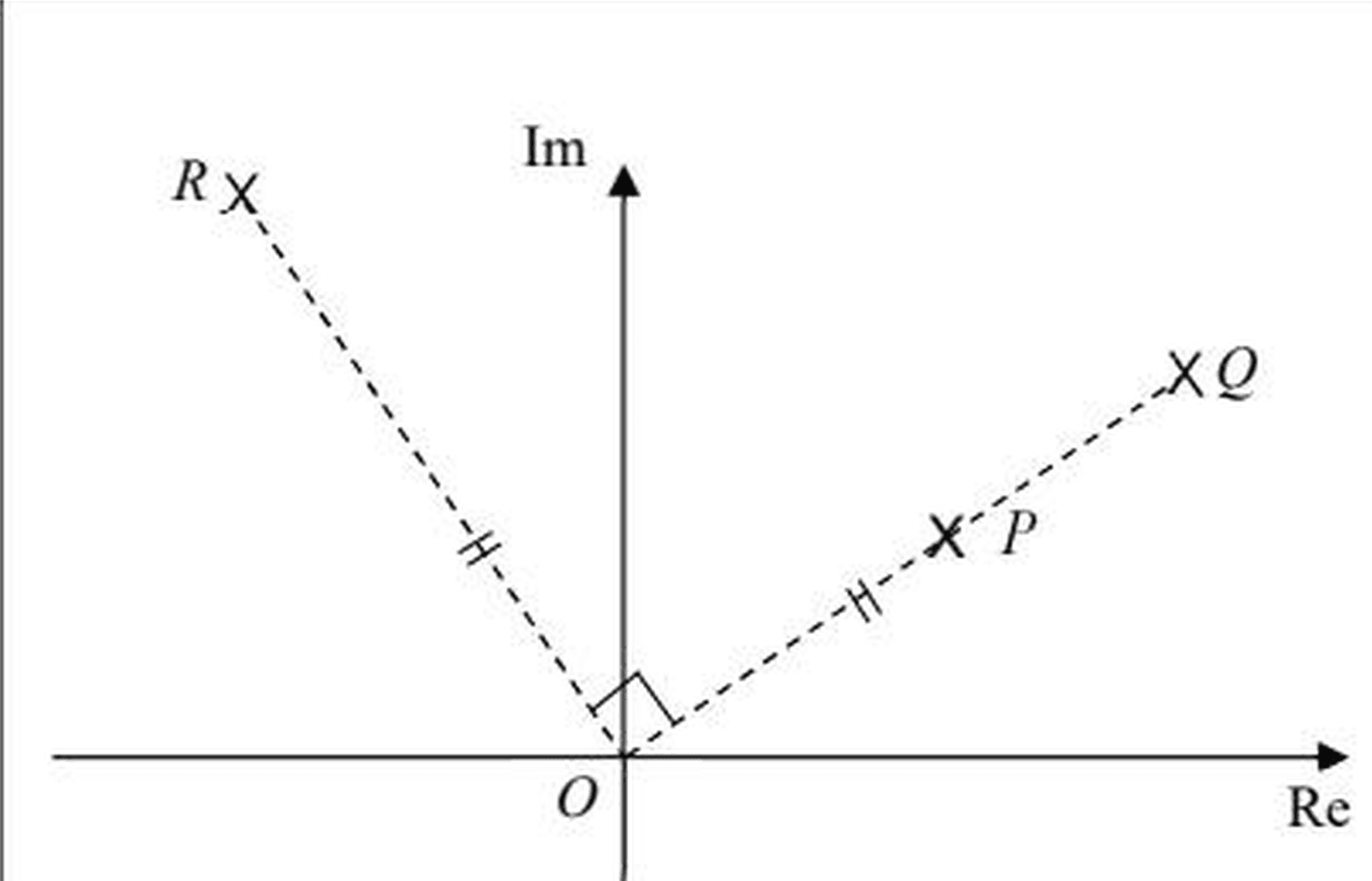
Since \(kw\) is \(w\) scaled by \(k > 1\), \(Q\) lies on the ray from \(O\) through \(P\), further from \(O\) than \(P\) (i.e. \(OQ > OP\)). Since \(R\) represents \(\mathrm{i}kw\), \(R\) is \(Q\) rotated \(90^\circ\) anticlockwise about the origin, so \(OR = OQ\) and \(OR \perp OQ\).
(b)(i) Factorising the difference
Factor out the common \(\mathrm{f}(z)=z^2-2z\), then factorise the remaining quadratic.
\[ \begin{aligned} \mathrm{f}(\mathrm{f}(z)) - \mathrm{f}(z) &= (z^2-2z)^2 - 2(z^2-2z) - (z^2-2z)\\ &= (z^2-2z)\left[(z^2-2z) - 2 - 1\right]\\ &= (z^2-2z)(z^2-2z-3)\\ &= z(z-2)(z-3)(z+1). \end{aligned} \](b)(ii) Turning the geometry into a complex equation
A right angle at \(B\) with \(BC = mBA\) anticlockwise means \(\overrightarrow{BC}\) rotated by \(\dfrac{\pi}{2}\) equals \(m\,\overrightarrow{BA}\).
Rotating \(\overrightarrow{BC}\) anticlockwise by \(\dfrac{\pi}{2}\) about \(B\) gives \(m\,\overrightarrow{BA}\):
(b)(iii) Solving for \(x\), \(m\) and \(B\)
Substitute \(z=x+2\mathrm{i}\), expand, and compare real and imaginary parts.
\[ \begin{aligned} (z-2)(z+1) &= m\mathrm{i}\\ z^2 - z - 2 &= m\mathrm{i}\\ (x+2\mathrm{i})^2 - (x+2\mathrm{i}) - 2 &= m\mathrm{i}\\ x^2 - 4 + 4x\mathrm{i} - x - 2\mathrm{i} - 2 &= m\mathrm{i}\\ (x^2 - x - 6) + \mathrm{i}(4x-2) &= m\mathrm{i} \end{aligned} \]Comparing real and imaginary parts:
\[ x^2 - x - 6 = 0 \quad\cdots(1), \qquad 4x - 2 = m \quad\cdots(2) \]From (1): \((x-3)(x+2) = 0 \Rightarrow x = 3\) or \(-2\). Since \(x > 0\), \(x = 3\).
From (2): \(m = 4(3) - 2 = 10\).
\(B\) represents \(\mathrm{f}(z) = z^2 - 2z = (3+2\mathrm{i})^2 - 2(3+2\mathrm{i}) = 9+12\mathrm{i}-4-6-4\mathrm{i} = -1+8\mathrm{i}\).