Complex Numbers: Triangle geometry — RVHS 2025 H2 Math Prelim Paper 2
What this question tests
Question
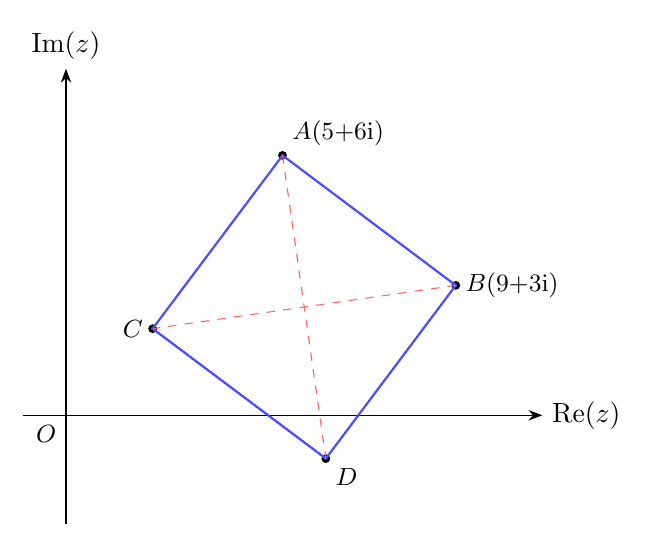
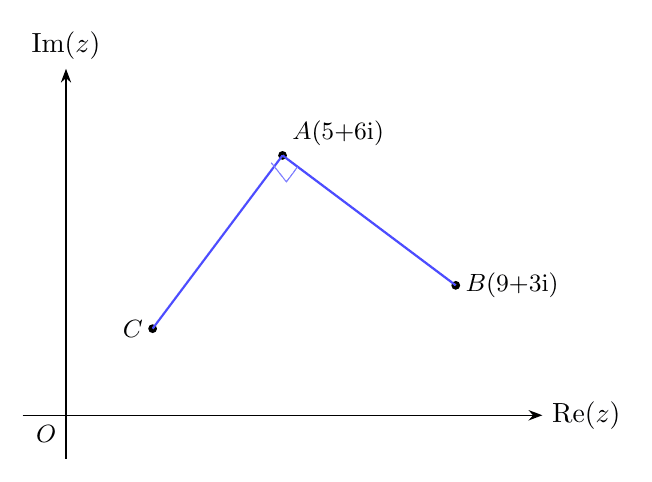
The points \(A\), \(B\) and \(C\) represent the complex numbers \(z_A = 5+6\mathrm{i}\), \(z_B = 9+3\mathrm{i}\) and \(z_C\) respectively. \(ABC\) is an isosceles triangle labelled in a clockwise direction where \(\angle CAB = 90°\).
- Find \(z_C\).
- The point \(D\) representing the complex number \(z_D\), is such that \(ABDC\) is a parallelogram. Find \(z_D\).
Show full worked solution▾
(a) The line segment \(AC\) can be obtained by rotating the line segment \(AB\), \(90^\circ\) in a clockwise direction about \(A\). \[ z_C - z_A = -\mathrm{i}(z_B - z_A) \] \[ z_C = z_A - \mathrm{i}(z_B - z_A) \] \[ z_C = (5+6\mathrm{i}) - \mathrm{i}\bigl[(9+3\mathrm{i}) - (5+6\mathrm{i})\bigr] = (5+6\mathrm{i}) - \mathrm{i}[4-3\mathrm{i}] = 2 + 2\mathrm{i} \]
(b)
Method 1 — Midpoints of diagonals of parallelogram \(ABDC\)
\(ABDC\) is a parallelogram, so midpoint of \(AD\) \(=\) midpoint of \(BC\): \[ \frac{z_A + z_D}{2} = \frac{z_B + z_C}{2} \] \[ (5+6\mathrm{i}) + z_D = (9+3\mathrm{i}) + (2+2\mathrm{i}) \] \[ z_D = 11 + 5\mathrm{i} - (5+6\mathrm{i}) \]