Complex Numbers: Simultaneous equations — TJC 2025 H2 Math Prelim Paper 1
What this question tests
Question
- The complex numbers \(z\) and \(w\) satisfy the following equations. \[\begin{aligned} 2z + |w| &= 2 - 4\mathrm{i}\\ \mathrm{i}z - w &= 2\mathrm{i} \end{aligned}\] Find \(z\) and \(w\), giving your answers in the form \(a + \mathrm{i}b\), where \(a\) and \(b\) are real numbers.
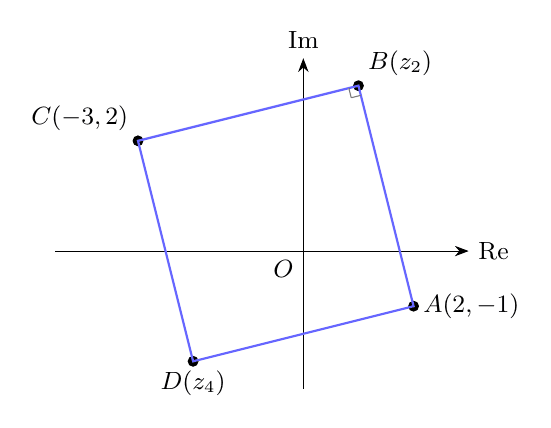
- It is given that \(z_1 = 2 - \mathrm{i}\) and \(z_3 = -3 + 2\mathrm{i}\). On an Argand diagram, mark the points \(A\) and \(C\) representing \(z_1\) and \(z_3\) respectively.
The points \(B\) and \(D\) on the Argand diagram represent complex numbers \(z_2\) and \(z_4\) respectively. Given that \(ABCD\) is a square, labelled in an anti-clockwise direction, find \(z_2\) and \(z_4\).
Show full worked solution▾
(a) \[\begin{aligned} 2z + |w| &= 2 - 4\mathrm{i} \quad\cdots(1)\\ \mathrm{i}z - w &= 2\mathrm{i} \quad\cdots(2) \end{aligned}\]
From (1): \(z = \dfrac{2-4\mathrm{i}-|w|}{2}\).
Substitute into (2): \[ \mathrm{i}\!\left(\frac{2-4\mathrm{i}-|w|}{2}\right) - w = 2\mathrm{i} \implies 2\mathrm{i} - 4\mathrm{i}^2 - \mathrm{i}|w| - 2w = 4\mathrm{i} \implies 4 + 2\mathrm{i} - \mathrm{i}|w| - 2w = 4\mathrm{i} \]
Let \(w = a + b\mathrm{i}\), \(a,b\in\mathbb{R}\), so \(|w| = \sqrt{a^2+b^2}\): \[ 4 + 2\mathrm{i} - \mathrm{i}\sqrt{a^2+b^2} - 2(a+b\mathrm{i}) = 4\mathrm{i} \] \[ (4-2a) + \mathrm{i}\!\left(2 - \sqrt{a^2+b^2} - 2b\right) = 4\mathrm{i} \]
Comparing real parts: \(4-2a = 0 \implies a = 2\) \(\cdots(3)\)
Comparing imaginary parts: \(2 - \sqrt{4+b^2} - 2b = 4 \implies -2-2b = \sqrt{4+b^2}\) \(\cdots(4),(5)\)
(Requires \(-2-2b \geq 0\), i.e. \(b \leq -1\).)
Squaring: \[ (2+2b)^2 = 4+b^2 \implies 4+8b+4b^2 = 4+b^2 \implies 3b^2+8b = b(3b+8) = 0 \] \[ b = 0 \quad\text{(rejected since } \sqrt{4+b^2} \neq -2 \text{ from (5))} \qquad\text{or}\qquad b = -\frac{8}{3} \]
\[ z = \frac{2-4\mathrm{i}-(-(-2-2b))}{2} = \frac{2-4\mathrm{i} - \frac{10}{3}}{2} = \frac{-\frac{4}{3}-4\mathrm{i}}{2} = -\frac{2}{3} - 2\mathrm{i} \](b) Argand diagram with \(A(2,-1)\) and \(C(-3,2)\). \(\overrightarrow{BA}\) represents \(2-\mathrm{i}-z_2\) and \(\overrightarrow{BC}\) represents \(-3+2\mathrm{i}-z_2\).
Since \(\angle ABC = \dfrac{\pi}{2}\), \(A\) is obtained by rotating \(C\) through \(90^\circ\) anticlockwise about \(B\): \[ \mathrm{i}(-3+2\mathrm{i}-z_2) = 2-\mathrm{i}-z_2 \] \[ -3\mathrm{i} - 2 - \mathrm{i}z_2 = 2 - \mathrm{i} - z_2 \implies (1-\mathrm{i})z_2 = 4 + 2\mathrm{i} \] \[ z_2 = \frac{4+2\mathrm{i}}{1-\mathrm{i}}\cdot\frac{1+\mathrm{i}}{1+\mathrm{i}} = \frac{4+4\mathrm{i}+2\mathrm{i}-2}{2} = \frac{2+6\mathrm{i}}{2} = 1+3\mathrm{i} \]
Since \(ABCD\) is a parallelogram, \(\overrightarrow{AB} = \overrightarrow{DC}\): \[ 1+3\mathrm{i} - (2-\mathrm{i}) = -3+2\mathrm{i} - z_4 \implies -1+4\mathrm{i} = -3+2\mathrm{i} - z_4 \implies z_4 = -2-2\mathrm{i} \]