
Vectors: Pos. vectors; collinearity; angle — DHS 2025 H2 Math Prelim Paper 2
What this question tests
Question
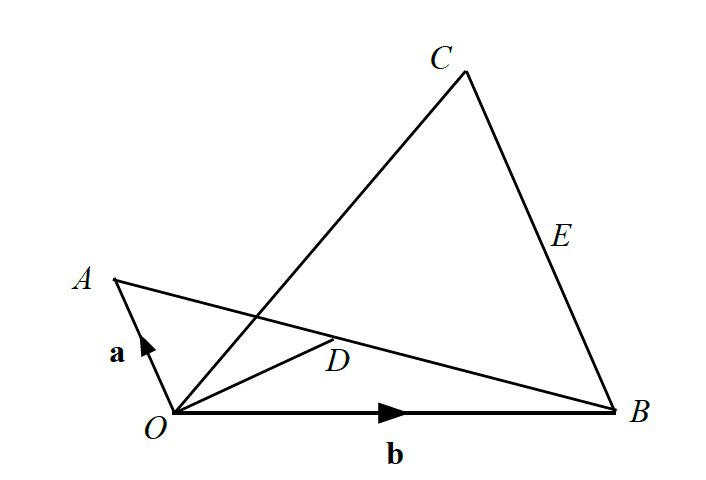
Relative to the origin \(O\), the points \(A\), \(B\), and \(C\) have position vectors \(\mathbf{a}\), \(\mathbf{b}\) and \(3\mathbf{a}+\mathbf{b}\) respectively. The point \(D\) lies on \(AB\) such that \(AD = kAB\), where \(0 < k < 1\).
- Find a vector equation of the line \(OD\) in terms of \(k\), \(\mathbf{a}\) and \(\mathbf{b}\).
- The point \(E\) is the midpoint of \(BC\). Find the value of \(k\) if \(O\), \(D\) and \(E\) are collinear.
It is given that \(|\mathbf{a}| = 1\), \(|\mathbf{b}| = 2\) and \(|3\mathbf{a}-2\mathbf{b}| = \sqrt{31}\).
- By considering the scalar product \((3\mathbf{a}-2\mathbf{b})\cdot(3\mathbf{a}-2\mathbf{b})\), find the numerical value of \(\mathbf{a}\cdot\mathbf{b}\) and hence determine the angle between \(\mathbf{a}\) and \(\mathbf{b}\).
- Give a geometrical interpretation of \(|\mathbf{a}\cdot\mathbf{b}|\).
Show full worked solution▾
(a)
Let \(\overrightarrow{AD} = k\overrightarrow{AB}\).
\[\overrightarrow{OD} = \frac{k\mathbf{b} + (1-k)\mathbf{a}}{k+(1-k)} = k\mathbf{b} + (1-k)\mathbf{a}\](b)
\(\overrightarrow{OC} = 3\mathbf{a} + \mathbf{b}\), \(\overrightarrow{OB} = \mathbf{b}\).
\[\overrightarrow{OE} = \tfrac{1}{2}\!\left(\overrightarrow{OC} + \overrightarrow{OB}\right) = \tfrac{1}{2}(3\mathbf{a} + \mathbf{b} + \mathbf{b}) = \tfrac{1}{2}(3\mathbf{a} + 2\mathbf{b})\]Since \(O\), \(D\) and \(E\) are collinear, \(E\) lies on \(l_{OD}\): \[\overrightarrow{OE} = \lambda\bigl(k\mathbf{b} + (1-k)\mathbf{a}\bigr)\] \[\tfrac{3}{2}\mathbf{a} + \mathbf{b} = \lambda(1-k)\mathbf{a} + \lambda k\mathbf{b}\]
Since \(\mathbf{a}\) and \(\mathbf{b}\) are non-zero and non-parallel: \[\begin{aligned} \lambda k &= 1 \quad \cdots (1)\\ \lambda(1-k) &= \tfrac{3}{2} \quad \cdots (2) \end{aligned}\] Substituting (1) into (2): \(\lambda - 1 = \tfrac{3}{2} \Rightarrow \lambda = \tfrac{5}{2}\).
(c)
\(|\mathbf{a}| = 1\), \(|\mathbf{b}| = 2\), \(|3\mathbf{a} - 2\mathbf{b}| = \sqrt{31}\).
\[\begin{aligned} |3\mathbf{a} - 2\mathbf{b}|^2 &= 31\\ (3\mathbf{a} - 2\mathbf{b})\cdot(3\mathbf{a} - 2\mathbf{b}) &= 31\\ 9|\mathbf{a}|^2 - 12\,\mathbf{a}\cdot\mathbf{b} + 4|\mathbf{b}|^2 &= 31\\ 9(1)^2 - 12\,\mathbf{a}\cdot\mathbf{b} + 4(2)^2 &= 31\\ 25 - 12\,\mathbf{a}\cdot\mathbf{b} &= 31\\ \mathbf{a}\cdot\mathbf{b} &= -\tfrac{1}{2} \end{aligned}\]Let \(\theta\) be the angle between \(\mathbf{a}\) and \(\mathbf{b}\): \[\cos\theta = \frac{\mathbf{a}\cdot\mathbf{b}}{|\mathbf{a}||\mathbf{b}|} = \frac{-\frac{1}{2}}{1 \times 2} = -\frac{1}{4}\]
(d)
\(|\mathbf{a}\cdot\mathbf{b}|\) is the length of projection of \(\mathbf{b}\) onto \(\mathbf{a}\).