Vectors: Line intersection; area; proj. — MI 2025 H2 Math Prelim Paper 1
What this question tests
Question
Referred to the origin \(O\), the points \(A\) and \(B\) have position vectors \(\mathbf{a}\) and \(\mathbf{b}\) respectively, where \(\mathbf{a}\) and \(\mathbf{b}\) are non-zero and non-parallel vectors. The point \(C\) lies on \(OA\) such that \(OC:CA = 1:2\). The point \(D\) lies on \(OB\) such that \(OB:DB = 3:1\).
- Find the position vectors \(\overrightarrow{OC}\) and \(\overrightarrow{OD}\), giving your answers in terms of \(\mathbf{a}\) and \(\mathbf{b}\).
- Show that the point \(E\) where the lines \(AD\) and \(BC\) meet has position vector \(\dfrac{1}{7}\mathbf{a} + \dfrac{4}{7}\mathbf{b}\).
- Show that the area of triangle \(OAE\) can be written as \(k|\mathbf{a}\times\mathbf{b}|\), where \(k\) is a constant to be found.
It is further given that \(\mathbf{b}\) is a unit vector.
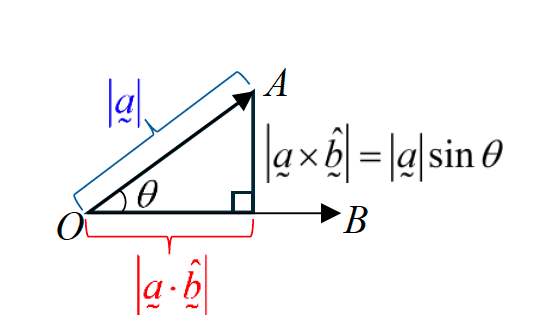
- Give the geometrical meaning of \(|\mathbf{a}\cdot\mathbf{b}|\).
- If \(|\mathbf{a}\cdot\mathbf{b}| = \dfrac{1}{2}|\mathbf{a}|\), find the perpendicular distance of point \(A\) to \(OB\), leaving your answer in terms of \(|\mathbf{a}|\).
Show full worked solution▾
(i) \(OC:CA = 1:2\) means \(C\) divides \(OA\) in the ratio \(1:2\).
\(\overrightarrow{OC} = \dfrac{1}{3}\overrightarrow{OA} = \dfrac{1}{3}\mathbf{a}\).
\(OB:DB = 3:1\) means \(D\) divides \(OB\) such that \(OD:DB = 2:1\).
\(\overrightarrow{OD} = \dfrac{2}{3}\overrightarrow{OB} = \dfrac{2}{3}\mathbf{b}\).
\(\overrightarrow{OC} = \dfrac{1}{3}\mathbf{a}\), \(\overrightarrow{OD} = \dfrac{2}{3}\mathbf{b}\)
(ii) \[\begin{aligned} \overrightarrow{OE} &= \overrightarrow{OA}+\lambda\overrightarrow{AD} \quad\text{--- (1)}\\ \overrightarrow{OE} &= \overrightarrow{OB}+\mu\overrightarrow{BC} \quad\text{--- (2)} \end{aligned}\]
Solve (1) = (2): \[\begin{aligned} \overrightarrow{OA}+\lambda\overrightarrow{AD} &= \overrightarrow{OB}+\mu\overrightarrow{BC}\\ \overrightarrow{OA}+\lambda(\overrightarrow{OD}-\overrightarrow{OA}) &= \overrightarrow{OB}+\mu(\overrightarrow{OC}-\overrightarrow{OB})\\ \mathbf{a}+\lambda\!\left(\frac{2}{3}\mathbf{b}-\mathbf{a}\right) &= \mathbf{b}+\mu\!\left(\frac{1}{3}\mathbf{a}-\mathbf{b}\right)\\ (1-\lambda)\mathbf{a}+\frac{2}{3}\lambda\mathbf{b} &= \frac{1}{3}\mu\mathbf{a}+(1-\mu)\mathbf{b} \end{aligned}\]
Comparing coefficients of \(\mathbf{a}\): \(1-\lambda = \dfrac{1}{3}\mu \;\Rightarrow\; \lambda + \dfrac{1}{3}\mu = 1\) — (3)
Comparing coefficients of \(\mathbf{b}\): \(\dfrac{2}{3}\lambda = 1-\mu \;\Rightarrow\; \dfrac{2}{3}\lambda+\mu = 1\) — (4)
Solving (3) & (4) by GC: \(\lambda = \dfrac{6}{7}\), \(\mu = \dfrac{3}{7}\).
Substituting \(\lambda = \dfrac{6}{7}\) into (1): \[\begin{aligned} \overrightarrow{OE} &= \mathbf{a}+\frac{6}{7}\!\left(\frac{2}{3}\mathbf{b}-\mathbf{a}\right)\\ &= \mathbf{a}+\frac{4}{7}\mathbf{b}-\frac{6}{7}\mathbf{a}\\ &= \frac{1}{7}\mathbf{a}+\frac{4}{7}\mathbf{b} \quad\text{(shown)} \end{aligned}\]
(iii) Area of \(\triangle OAE = \dfrac{1}{2}|\overrightarrow{OA}\times\overrightarrow{OE}|\).
\[\begin{aligned} &= \frac{1}{2}\left|\mathbf{a}\times\left(\frac{1}{7}\mathbf{a}+\frac{4}{7}\mathbf{b}\right)\right|\\ &= \frac{1}{2}\left|\frac{1}{7}(\mathbf{a}\times\mathbf{a})+\frac{4}{7}(\mathbf{a}\times\mathbf{b})\right|\\ &= \frac{1}{2}\left|0+\frac{4}{7}(\mathbf{a}\times\mathbf{b})\right| \quad (\because\;\mathbf{a}\times\mathbf{a}=\mathbf{0})\\ &= \frac{2}{7}|\mathbf{a}\times\mathbf{b}| \end{aligned}\]where \(k = \dfrac{2}{7}\) (shown).
\(k = \dfrac{2}{7}\) (shown)
(iv) \(|\mathbf{a}\cdot\mathbf{b}|\) is the length of projection of \(\overrightarrow{OA}\) onto the line \(OB\).
The length of projection of \(\overrightarrow{OA}\) onto \(\overrightarrow{OB}\).
(v) Perpendicular distance from \(A\) to \(OB\):