
Vectors: Drone rooftop; parallel planes — TMJC 2025 H2 Math Prelim Paper 1
What this question tests
Question
A drone flies in a straight line towards a rooftop for inspection. The drone's flight path is modelled by the line \[ l: \mathbf{r} = \begin{pmatrix} 2 \\ 1 \\ 0 \end{pmatrix} + \lambda \begin{pmatrix} 3 \\ -2 \\ 1 \end{pmatrix},\quad \lambda \in \mathbb{R}, \] and the rooftop is modelled by the plane \(p: 2x + y - z = 7\).
- On Day 1, the drone flies towards the rooftop using the flight path. Upon reaching the rooftop, the drone flies in a new flight path, \(m\). The acute angle between the original flight path and the normal to the rooftop is the same as the acute angle between the new flight path and the same normal to the rooftop. Both flight paths and the normal lie on the same plane. Find the cosine of the angle between the original flight path and the new flight path in an exact non-trigonometrical form.
- On Day 2, the drone starts to descend from point \(A\) with coordinates \((2,1,0)\) towards the rooftop using the shortest possible path. Find the exact coordinates of the point where the drone lands on the rooftop.
- After landing, the drone glides on the rooftop in another new flight path, \(s\), that is perpendicular to the flight path \(l\). Find a cartesian equation of the flight path \(s\).
A second rooftop is built parallel to the first rooftop \(p\) such that the perpendicular distance between these two rooftops is \(d\) units. Find two possible cartesian equations of the second rooftop in terms of \(d\).
Show full worked solution▾
(a) Let \(\theta\) be the acute angle between the direction vector of \(l\) and the normal \(\mathbf{n}\) of \(p\). With \(\mathbf{d}_l = (3, -2, 1)\) and \(\mathbf{n} = (2, 1, -1)\):
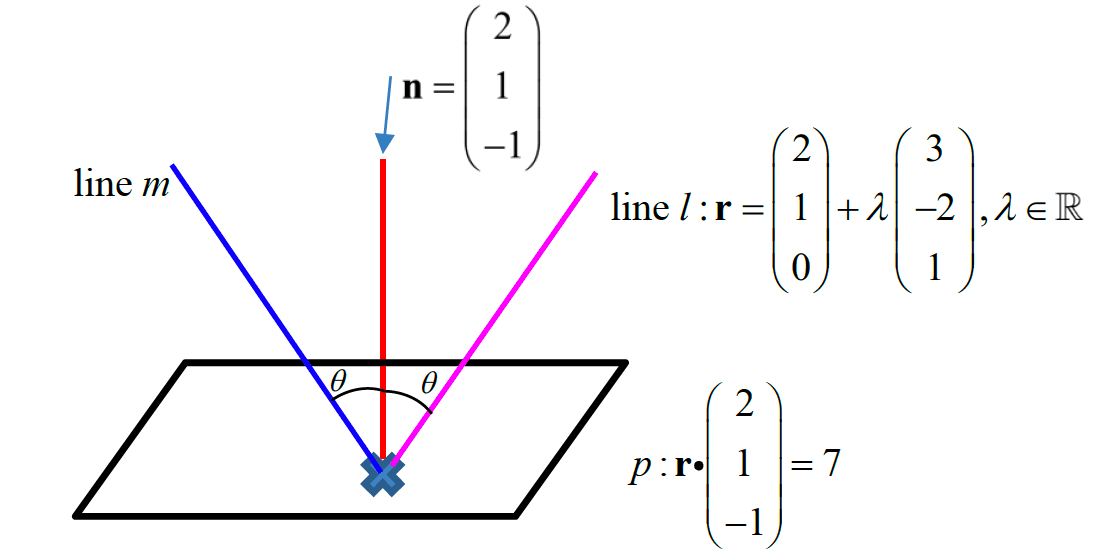
The angle between the original flight path and the new (reflected) flight path is \(2\theta\). \[ \cos 2\theta = 2\cos^2\theta - 1 = 2\left(\dfrac{3}{\sqrt{14}\sqrt{6}}\right)^2 - 1 = \dfrac{18}{84} - 1 = -\dfrac{11}{14}. \]
(b) Let \(F\) be the foot of perpendicular from \(A(2,1,0)\) to \(p\). Then \(l_{AF}:\ \mathbf{r} = (2,1,0) + \mu(2,1,-1)\), \(\mu \in \mathbb{R}\).
Substituting into \(p\): \[\begin{aligned} \begin{pmatrix} 2 + 2\mu \\ 1 + \mu \\ -\mu \end{pmatrix} \cdot \begin{pmatrix} 2 \\ 1 \\ -1 \end{pmatrix} &= 7 \\ 4 + 4\mu + 1 + \mu + \mu &= 7 \\ 6\mu + 5 &= 7 \\ \mu &= \dfrac{1}{3}. \end{aligned}\] Coordinates of \(F\): \(\left(\tfrac{8}{3},\, \tfrac{4}{3},\, -\tfrac{1}{3}\right)\).
(c) The direction of \(s\) is perpendicular to both \(\mathbf{d}_l\) and \(\mathbf{n}\): \[ \mathbf{d}_s = \mathbf{d}_l \times \mathbf{n} = \begin{pmatrix} 3 \\ -2 \\ 1 \end{pmatrix} \times \begin{pmatrix} 2 \\ 1 \\ -1 \end{pmatrix} = \begin{pmatrix} 1 \\ 5 \\ 7 \end{pmatrix}. \]
So \(l_s:\ \mathbf{r} = \begin{pmatrix} 8/3 \\ 4/3 \\ -1/3 \end{pmatrix} + \alpha\begin{pmatrix} 1 \\ 5 \\ 7 \end{pmatrix}\).
Converting to cartesian form:
\[\begin{aligned} x &= \tfrac{8}{3} + \alpha \implies \alpha = \tfrac{3x-8}{3}, \\ y &= \tfrac{4}{3} + 5\alpha \implies \alpha = \tfrac{3y-4}{15}, \\ z &= -\tfrac{1}{3} + 7\alpha \implies \alpha = \tfrac{3z+1}{21}. \end{aligned}\] \[ \therefore\ \dfrac{3x - 8}{3} = \dfrac{3y - 4}{15} = \dfrac{3z + 1}{21}. \]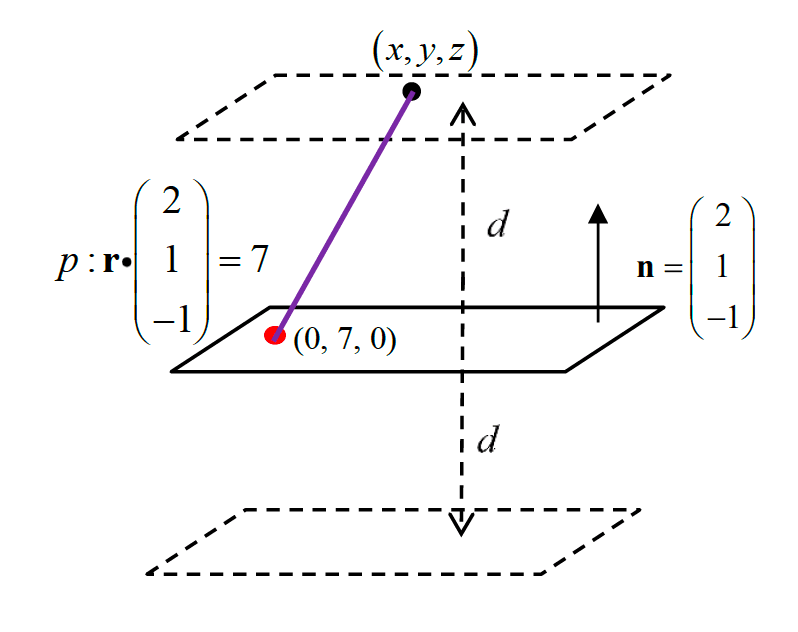
Second rooftop. Let the second rooftop be \(\mathbf{r} \cdot (2,1,-1) = D\). Distance from \(p\): \[ \left|\dfrac{7 - D}{\sqrt{6}}\right| = d \Rightarrow D = 7 \pm \sqrt{6}\,d. \] The two possible equations are \[ 2x + y - z = \sqrt{6}\,d + 7 \quad \text{or} \quad 2x + y - z = -\sqrt{6}\,d + 7. \]