
Free practice / Secondary 4 A Maths
Sec 4 A Math: Differentiation: Applications, practice questions & worked solutions
Differentiation: Applications practice questions selected from 2025 Singapore school A Math prelim papers, each with a full worked solution.
About this topic & key methods
These questions support Secondary 4 and O-Level Additional Mathematics revision.
Attempt each question on paper before opening its worked solution. Keep the source question number when checking against the original paper.
Key methods
- Find equations of tangents and normals using the derivative.
- Locate and classify stationary points.
- Solve connected-rate problems with the chain rule.
- Form and optimise a function subject to the given conditions.
For guided practice, see our Sec 4 A Maths tuition programme.
Questions & worked solutions
Unless the question specifies otherwise, give numerical answers to 3 significant figures and angles in degrees to 1 decimal place. Angles in radians are stated explicitly.
Differentiation (Tangents)
The curve has the equation . A line with gradient 1 is a tangent to the curve. Find the equation of the tangent line.
Show worked solution▾
Connected Rates of Change
Water is being poured, at a constant rate of , into an empty container. After seconds, the depth of water is m and the volume, , of the water in the container is given by
Find the rate of change of the depth of water in terms of and .
As the depth of water in the container rises, determine with a reason, whether the rate of change of will increase or decrease.
Show worked solution▾
(a)
(b)
Method 1: As increases, increases. Since is a constant, will decrease.
Method 2:
Rates of Change
Oil is dripping into an empty inverted right circular cone at the rate of per second. The height, cm, of the cone is three-quarters its radius, cm.
Show that the volume, , of the cone is .
Calculate, at the instant when the radius is 8 cm, the rate of change of the radius.
Show worked solution▾
(a)
(b)
Related Rates of Change
A circular patch of water of negligible thickness is evaporating. The radius of the patch, cm, is decreasing at a constant rate of cm/s. Find the rate of change of the area of this patch, cm, when the area of the patch is cm.
Show worked solution▾
Differentiation : Stationary Points
The equation of a curve is .
Find the stationary point(s) and determine the nature of the stationary point(s).
Show worked solution▾
When , .
is a maximum point.
Rate of Change
A particle moves along the curve , where , in such a way that the -coordinate is decreasing at a rate of units per second.
Find the rate of change of the -coordinate when .
Find the value of when increases at the rate of units per second.
Show worked solution▾
(a)
when , .
(b)
Differentiation (Max & Min)
The diagram shows a container, made of a thin sheet of plastic, in the shape of a hollow cylinder. The length of the container is cm and each of the semicircular ends has radius cm. The total external area of the plastic used is .
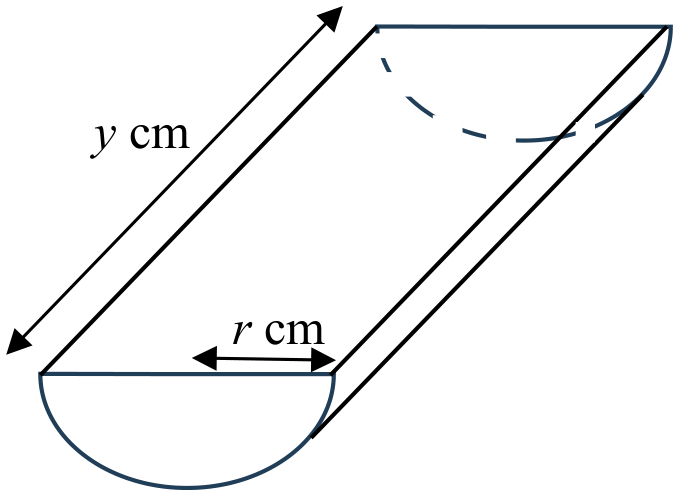
Show that the volume, , of the container is given by .
Given that can vary, find the stationary value of and determine its nature.
Show worked solution▾
(a)
(b)
For stationary value of , : When , .
When , is maximum.
Differentiation (Maxima/Minima)
The diagram shows part of the graph of , . is the origin and points and lie on the and axes respectively. Point is a point on the curve such that forms a rectangle.
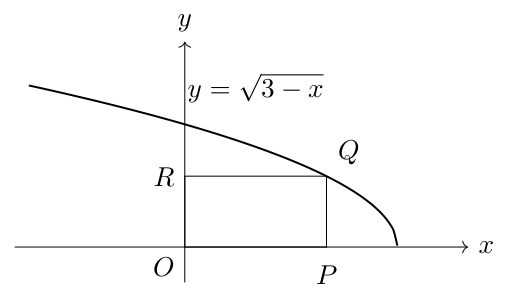
Given that the -coordinate of is , write down an expression for the area of the rectangle, units, in terms of and show that .
Find the stationary value of and determine the nature of this stationary value.
Show worked solution▾
(a)
When ,
(b)
| Slightly less than 2 | Slightly more than 2 | ||
|---|---|---|---|
| Shape |
Or
At ,
Therefore Stationary value is a maximum value.
Rates of Change & Differentiation
The surface area of a solid cube is increasing at . Find the rate of increase of the volume when the length of a side is 1 cm.
A curve has the equation , where . Find the gradient of the curve at the point where , leaving your answer in exact form.
Show worked solution▾
(a)
Subst. ,
(b)
When ,
Differentiation (Applications)
The gradient at any point on a curve is given by . The line is a normal to the curve at the point where .
Show that .
Hence find the -coordinates of the stationary points.
Find and explain whether the gradient has a turning point.
Show worked solution▾
(a)
At and ,
(b)
At stat points,
(c)
Since , the gradient has no turning point.
Differentiation (Stationary Points)
A curve has equation .
Find the -coordinates of the stationary points, and , on the curve.
It is given that is a point on the curve where the gradient is a minimum.
Show that and the midpoint of are the same point.
Show worked solution▾
(a)
For stationary points, The -coordinates are and .
(b)
Let For max./min. gradient, . Subt. ,
Therefore, is a point on the curve where the gradient is a minimum.
Since the midpoint of , and the midpoint of are the same.
Increasing / Decreasing Functions & Maxima & Minima
It is given that .
Show that the range of values of for which is a decreasing function is .
The gradient with the least value is in the range . Find the value of this gradient, giving your answer in exact form.
Show worked solution▾
(a)
For decreasing function, since
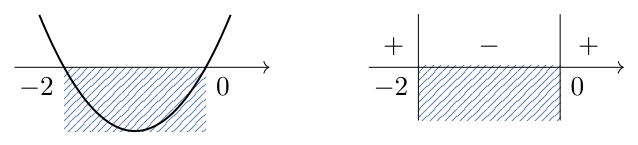
(b)
For the least gradient, Since the least gradient lies in , Least gradient