JC · H2 Mathematics · Notes
Work through ratios, vector algebra, equations and relationships of lines and planes, angles, shortest distances, perpendicular feet, reflections and geometrical loci.
Vectors summary and formula sheet: every formula on 3 pages
Mr Ian Ang’s summary of the whole vectors chapter on three pages, in the same order as the films.
Page 1 of 3 Key concepts
Watch in order
H2 Maths Vectors videos: 16 films in teaching order
Each film works one exam skill in about three minutes, with every step on screen. Watch them in order, or jump to the skill you need. 16 films, about 55 minutes in all.
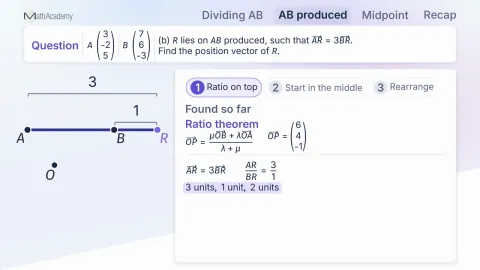 Start hereFilm 1: Ratio theorem in vectors
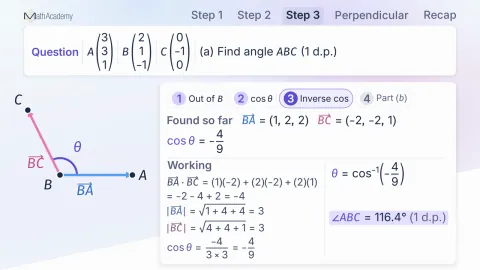 Film 2: Scalar product and the angle between two vectors
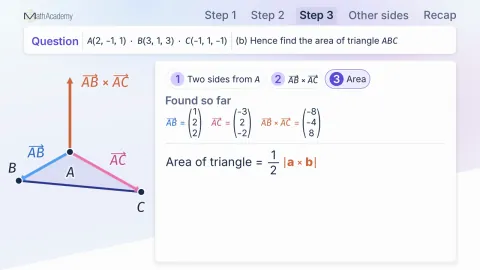 Film 3: Vector product and the area of a triangle
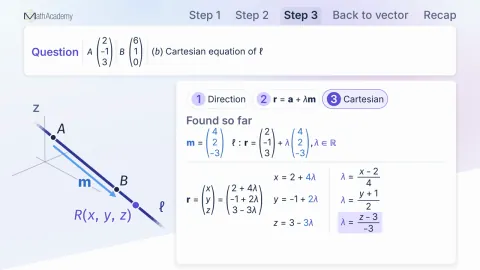 Film 4: Vector equation of a line, and cartesian form
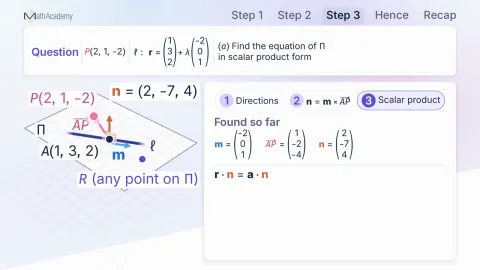 Film 5: Equation of a plane from a point and a line
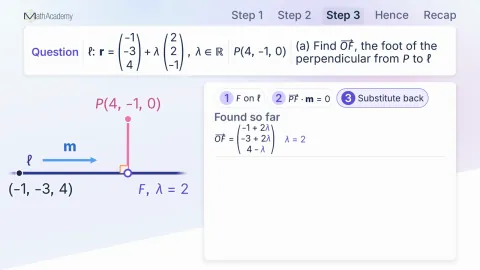 Film 6: Foot of the perpendicular from a point to a line
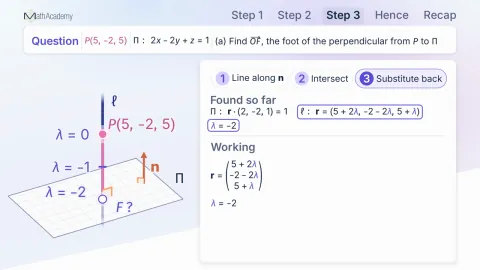 Film 7: Foot of the perpendicular from a point to a plane
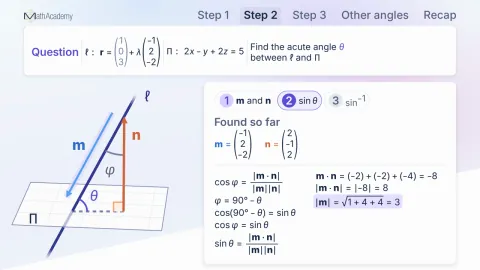 Film 8: Angle between a line and a plane
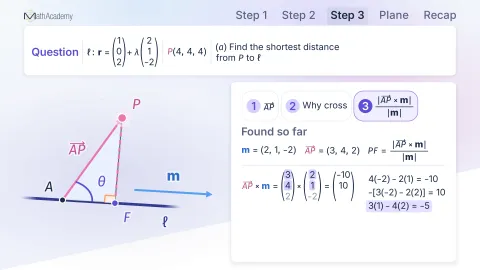 Film 9: Shortest distance from a point to a line or a plane
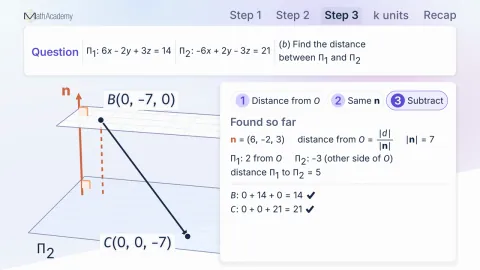 Film 10: Distance between parallel planes
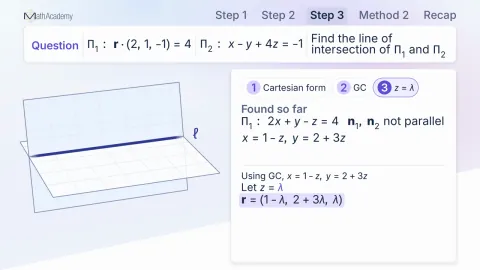 Film 11: Line of intersection of two planes
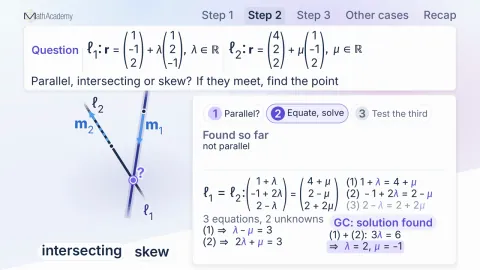 Film 12: Two lines: parallel, intersecting or skew
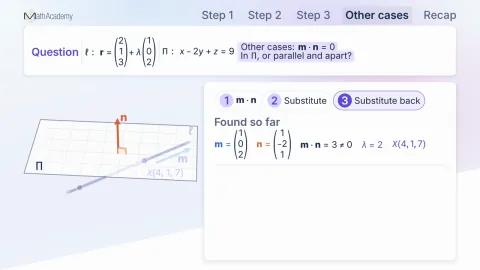 Film 13: Line and plane: parallel, in the plane, or meeting
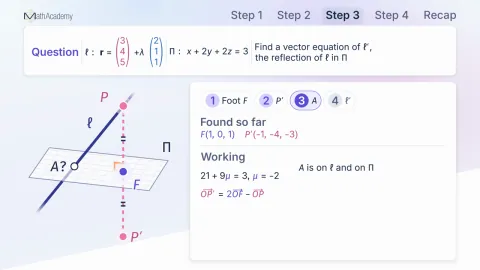 Film 14: Reflection of a line in a plane
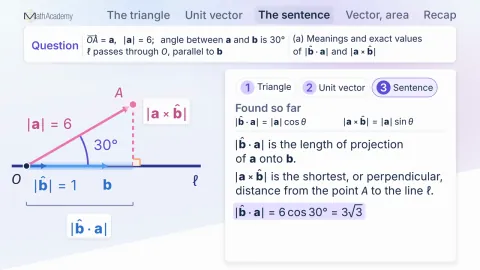 Film 15: Geometrical meaning of the dot and cross products
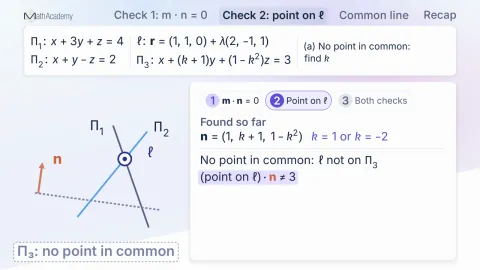 Film 16: Three planes: no point in common, or a common line
H2 Math summary notes
Vectors formulas and methods, section by section
Page 1 of 3Key concepts
Vector basics: magnitude, unit vector and collinear points
- Final minus initial: .
- A hat means a unit vector: divide by the length.
- Collinear points: .
Used in every film; no film of its own.
Ratio theorem
- Cross the ratio, divide by the sum.
- Midpoint: .
- All vectors point out of , never .
- Point on produced: start from the middle point, then make the unknown the subject.
Scalar product (dot product) and the angle between two vectors
- Both vectors point out of the vertex (or both in).
- No modulus here: a negative value means the angle is obtuse.
- , and .
- Length of projection of onto : ; projection vector: .
Vector product (cross product) and the area of a triangle
- Cover the row, diagonal minus diagonal; only the second row gets the extra minus.
- is perpendicular to and ; .
- Parallelogram: , any two adjacent sides.
- , and .
Dot or cross? One right-angled triangle for distances
- SOH CAH TOA: the opposite side is sine, and sine is cross.
- The adjacent side is cosine, and cosine is dot.
- It works because .
- Take the length out first: .
Geometrical meaning of the dot product and cross product
- is the length of projection of onto ; is the projection vector.
- is the shortest (perpendicular) distance from to the line through parallel to .
- is the area of the parallelogram with adjacent sides and .
- Always onto the unit vector, and name the adjacent sides.
Page 2 of 3Lines and planes
Vector equation of a line and cartesian equation
- Through and : .
- To cartesian: make the subject. Back: set each part equal to .
- Not unique: any point on the line, any parallel . on its own means in .
- Always write .
Equation of a plane: scalar product, parametric and cartesian form
- In cartesian form, is read off the coefficients: .
- A point on the plane: set more zeros, for example .
- From a point and a line: and with on the line.
- Simplest : take out common factors.
Foot of the perpendicular from a point to a line
- is on the line, for some .
- .
- Solve for and put it back into .
- is the shortest distance. Dot with , not with the line.
Foot of the perpendicular from a point to a plane
- The line through along the normal .
- Put the line into the plane and solve for .
- back into the line gives .
- is an intersection: no dot here.
Reflection of a point and of a line in a plane
- Find the foot first, then make the subject.
- For a line: the point where the line meets the mirror stays.
- A plane in a plane: the image contains the common line and .
Shortest distance from a point to a plane, and between parallel planes
- Lines: cross. Planes: dot. Point to line is .
- Make the normals the same first; and of opposite signs mean opposite sides of .
- Planes units from : .
Page 3 of 3Angles and intersections
Angle between two lines, two planes, and a line and a plane
- Directions for lines, normals for planes.
- Only a line and a plane use sine (or find with cosine, then ).
- The modulus gives the acute angle.
Two lines: parallel, intersecting or skew
- If : test a point of on . Yes: the same line. No: parallel.
- If for any : equate .
- On the graphing calculator: 3 equations, 2 unknowns. A solution means they intersect; none means skew.
- By hand: solve the , rows, test the row; put back for the point.
Line and plane: parallel, in the plane, or meeting at a point
- Check parallel by checking perpendicular: .
- Then (with on ) means lies in ; otherwise no common point.
- Otherwise they meet at one point: put into .
Line of intersection of two planes, and three planes
- Otherwise the planes meet in a line. Graphing calculator (the default): cartesian first, 2 equations, 3 unknowns; the free variable becomes .
- Without the graphing calculator (unknowns, or a "show" question): , and a point by setting .
- Three planes: and meet in , and . If , then : puts on , and means no common point.
Worked examples
Vectors worked examples
Mr Ian’s worked examples for the chapter, with the full working.
Identify points, directions and normals
A position vector locates a point. Subtract two position vectors to obtain a direction. A scalar product tests perpendicularity; a vector product produces a vector perpendicular to both inputs. Start with the geometrical condition, then translate it into an equation.
Ratio, scalar product and vector product
Watch the 3 and a half minute summary: Ratio theorem in vectors
Ratios lead to an intersection and an area
Let A and B have non-parallel position vectors and . C lies on OA with OC:CA = 2:1. D lies on OB produced with OD:BD = 3:2. Find the intersection E of BC and AD, and express the area of triangle CDE in terms of .
For C use the internal ratio. For D, OB is the difference between OD and BD, so OD is three times OB.
Use different line parameters and equate the independent a and b coefficients:
The negative μ places E beyond A away from D; an intersection need not lie inside both segments. Use two sides of triangle CDE:
Taking the magnitude makes the area positive. Reversing the order of the cross product changes its sign, not the area.
A vector equation determines a scalar parameter
Given , , , , and , find k.
The norm equation gives two signs. Neither is excluded by the stated information.
Rearrange a vector-product identity
Let and . Show that is a scalar multiple of .
A zero cross product means that the second vector is parallel to the non-zero a, or is zero; both are included by a scalar λ.
Form equations of lines and planes
Watch the 3 and a half minute summary: Vector equation of a line, and cartesian form
Obtain two direction vectors to find a normal
Let , , and . Find a line through A and B, the plane ABC, and the area of triangle ABC.
For the line, a Cartesian form is , . Do not divide by the zero z-component. A normal to the plane is
The parametric plane uses both independent directions:
Substitute all three points into the Cartesian plane as a check. A direction vector and a normal vector have different roles.
Non-parallel lines may be skew
Consider and . Determine their relationship and their shortest distance.
The direction vectors are not scalar multiples. To check whether the lines meet, equate the three coordinates:
The first two equations give μ = 1 and λ = 7. The third would require −13 = 0, which is false. The lines are non-parallel and non-intersecting, so they are skew.
Their shortest joining segment is perpendicular to both directions. Project a vector between the lines onto that common normal:
This projection gives a distance, not a point on either line. A zero dot product between direction vectors alone would not establish that the lines meet.
Intersections, angles and distances
Watch the 3 and a half minute summary: Angle between a line and a plane
Two intersecting planes and a line–plane angle
Use and . Find their intersection line, their acute angle, and the acute angle between π and a line with direction .
The intersection direction is perpendicular to both normals. Find one common point by setting z = 0.
For the acute angle α between planes, use the acute angle between their normals:
For the angle β between a line and a plane, use sine because the normal is perpendicular to the plane:
The modulus selects the acute angle. For the angle between directed vectors, retain the signed dot product.
A line parallel to a plane may lie inside it
The line is . Determine its relationship with .
If q = 5, every point on the line satisfies the plane, so the line is contained in it. If q ≠ 5, no point satisfies it, so the line is parallel and separate.
For comparison, the line intersects :
A unique parameter means one intersection; an identity means the line is in the plane; an inconsistent equation means no intersection.
Three planes: one point, a line, or no common point
Two planes are , . A third is . Classify their common intersection in terms of a, b, c.
Substitute this entire line into the third plane:
If , there is one value of s, hence one common point. If and , every s works, hence all three planes contain the line. If and , the equation is inconsistent and there is no common point.
For example, gives the single point ; gives a common line; gives no common point.
Foot of perpendicular and reflection
Watch the 3 and a half minute summary: Foot of the perpendicular from a point to a line
Watch the 3 and a half minute summary: Foot of the perpendicular from a point to a plane
From a point to a line: locate the foot first
Let , and let the line OB have direction through the origin. Find the perpendicular foot H, the distance from A to the line, and the reflection A′ in the line.
H lies on the line, so write its position vector with one parameter. The joining segment AH must be perpendicular to the line direction.
H is the midpoint of AA′. As a separate projection check:
A projection length is a non-negative number. A projection vector includes direction. They are not interchangeable.
From a point to a plane: move along the normal
Find the perpendicular foot and reflection of in the plane , and its distance from the plane.
Both conditions are visible: H lies on the plane, and PH is parallel to its normal. For a variable P = (u,0,0), the same working gives
This is the family shown in the adjacent graph.
Move the point and keep both reflection conditions
u = 0.0: H = (1.00, 1.00, 0), P′ = (2.00, 2.00, 0). Distance = 1.414. H is the midpoint and lies on x + y = 2.
Distances between parallel planes
Use the same normal before comparing constants
Find the distance between and . Then find the planes parallel to at distance 2 from it.
Divide the second equation by 2 before subtracting constants:
For an unknown plane x + y = k at distance 2:
There are two offset planes, one on each side. If finding a point-to-plane distance, the same normal projection gives |p · n − k| / |n|.
Reflect an entire line or plane
Reflect enough points to determine the image
Reflect the z-axis and the plane in . The point mapping, obtained from the foot method, is .
Two distinct points determine a line:
The reflected z-axis is
Choose three non-collinear points in x = 0 for the plane:
The image points are non-collinear and all have y = 2, so the reflected plane is y = 2. Their common intersection with the reflecting plane, x = 0, y = 2, is fixed.
Geometrical meanings: translate the vector condition
A dot-product locus is a sphere
The variable point R has position vector . Let , . Describe the locus .
The locus is the sphere with centre (1,0,0) and radius 2. Geometrically, RA and RB are perpendicular away from the endpoints, and AB is a diameter. The algebraic equation also includes A and B.
Compare these related conditions: , with non-zero d, gives a line through A parallel to d. The condition , with non-zero n, gives a plane through A normal to n.
Parameters in scalar and vector products
Collinearity and a greatest projection
Let , , with . Find the parameter values for O, P, Q to be collinear. Then, for α = 1/2, find the greatest projection length of q onto p.
For collinearity every component must be zero. The last one gives sin 3t = 0:
Use the first component to obtain α and check the second component as well:
For the projection question, set α = 1/2 and use a scalar product:
Since , the largest numerator is 3/2, attained at , which is allowed. Hence . The negative dot product at this point still gives a positive length.
Before you finish
Use different parameters for different lines. Check all three coordinates at an intersection. Verify a foot is on its line or plane and that the joining vector is perpendicular. For reflection, check the midpoint. Distinguish an acute angle, a directed-vector angle, a distance and a projection vector.