
Sec 1 Maths: Approximation & Estimation — practice questions & worked solutions
Approximation and estimation questions from Singapore Secondary 1 examination papers, each with a full worked solution that shows every rounding step — the way marks are actually awarded.
About this topic & key methods
Approximation and estimation are bread-and-butter skills in Secondary 1 Mathematics. The questions below test the core techniques of rounding to a given number of decimal places, rounding to significant figures, and estimating the value of an expression by replacing each number with a convenient 1-significant-figure approximation. Several questions also probe the upper and lower bounds of a rounded measurement, which is where careful candidates pick up easy marks.
The marks here are usually awarded for the method — showing the rounded values you substituted before computing — not just for the final number. Each worked solution below sets out every rounding decision and the arithmetic that follows. For a structured programme that builds this fluency from the ground up, see our Secondary 1 Maths tuition.
Key methods
- Rounding to decimal places (d.p.) — keep the required digits after the point; look at the next digit to round up or down.
- Rounding to significant figures (s.f.) — count from the first non-zero digit; use zeros as placeholders to keep the size of the number.
- Estimation by rounding — replace every value with its 1 s.f. (or other convenient) approximation before calculating, then simplify.
- Upper and lower bounds — a value rounded to a given place lies in a half-unit interval, e.g. to 1 d.p. means .
- Reasonableness check — use a quick estimate to judge whether a calculator answer is plausible.
- Truncation vs rounding — chopping digits (truncating) is not the same as rounding; significant-figure rounding adjusts the last kept digit.
Questions & worked solutions
Largest & smallest value of a rounded timing
During Sports Fest, Alicia recorded a timing of seconds for the m sprint event. This number had been corrected to decimal place. State the largest and smallest possible values of her actual timing recorded, assuming that the stopwatch can measure up to decimal places.
Show worked solution▾
Values rounding to to 1 d.p. lie in .
With 3 decimal places, the smallest measurable value is:
and the largest measurable value below is:
Significant figures then estimate
Express the following numbers correct to 2 significant figures:
.
Hence, without the use of a calculator, estimate the value of , giving your answer correct to 1 significant figure.
Show worked solution▾
(i)(a)
(i)(b)
(ii) Using the 2 s.f. estimates:
Estimate a surd expression & a shopping total
Without the use of a calculator, estimate , giving your answer correct to 2 significant figures.
Meiling has 27. She wants to buy 5 pens at 2.95 each, 2 notebooks at 4.10 each and 3 highlighters at 2.05 each. Without the use of a calculator, estimate the total amount that Meiling has to pay for these stationeries and determine if she has enough money.
Show worked solution▾
(a) Round each value:
(b) Round each price up:
Estimated total , so she does not have enough money.
Estimate a total from a table
The table below shows the number of people and the respective entrance fees for a carnival on a specific day.
Adult: people at 14.15 per person. Child: people at 9.95 per person. Without the use of a calculator, estimate the total amount collected on that day.
Show worked solution▾
Rounding to convenient values:
Number line & estimating a fraction
Express the following numbers on a number line: .
Without the use of a calculator, estimate the value of the expression , leaving your answer correct to the nearest integer.
Show worked solution▾
(a) Approximate values:
Order on the number line from left to right:
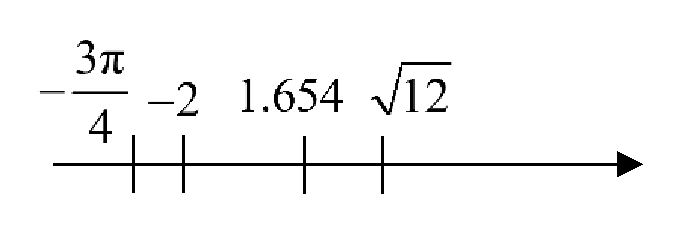
(b) Round each value:
Estimate:
Evaluate to 4 s.f. & check reasonableness
Calculate , giving your answer correct to 4 significant figures.
Mike evaluates using a calculator and he says that the answer is . Without doing the actual calculation, use estimation to determine whether Mike’s answer is reasonable.
Show worked solution▾
(a)
(b) Estimate by rounding each value to 1 significant figure:
Mike’s answer is not reasonable, as is far from the estimated value of .
Bounds of an area rounded to 4 s.f.
The area of Singapore is m. This number has been rounded to 4 significant figures. What is the largest and the smallest possible integer value of the area of Singapore?
Show worked solution▾
Largest:
Smallest:
Evaluate & round to 1 s.f.
Evaluate and correct your answer to 1 significant figure.
Show worked solution▾
Evaluate & round to 4 s.f.
Evaluate and correct your answer to 4 significant figures.
Show worked solution▾
Secondary 1 Maths programme — every method behind these questions, taught step by step.