
Sec 1 Maths: Rate, Speed & Time — practice questions & worked solutions
Speed–distance–time and rate questions from Singapore Secondary 1 examination papers, each with a full worked solution that shows every step — the way marks are actually awarded.
About this topic & key formulas & methods
Rate, speed and time is one of the most practical topics in Secondary 1 Mathematics. Almost every question below is built on one core relationship — speed = distance ÷ time — extended into average speed over a multi-stage journey, reading and interpreting distance–time graphs, converting units such as km/h ↔ m/s, and working with general rates (pay rates, work rates, fuel consumption). The Sec 1 maths speed–distance–time question is usually dressed up as a word problem, so the skill is translating the words into an equation.
The marks in these questions are usually awarded for the working — a correct setup, a clear unit conversion, a stated equation — not only for the final number. Each worked solution below lays out every line a marker would credit. For a structured programme that teaches this reasoning from the ground up, see our Secondary 1 Maths tuition.
Key formulas & methods
- Speed ; rearranged, distance speed time and time distance speed.
- Average speed — never the average of the separate speeds.
- Converting km/h to m/s: multiply by (i.e. ); for m/s to km/h, multiply by .
- Converting m/min, m/s, km/h by scaling the distance unit (, ) and the time unit (, , ).
- Distance–time graphs: the gradient of a segment is the speed; a horizontal segment means the object is stationary.
- Rate — cups made per minute, scripts marked per hour, litres of fuel per 100 km; combined rates add.
- Forming equations: for two-stage journeys, write each leg’s time as distance ÷ speed and sum to the total time.
Questions & worked solutions
Form an equation in v from two journey times
A bus took hours to travel from a village in Malaysia to Singapore at an average speed of km/h.
Find the distance between the village in Malaysia and Singapore, in terms of .
If it increases its speed by km/h, the bus will reach Singapore minutes earlier. Find another expression, in terms of , for the distance between the village in Malaysia and Singapore.
Hence, by forming an equation, find the value of .
Show worked solution▾
(a)
(b)
New time hours.
(c)
Combined work rate
Pat can make cups of bubble tea in minutes and Sally can make cups of bubble tea in minutes. How much time will Pat and Sally take to make cups of bubble tea if they work concurrently?
Show worked solution▾
Rate of Pat:
Rate of Sally:
Combined rate:
Time for cups:
Convert m/s to km/h
Express
m/s in km/h.
Show worked solution▾
Convert litres/min to ml/s
Express
/min to ml/s.
Show worked solution▾
Weekly pay under Rate A
Malek, a new employee, is given a choice of any of the following rates of pay per week.
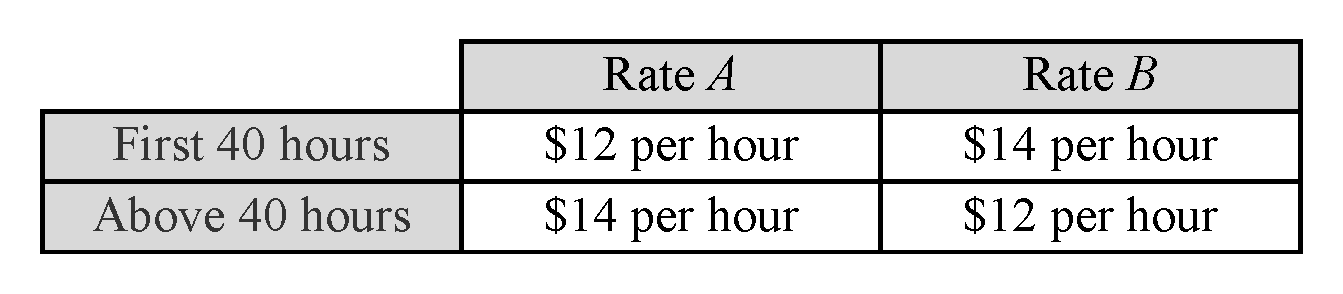
If Malek works 55 hours a week, find
his pay under Rate .
Show worked solution▾
Weekly pay under Rate B
his pay under Rate .
Show worked solution▾
Which pay rate is better?
which rate would be a better choice? Explain your answer.
Show worked solution▾
Rate is better as it pays more than Rate (740 dollars 690 dollars).
Distance from speed and time
Mr Chia took 24 minutes to drive from his house to the market at an average speed of 60 km/h.
Find the distance between his house and the market.
Show worked solution▾
Difference in time after a speed increase
If he increased his average speed by 12 km/h, find the difference in the time taken, in minutes, to travel the same distance.
Show worked solution▾
Distance–time graph interpretation
A man travelled to a museum, which is km away from a town . The diagram below is a distance–time graph of his journey.
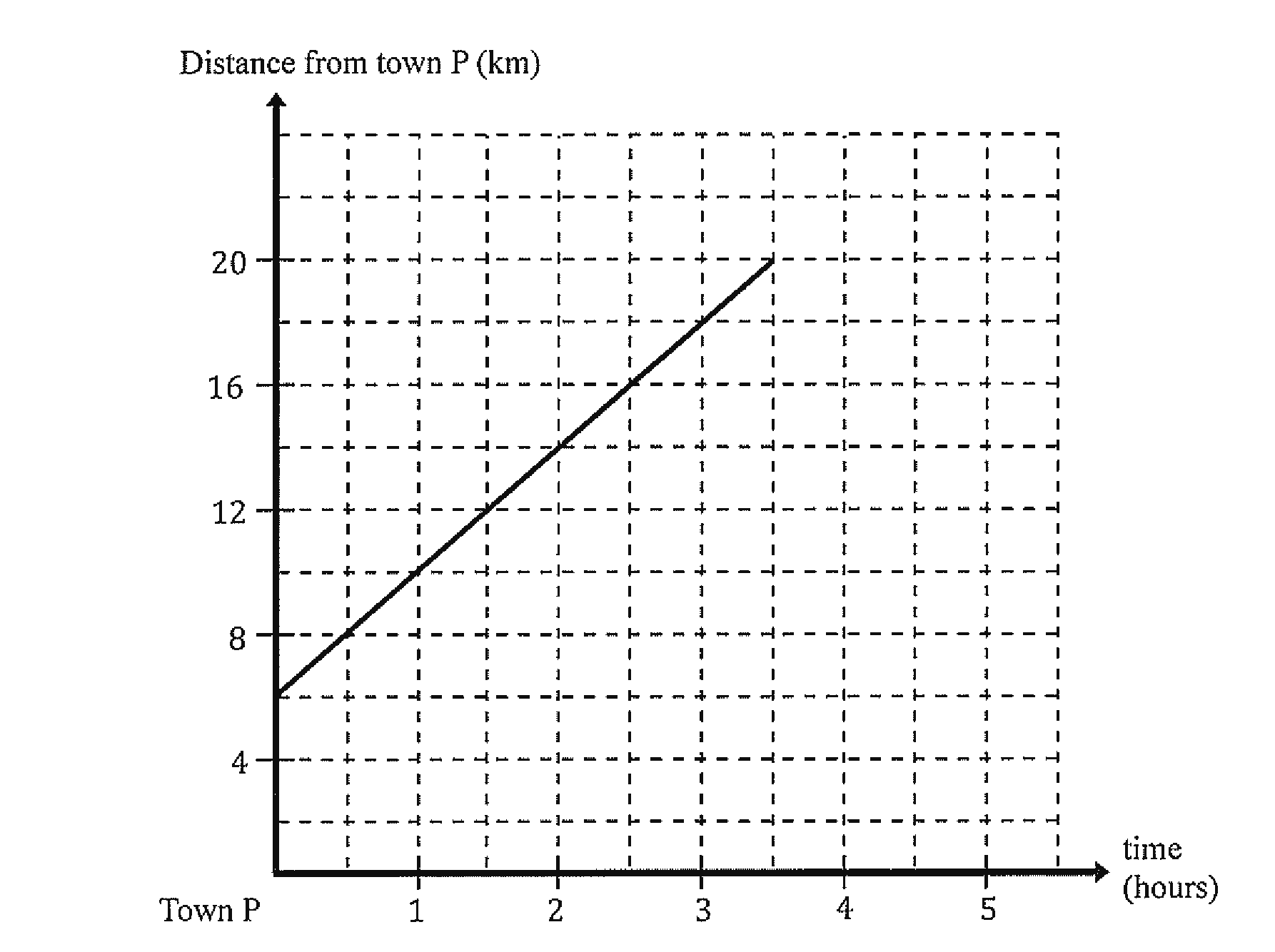
Give a physical interpretation of the vertical-intercept.
After hours into his journey, how far was the man from the museum?
What was the time taken by the man to travel km?
Find the gradient of the straight line.
Hence, explain the physical interpretation of this gradient.
Show worked solution▾
(i) At the start (), the man was already km away from town .
(ii) Gradient km/h, so distance at is km from . Distance from museum km.
(iii) To travel km, the man’s distance from becomes km.
(iv)(a)
(b) The gradient represents the speed of the man, km/h.
Speeds from a ratio & average speed
Kelvin went jogging at a park. He first ran up a slope for minutes, followed by jogging on flat ground which is km long at a speed of km/min before running down another slope for minutes. The ratio of Kelvin’s speed while running up the slope, on the flat ground and down the slope is .
Find Kelvin’s speed while going up the slope in kilometres per minute.
Given that Kelvin rested for minutes after going up the slope, find the average speed of his workout, in kilometres per minute, correct to decimal places.
Show worked solution▾
(i) The flat-ground speed corresponds to parts km/min, so part km/min. Speed up the slope is parts:
(ii) Distance up the slope:
Speed down the slope km/min, distance down:
Total distance:
Time on flat ground min. Total time (including min rest):
Average speed:
Two-speed journey, form an equation
A man drives a total distance of km on a journey. He drives the first km at an average speed of km/h and the rest of the journey at an average speed of km/h. The whole journey took hours and minutes.
Write down an expression of the time taken, in terms of , for the first part of the journey.
Form an equation in terms of and solve it.
Find the time taken, in minutes, for the first part of the journey.
Show worked solution▾
(i) Time for first part:
(ii) Total time hours; remaining distance km.
Multiply throughout by :
(iii) Time for first part:
Gradient of a distance–time segment
The graph below shows Penelope’s journey from her house to Hudson’s house. During the journey, she stopped at a café for lunch, after which she continued her journey to Hudson’s house.
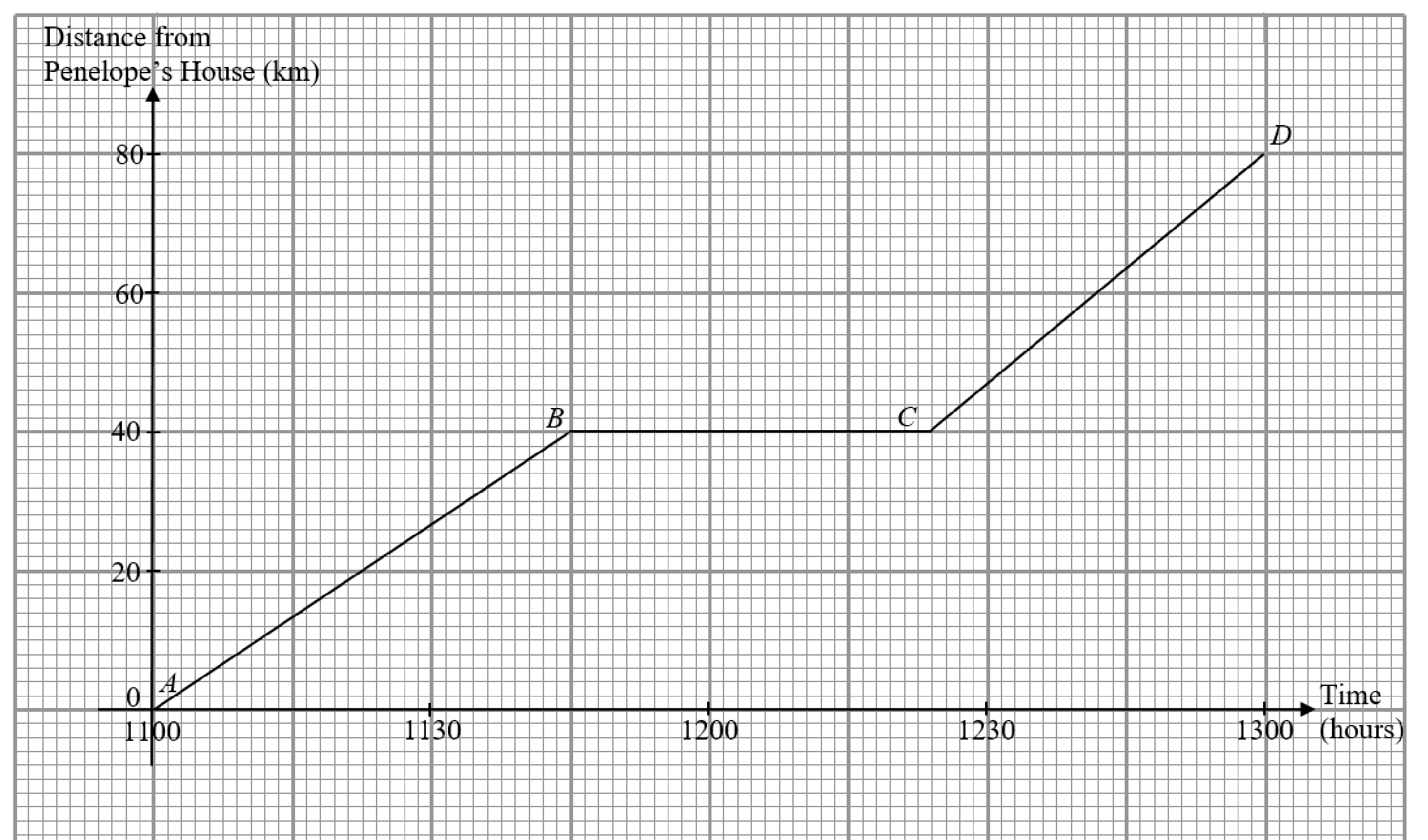
Find the gradient of the line segment , stating clearly what the gradient represents.
Show worked solution▾
and , so the time taken is min h.
The gradient represents the speed, in km/h, at which Penelope travels from her house to the café.
Gradient of a horizontal segment
Find the gradient of the line segment , stating clearly what the gradient represents.
Show worked solution▾
Segment is horizontal (distance stays at km):
The gradient represents the speed. In this case Penelope is having her lunch, so her speed is zero.
Compare two speeds on a graph
Hudson claimed that Penelope travelled at a faster speed from Penelope’s house to the café than from the café to his house. Is his claim accurate? Justify your answer, showing all working clearly.
Show worked solution▾
Speed from the café to Hudson’s house (segment ): distance km over min h.
Since , Penelope travelled faster from the café to Hudson’s house than from her house to the café. Hudson’s claim is not accurate.
Triathlon: form an equation, ratios & speed
A triathlete takes hours to complete a sprint triathlon which consists of swimming, cycling and running. He takes minutes to run, 25 minutes less than running to swim and minutes to cycle.
Form an equation, in terms of , and solve it to find the time taken for him to complete running, leaving your answer in minutes.
The total distance completed during the triathlon is m. Given that the triathlete swims at an average speed of 50 metres per minute, and the ratio of the distances covered is for swimming, cycling, and running respectively,
find the value of
calculate the average cycling speed in m/min.
Show worked solution▾
(i) Total time min. Swim time min, cycle time min.
Time taken to run min.
(ii) Swim time min, so swimming distance m.
(iii) Cycle time min.
Unit conversion, compound growth & ratio
Convert m/s to km/h.
It is given that the value of a limited-edition pair of sneakers increases by every year. In 2020, the value of the pair of sneakers is 3000 dollars. Find the value of the pair of sneakers in 2023, leaving your answer correct to the nearest cent.
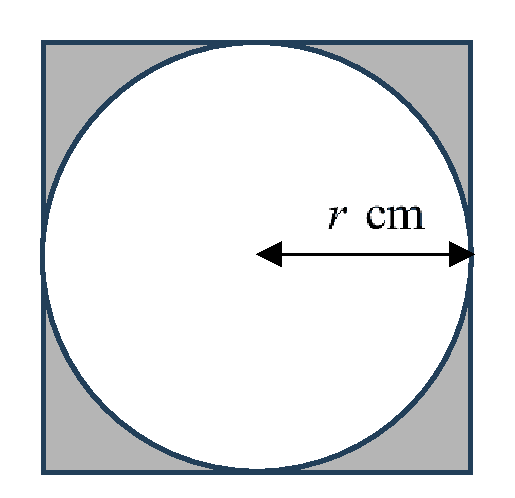
The diagram below (not drawn to scale) shows a circle with radius cm inscribed in a square, where the circle touches all four sides of the square. Find the ratio of the area of the circle to the area of the shaded region, leaving your answers in terms of .
Show worked solution▾
(a)
(b)
From 2020 to 2023 is 3 years.
(c)
The square has side .
Ratio:
Biathlon: form an equation, total time
In a biathlon race, Penelope ran a total of 15 km at an average speed of km/h and cycled 40 km at an average speed of 15 km/h faster than her average running speed. It is given that Penelope took hours longer to cycle than to run.
Form an equation in terms of and solve it.
Hence find the total time taken, in hours, for Penelope to complete the race.
Show worked solution▾
(i) Running speed , cycling speed .
Cycling took hour longer:
(ii) Total time:
Combined marking rate
Mr Tan can mark scripts in hours. Mrs Lim can mark scripts in hour. Working at constant rates, Mr Tan and Mrs Lim work together to complete marking the scripts for a class of students. How long will it take to complete the marking? Leave your answer in hours and nearest minutes.
Show worked solution▾
Marking rates:
Combined rate:
Time for scripts:
Fuel consumption, speed & cost
Omar lives in Johor Bahru and drives an SUV. The table below gives information that Omar can use to work out his driving cost.
Amount of fuel used (litres/100 km): for an SUV — City , Expressway , Combination of City and Expressway . (Other car types: Compact, Sedan and Large Family use less.) Fuel prices per litre: Regular RM 2.05, Premium RM 4.05, Diesel RM 2.15, with a 10% discount when paying with a loyalty card.
In a week, Omar drives a total distance of 76 km in the city. He estimates that he uses 7.0 litres of fuel. Show that Omar is correct.
In one particular trip, Omar drives for 50 mins on the expressway at an average speed of 90 km/h. Calculate the amount of the fuel he uses on this trip.
Omar and Hamid go on a journey together in Omar’s car. They drive from Johor Bahru to Malacca. The distance for the first part of the journey is km and the second part is 23 km more. The average speed that Omar drives for the whole journey is 105 km/h. The journey takes a total of 2 hours 36 mins.
Form an equation in and show that .
Hamid offers to pay half of the cost of the fuel used for the journey. Omar’s car uses regular fuel and he has a loyalty card. Hence, find the cost of the fuel used in the journey and suggest a suitable amount for Hamid to pay Omar. Justify the decision you make and show your calculations clearly.
Show worked solution▾
(a) SUV in city uses 9.2 litres/100 km.
(b) Distance on expressway:
SUV on expressway uses 6.6 litres/100 km.
(c)(i) Total time (in hours) h min h. Total distance .
(c)(ii) Total distance km (combination of city and expressway, SUV litres/100 km).
Using regular fuel at RM 2.05 with 10% loyalty discount:
Half the cost , so a suitable amount for Hamid to pay is about RM 19.14 (or rounded to RM 19.10 / RM 19.20).
Rate of charge from a graph
Two bicycle rental companies, and , offer bicycle rental at the charges as shown in the graph below.
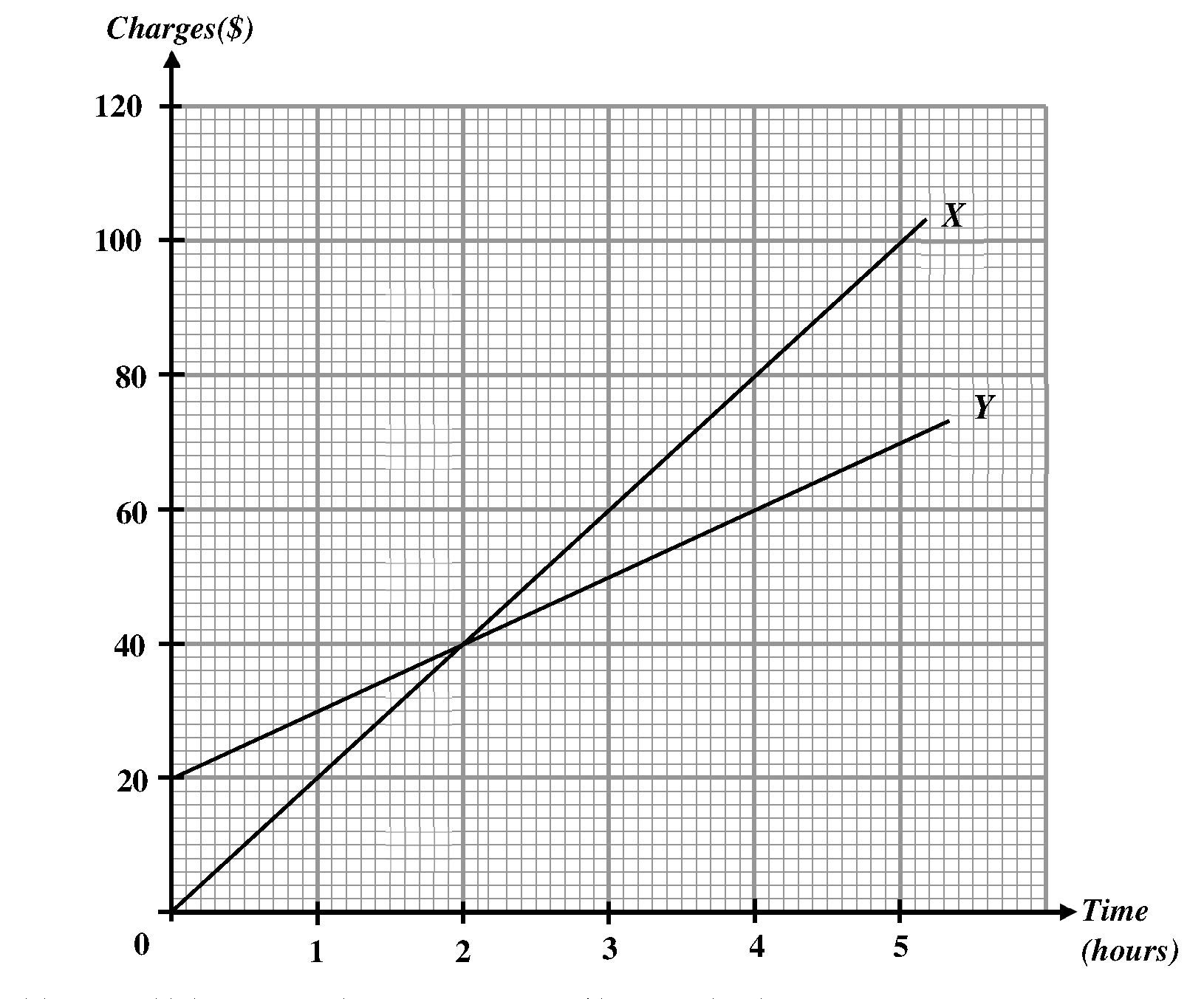
Which company has a greater rate of increase in charges? Explain your answer.
If Henry has a budget of 60 dollars, which company should he rent a bicycle from? Explain your answer.
Show worked solution▾
(a) Company , because its line has a steeper gradient (a greater rate of increase in charges per hour).
(b) Company . For a budget of 60 dollars, Company allows about hours of rental compared with about hours for Company , so Company gives better value for money (an extra hour of riding for the same 60 dollars).
Read a distance–time graph & find a gradient
Daniel cycled from home to a supermarket. On his way home, he stopped by a food centre to have his breakfast. The distance–time graph for his entire journey is shown below.
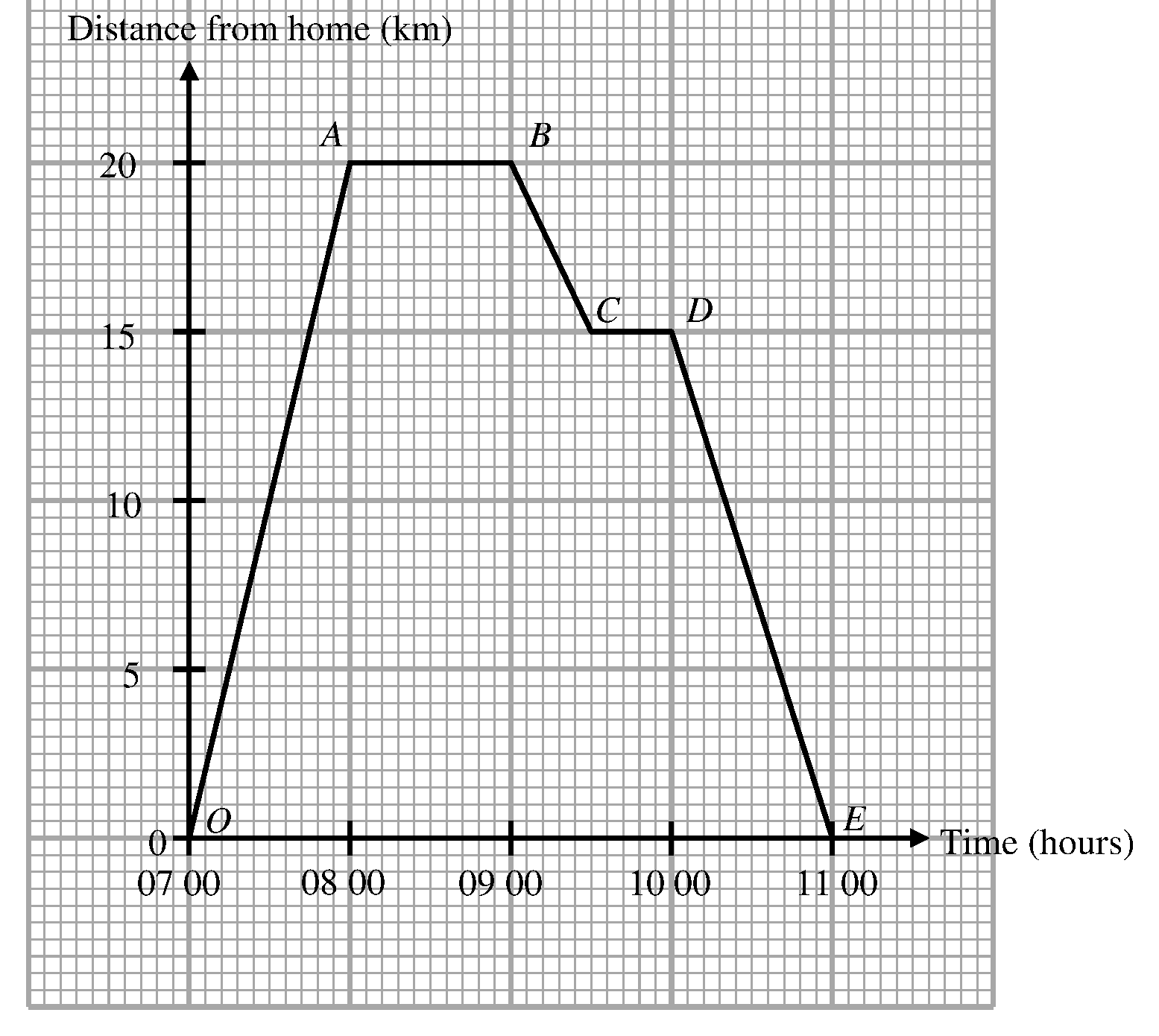
What is the distance between the supermarket and food centre?
Find the total time Daniel stayed at the supermarket and the food centre.
Find the gradient of the line segment , stating clearly what the gradient represents.
Show worked solution▾
(a)
(b)
(c)
km/h represents the speed of Daniel travelling from home to the supermarket.
Convert km/h to m/min & wheel revolutions
The radius of a wheel of a unicycle is m. A clown cycles at an average speed of km/h during a performance.
Convert km/h into m/min.
Find the number of revolutions made by the wheel in minutes, giving your answer correct to the nearest whole number.
Show worked solution▾
(a)
(b) Distance in min m. Circumference m.
Convert m/min to km/h & find distance
A cyclist starts cycling at a speed of m/min at am.
Convert m/min into km/h.
If the cyclist increases his speed by km/h, he would be able to complete his journey at am. Find the distance covered by the cyclist.
Show worked solution▾
(a)
(b) New speed km/h. Time from am to am h:
Two-speed journey, form an equation
Thomas took part in a competition. He cycled km at an average speed of km/h and ran the remaining distance at an average speed of km/h. The entire -km journey took Thomas hours to complete.
Form an equation in and show that .
Find, in hours, the time that he ran.
Show worked solution▾
(a) Cycling time running time :
Multiply by :
(b) Running distance km:
Secondary 1 Maths programme — every method behind these questions, taught step by step.