
Discrete Random Variables: Distribution in terms of \(n\) — CJC 2025 H2 Math Prelim Paper 2
What this question tests
Question
Happie, the owner of a store selling novelty items, is organizing a publicity stunt for his store. Using a stock of ultra-rare Lubaba dolls that he acquired, he sets up a game where a player opens “mystery boxes” to try to find a Lubaba doll hidden inside one of the identical boxes used for the game.
The rules of the game are:
- The player pays an initial \$5 to start the game to open one of \(n\) boxes.
- If the opened box is empty, the player can pay an additional \$3 to open a second box.
- If the second box is empty, the player can pay \$2.50 again to open a third box.
- If the third box is still empty, the player loses the game. The doll that is not won will then be donated away and the game is reset for the next player.
As the Lubaba dolls are considered rare collectors' items, it can be assumed that in every game, the players will keep opening the boxes until they win the doll and that they have the means to pay for the maximum of 3 allowable tries at opening the boxes.
Let \(X\) be the random variable denoting the number of empty boxes a player has opened in a game.
- Show that \(\mathrm{P}(X=2) = \dfrac{1}{n}\).
- Find the probability distribution of \(X\), leaving your answers in terms of \(n\).
- If \(n=10\), find \(\mathrm{P}(X\leq\sigma)\), where \(\sigma\) is the standard deviation of \(X\).
- If the cost price of a Lubaba doll is \$10, find the number of boxes \(n\), that Happie should prepare so that he will not make any profit nor incur any loss from organising this publicity stunt.
Show full worked solution▾
(a) \(\mathrm{P}(X=2)\) = probability that the doll is in the 3rd box opened (first two are empty): \[ \mathrm{P}(X=2) = \frac{n-1}{n}\times\frac{n-2}{n-1}\times\frac{1}{n-2} = \frac{1}{n} \qquad\text{(shown)} \]
(b) \[\begin{aligned} \mathrm{P}(X=0) &= \frac{1}{n}\\ \mathrm{P}(X=1) &= \frac{n-1}{n}\times\frac{1}{n-1} = \frac{1}{n}\\ \mathrm{P}(X=2) &= \frac{1}{n}\\ \mathrm{P}(X=3) &= \frac{n-1}{n}\times\frac{n-2}{n-1}\times\frac{n-3}{n-2} = \frac{n-3}{n} \end{aligned}\]
| \(X\) | 0 | 1 | 2 | 3 |
|---|---|---|---|---|
| \(\mathrm{P}(X=x)\) | \(\dfrac{1}{n}\) | \(\dfrac{1}{n}\) | \(\dfrac{1}{n}\) | \(\dfrac{n-3}{n}\) |
(c)
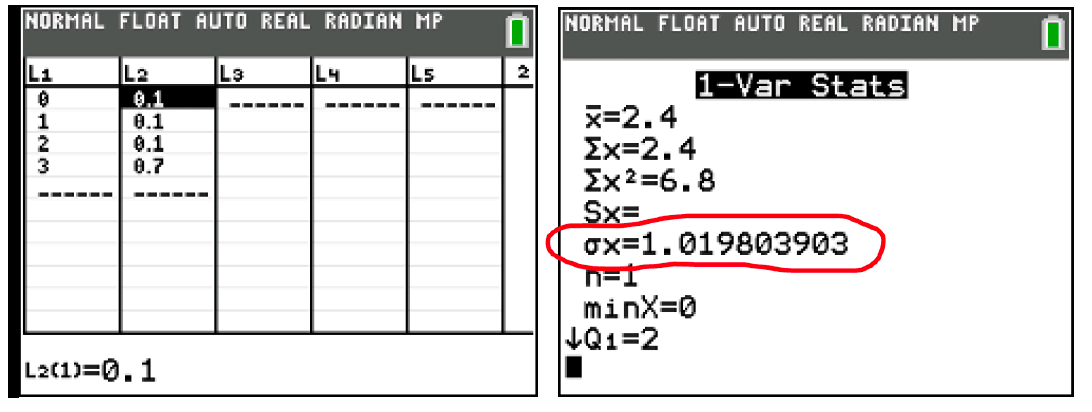
From GC:
\[ \sigma = \sqrt{1.04} \approx 1.0198 \] \[ \mathrm{P}(X\leq\sigma) = \mathrm{P}(X\leq 1.0198) = \mathrm{P}(X=0)+\mathrm{P}(X=1) = \frac{1}{10}+\frac{1}{10} = 0.2 \](d) Let \(Y\) (in dollars) be the amount obtained by Happie in a game.
| \(X\) | 0 | 1 | 2 | 3 |
|---|---|---|---|---|
| \(Y\) | 5 | 8 | 10.5 | 10.5 |
| \(\mathrm{P}(Y=y)\) | \(\dfrac{1}{n}\) | \(\dfrac{1}{n}\) | \(\dfrac{1}{n}\) | \(\dfrac{n-3}{n}\) |
\[ \mathrm{E}(Y) = \frac{5+8+10.5+10.5(n-3)}{n} = \frac{10.5n-8}{n} \] For no profit/loss: \(\mathrm{E}(Y) = 10\) (cost of doll). \[\begin{aligned} \frac{10.5n-8}{n} &= 10\\ 10.5n-8 &= 10n\\ 0.5n &= 8\\ n &= 16 \end{aligned}\]
| \(X\) | 0 | 1 | 2 | 3 |
|---|---|---|---|---|
| \(\mathrm{P}(X=x)\) | \(\dfrac{1}{n}\) | \(\dfrac{1}{n}\) | \(\dfrac{1}{n}\) | \(\dfrac{n-3}{n}\) |