
Binomial Expansion: Multi-stage binomial — SAJC 2025 H2 Math Prelim Paper 2
What this question tests
Question
A company sells toys in blind boxes. Each blind box contains exactly one toy. On average, 2% of such blind boxes contain a faulty toy.
A collector buys 15 such blind boxes at random.
- State, in context, two assumptions needed for the number of faulty toys he gets to be well modelled by a binomial distribution.
Assume now that the number of faulty toys the collector gets has a binomial distribution.
- Find the probability that the collector gets no less than 3 faulty toys.
- Find the probability that the fourteenth box is the second box with a faulty toy.
The company also sells keychains. The probability of a keychain being faulty is \(p\). The number of faulty keychains follows a binomial distribution. Faults on keychains are independent of faults on toys in blind boxes.
- Write down an expression, in terms of \(p\), for the probability that in a random sample of 3 keychains, exactly one is faulty.
A surprise pack contains 2 randomly chosen blind boxes and 3 randomly chosen keychains. Given that a randomly selected surprise pack contains at most 1 faulty item, the probability that one of the toys is the only faulty item in the pack is 0.035.
- Write down an equation satisfied by \(p\). Hence, find the value of \(p\).
Show full worked solution▾
(i) Assumptions:
- Whether a toy is faulty or not is independent of other toys.
- The probability of a toy being faulty is constant at 0.02 for each toy.
(ii) Let \(X\) be the number of faulty toys in 15 blind boxes. \[ X \sim \mathrm{B}(15,\;0.02) \] \[ \mathrm{P}(X \geq 3) = 1 - \mathrm{P}(X \leq 2) = 0.00304\text{ (3 s.f.)} \]
(iii)
Method 1
Let \(Y\) be the number of faulty toys in 13 blind boxes. \(Y \sim \mathrm{B}(13,\;0.02)\). \[ \text{Required probability} = \mathrm{P}(Y = 1)\times 0.02 = 0.204026\times 0.02 = 0.00408\text{ (3 s.f.)} \]
Method 2
\[ = \binom{13}{1}(0.02)(0.98)^{12}\times 0.02 = 0.00408\text{ (3 s.f.)} \](iv) Let \(K\) be the number of faulty keychains out of 3. \(K \sim \mathrm{B}(3,\;p)\). \[ \mathrm{P}(K = 1) = \binom{3}{1}p(1-p)^2 = 3p(1-p)^2 \]
(v) Let \(A\) be the number of faulty toys in 2 blind boxes. \(A \sim \mathrm{B}(2,\;0.02)\).
\[ \mathrm{P}(A=1)\mathrm{P}(K=0) = 0.035 \times\mathrm{P}(\text{at most 1 faulty toy in the pack}) \] \[ \frac{\mathrm{P}(A=1)\cdot\mathrm{P}(K=0)} {\mathrm{P}(A=0)\mathrm{P}(K=0) + \mathrm{P}(A=1)\mathrm{P}(K=0) + \mathrm{P}(A=0)\mathrm{P}(K=1)} = 0.035 \] \[ \frac{0.0392(1-p)^3} {0.9604(1-p)^3 + 0.0392(1-p)^3 + 0.9604\cdot 3p(1-p)^2} = 0.035 \]Method 1: Using GC
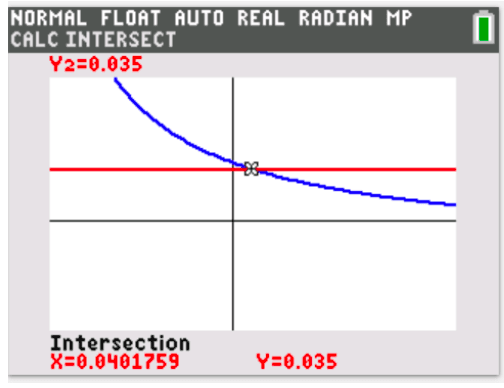
From GC, since \(0 \leq p \leq 1\): \(p = 0.0402\) (3 s.f.)
Method 2: Algebraic approach
\[ 0.0392(1-p)^3 = 0.035\bigl[0.9604(1-p)^3 + 0.0392(1-p)^3 + 0.9604\cdot 3p(1-p)^2\bigr] \]Dividing by \((1-p)^2\) (since \(p \neq 1\)): \[ 0.0392(1-p) = 0.035\bigl[0.9604(1-p) + 0.0392(1-p) + 2.8812p\bigr] \] \[ 0.0392 - 0.0392p = 0.033614 - 0.033614p + 0.001372 - 0.001372p + 0.100842p \] \[ 0.0392 - 0.0392p = 0.034986 + 0.065856p \] \[ 0.004214 = 0.105056p \implies p = \frac{43}{1072} \approx 0.0401\text{ (3 s.f.)} \]