Free practice / Secondary 4 E Maths
Sec 4 E Maths: Equations and Inequalities, practice questions & worked solutions
Equations and inequalities questions selected from 2023 to 2025 Singapore school E Maths prelim papers, each with the school’s full worked solution.
About this topic & key methods
Linear equations, simultaneous equations and linear inequalities are built up from Sec 1 and Sec 2 and appear in most E Maths papers, often inside a word problem. The questions here are mostly Paper 1, with two Paper 2 questions on forming and solving simultaneous equations.
Attempt each question on paper before opening its worked solution. The solutions are the schools’ own marking schemes, so some steps are brief.
Key methods for equations and inequalities
- Clear fractions by multiplying every term by the lowest common denominator
- Reverse the inequality sign whenever you multiply or divide by a negative number
- Split a compound inequality such as into two parts, solve each, then combine
- Read integer or prime solutions off the combined range, checking each end point
- Turn a percentage target into an inequality such as
- Solve simultaneous equations by matching coefficients and adding or subtracting, then substitute back
- Check a solution by substituting it into the original equation
For lessons that build these methods week by week, see our E Maths tuition for Sec 3 and Sec 4.
Equations and Inequalities questions with worked solutions
Unless the question specifies otherwise, give non-exact answers to 3 significant figures and angles in degrees to 1 decimal place.
Linear equation with fractional terms, Ahmad Ibrahim Secondary School, 2023 Prelim P1 Q2
Solve the equation . [2]
Show worked solution▾
Answer:
Linear inequality with a negative coefficient, Boon Lay Secondary School, 2025 Prelim P1 Q5
Solve the inequality . [2]
Show worked solution▾
( throughout)
Answer:
Forming an inequality from a percentage target, CHIJ St. Nicholas Girls’ School, 2023 Prelim P1 Q7
In a school club, 72 of the members are boys and 48 are girls.
Calculate the least number of additional girls that would need to join the club in order to raise the percentage of girls to greater than 45%. [2]
Show worked solution▾
Let be the number of additional girls needed to join the club.
, least number is 11
Answer:
Compound inequality and its integer solutions, Anglo-Chinese School (Barker Road), 2024 Prelim P1 Q7
Solve the inequalities . [2]
Write down all the integers that satisfy . [1]
Show worked solution▾
(a)
(b)
.
Answer: (a) (b)
Combining two inequalities into one solution set, Chung Cheng High School (Main), 2025 Prelim P1 Q7
Solve the inequality . [3]
Show worked solution▾
Answer:
Fractional equation that reduces to a linear one, Ngee Ann Secondary School, 2025 Prelim P1 Q11
Solve . [3]
Show worked solution▾
Answer:
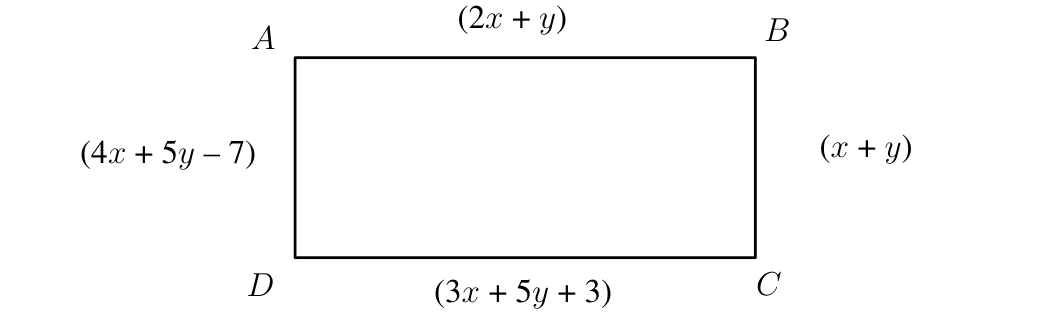
Simultaneous equations from the sides of a rectangle, Orchid Park Secondary School, 2024 Prelim P2 Q2
In the diagram, is a rectangle. Given that cm, cm, cm and cm.
Find the values of and . [3]
Show worked solution▾
Sub (1) into (2)
Sub into (1)
Answer: ,
Forming simultaneous equations from income, Bukit Merah Secondary School, 2025 Prelim P1 Q15
Cathy runs a dog-walking service. She charges $36 to walk a group of dogs and $20 to walk one dog.
In a particular year, Cathy's income from the dog-walking service was $5760.
Cathy carried out group walks and individual walks. The group walks earned Cathy $1800 more than the individual walks.
Form and solve two simultaneous equations, and find the total number of dog walks that Cathy carried out in that year. [4]
Show worked solution▾
(1)+(2),
From (1),
The total number of dog walks .
Answer:
Simultaneous equations from an equilateral triangle, Fairfield Methodist School (Secondary), 2024 Prelim P1 Q14
is an equilateral triangle with lengths cm, cm and cm.
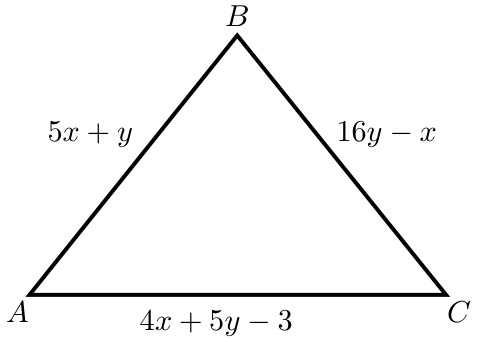
Write down two simultaneous equations, in terms of and , to represent this information. [2]
Solve the simultaneous equations and hence find the area of triangle . [4]
Show worked solution▾
(a)
(b)
sub into
Sub into
Perpendicular ht from to
OR
Answer: (a) , (b) ; cm
Simultaneous equations for a polygon diagonal formula, Broadrick Secondary School, 2024 Prelim P2 Q4
The table below shows the number of vertices () and number of diagonals () in a polygon.
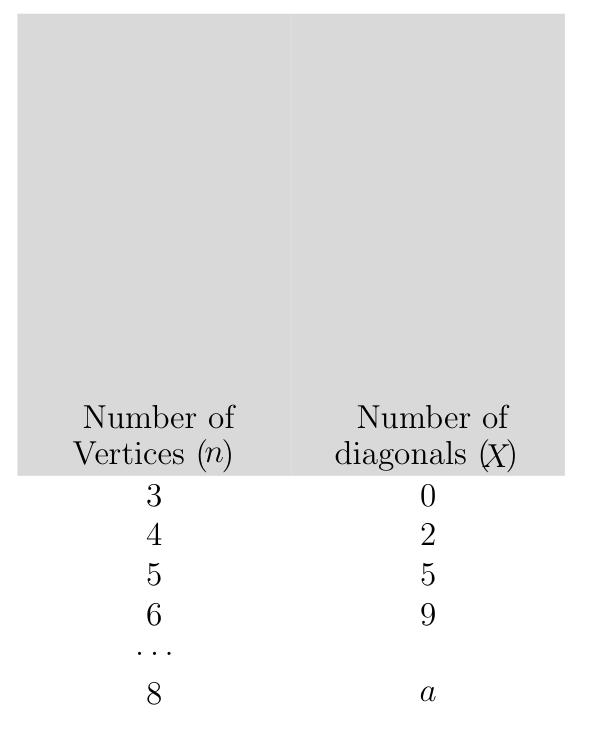
Write down the value of . [1]
The number of diagonals is related to the number of vertices by the equation where and are constants.
Using appropriate substitution, show that and . [2]
Solve these simultaneous equations to find the values of and of . [3]
Explain whether it is possible to have a -sided polygon with 495 diagonals.
Show your working clearly. [3]
Show worked solution▾
(a)
20
(b)(i)
When and ,
When and ,
(b)(ii)
(2)(1)
(b)(iii)
Since number of vertices is an integer, it is possible to have a -sided polygon with 495 diagonals.
Answer: (a) (b)(ii) , (iii) Yes, is a positive integer, so a 33 sided polygon has 495 diagonals
More practice related to equations and inequalities
Sec 2 Maths: Simultaneous Equations
Sec 2 Maths: Linear Inequalities
Sec 4 E Maths: Quadratic Equations and Completing the Square
Sec 4 E Maths: Algebraic Expansion, Factorisation and Fractions