
Sec 2 Maths: Linear Inequalities, practice questions & worked solutions
Linear inequalities questions from 2025 Singapore Secondary 2 End-of-Year examination papers. They cover solving an inequality, showing the solution on a number line, picking out the greatest or smallest integer, prime or perfect square, and forming an inequality from a word problem, and every question has a full step-by-step worked solution.
About this topic & key methods
In Secondary 2 Mathematics, a linear inequality such as is solved much like a linear equation: expand brackets, clear fractions, and collect the unknown on one side. The one extra rule is that multiplying or dividing both sides by a negative number reverses the inequality sign.
The answer is a range of values, not a single number, so questions often go on to ask for it on a number line, or for the largest or smallest integer, prime number or perfect square in that range. The last question below forms the inequality from a word problem about bank notes. For a structured programme covering this topic, see our Sec 2 Maths tuition.
Key methods
- Same as equations: you may add or subtract the same amount on both sides, and multiply or divide by a positive number, without changing the sign.
- Negative divisor: dividing or multiplying by a negative number reverses the sign: from you get .
- Fractions: multiply every term by the denominator first, e.g. multiply by .
- Number line: a solid (filled) circle means the end value is included ( or ); a hollow circle means it is not ( or ).
- Integer answers: for the smallest integer is ; for the greatest prime is itself because is included.
- Word problems: let the unknown be the quantity asked for, write the total as an expression, and turn “less than” or “at most” into the matching sign.
Questions & worked solutions
Solving an inequality with a negative coefficient
Solve the inequality .
Show worked solution▾
Divide both sides by and reverse the sign:
Solving an inequality and the smallest integer
Solve the inequality .
Hence write down the smallest integer value of .
Show worked solution▾
(a)
(b)
must be greater than , and itself is not allowed. The smallest integer is
Solving an inequality and showing it on a number line
Solve the inequality .
Represent the solution on the number line below.

Show worked solution▾
(a)
Divide both sides by and reverse the sign:
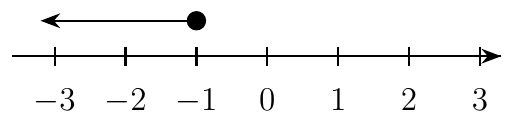
(b)
Draw a solid circle at , because is included, with an arrow pointing to the left:
Inequality with brackets, number line and the largest prime
Solve the inequality .
Represent the answer in (a) on the number.

Write down the largest prime number of .
Show worked solution▾
(a)
Multiply both sides by and reverse the sign:
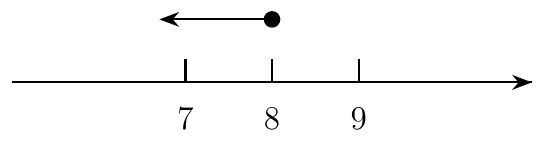
(b)
Draw a solid circle at , because is included, with an arrow pointing to the left:
(c)
The primes up to are , , and . The largest is
Inequality with a fraction and the smallest integer
Solve .
Represent the solution in (a) on the number line.

Hence, state the smallest integer that satisfies the inequality
Show worked solution▾
(a)
Multiply both sides by to clear the fraction:
Divide both sides by and reverse the sign:
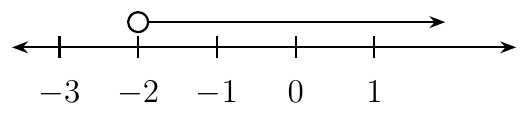
(b)
Draw a hollow circle at , because is not included, with an arrow pointing to the right:
(c)
must be greater than , so is excluded. The smallest integer is
Inequality with a fraction and the smallest prime
Solve the inequality .
Hence, state the smallest prime number that satisfies the inequality.
Show worked solution▾
(a)
Multiply both sides by and reverse the sign:
(b)
Every prime number is greater than , so the smallest prime that satisfies the inequality is the smallest prime of all:
Greatest perfect square and greatest prime in a solution set
Given that , find the greatest possible value of if is
a perfect square,
a prime number.
Show worked solution▾
First solve the inequality. Multiply both sides by :
(a)
The perfect squares up to are , and . The greatest is
(b)
is included (the sign is ) and is prime, so the greatest prime is
Linear and quadratic equations, then an inequality
Solve the following equations.
Solve the inequality .
Show worked solution▾
(a)(i)
Multiply every term by the LCM of the denominators, :
(a)(ii)
Bring every term to one side and factorise:
(b)
Multiply both sides by and reverse the sign:
Forming an inequality from a money problem
Annabelle has 12 pieces of $20 notes and $5 notes in her wallet. The total value of these notes is less than 16,000 cents. By forming an inequality in , where represents the number of $20 notes, find the maximum number of $20 notes.
Show worked solution▾
There are notes of $20, so there are notes of $5. Work in dollars: cents $160.
is a whole number of notes less than , so the maximum number of $20 notes is .
Check: notes of $20 and of $5 total $150, which is less than $160; and would total $165.