
Sec 2 Maths: Simultaneous Linear Equations, practice questions & worked solutions
Simultaneous linear equations questions from 2025 Singapore Secondary 2 End-of-Year examination papers. They cover solving a pair of equations by substitution and by elimination, reading a solution from a graph, and forming the equations yourself from a word problem, and every question has a full step-by-step worked solution.
About this topic & key methods
In Secondary 2 Mathematics, a pair of simultaneous linear equations in and is solved by finding the one pair of values that makes both equations true. There are two algebraic methods: substitution, where one equation is rearranged to make or the subject and substituted into the other, and elimination, where the equations are multiplied so that one unknown has the same coefficient and then added or subtracted away.
Graphically, each equation is a straight line and the solution is the point of intersection. Two parallel lines never meet, so their equations have no solution. The last questions below ask you to form the two equations from a word problem before solving them. For a structured programme covering this topic, see our Sec 2 Maths tuition.
Key methods
- Label the equations: number them (1), (2), (3) so that every step says which equation is being used.
- Substitution: best when one unknown already has a coefficient of , as in or .
- Elimination: multiply one or both equations so a pair of coefficients match, then subtract if the signs are the same and add if they are different.
- Finish the job: substitute the first value back into one of the original equations to find the second unknown.
- Check: substitute both values into the equation you did not use; it must balance.
- Graphical method: the solution is the point where the lines cross; parallel lines (same gradient, different -intercept) give no solution.
Questions & worked solutions
Solving by substitution
Solve these simultaneous equations.
Show worked solution▾
From (1), —(3). Substitute (3) into (2):
Substitute into (3):
So , . Check in (2): .
Substitution or elimination
Solve these simultaneous equations.
Show worked solution▾
By substitution
From (1), —(3). Substitute (3) into (2):
Substitute into (3):
By elimination
(1) gives —(4). The terms have opposite signs, so add (4) and (2):
Then , so . Either way, , .
Solving with a fractional substitution
Solve the following simultaneous equations.
Show worked solution▾
From (1):
Substitute (3) into (2), then multiply through by :
Substitute into (3):
So , . Check in (2): .
Solving by elimination
Solve the simultaneous equations.
Show worked solution▾
Make the coefficients equal: (1) and (2) :
The terms have the same sign, so subtract: (4) (3):
Substitute into (1):
So , . Check in (2): .
Graphical method and parallel lines
The grid shows the graphs of two equations and .
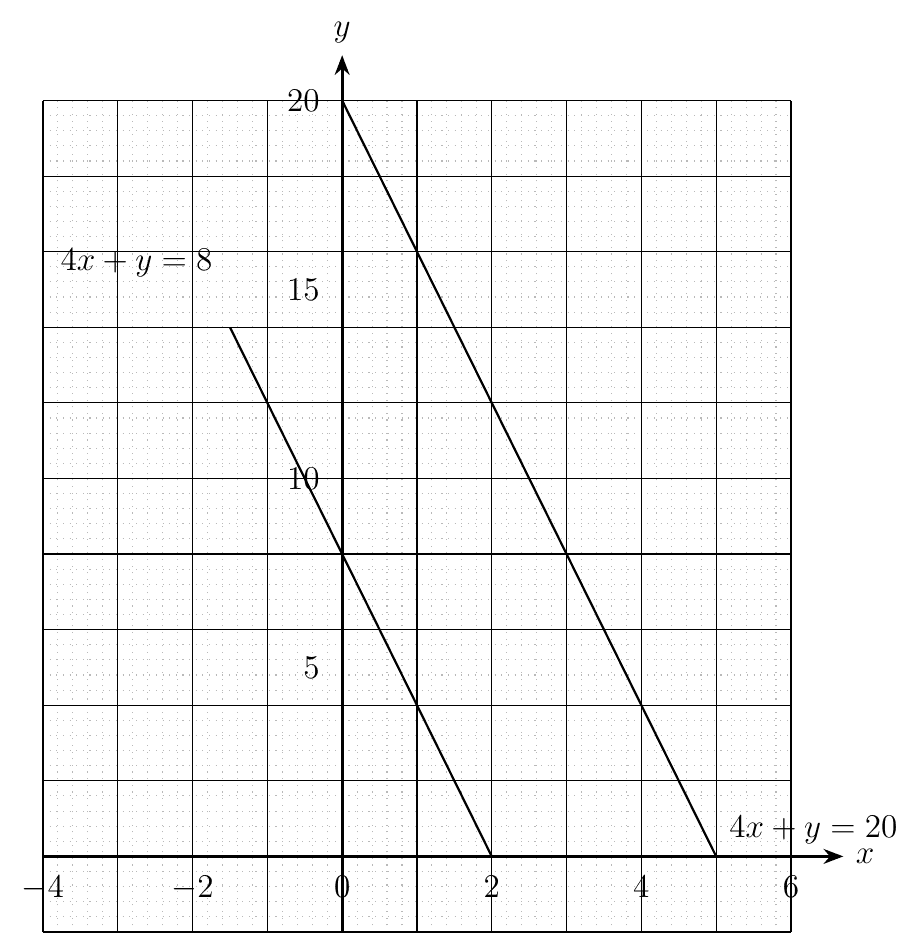
Without solving these two equations, state the number of solutions these equations have. Explain your answer.
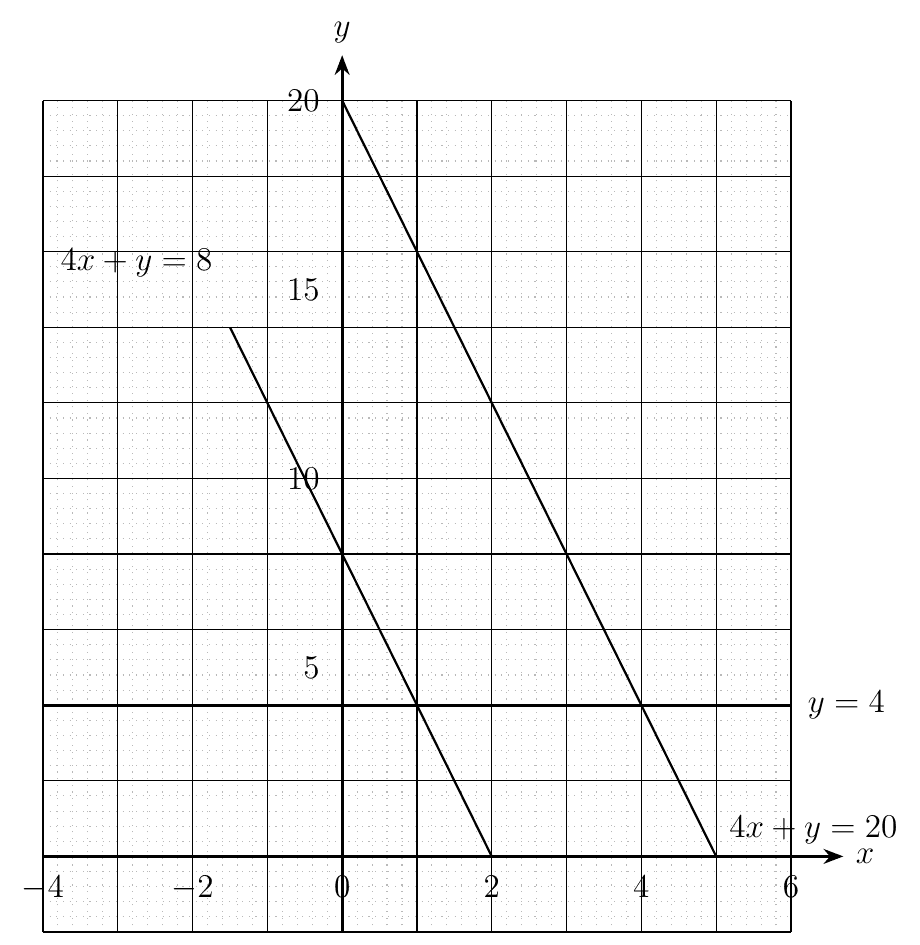
Draw and label the line onto the grid.
Hence, write down the coordinates of the point of intersection of the lines and .
Show worked solution▾
(a)
Rewrite both equations in the form :
Both lines have gradient but different -intercepts ( and ), so they are parallel and never meet. The equations have no solution (0 solutions).
(b)
is the horizontal line through on the -axis:
(c)
The line crosses at
Check: .
Forming simultaneous equations from a rectangle and a square
The diagram shows one rectangle, and one square, . The dimensions, in centimetres, of the quadrilaterals are shown below.
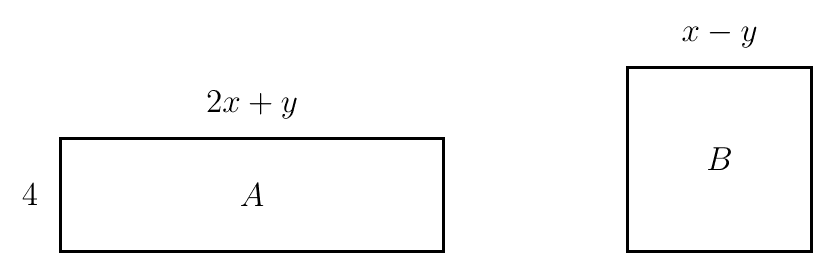
The area of rectangle is 36 cm. Find in terms of . Give your answer in its simplest form.
The length of square is 2 cm more than the breadth of rectangle . Find in terms of . Give your answer in its simplest form.
Solve the simultaneous equations found in (a) and (b).
David cuts the entire rectangle into squares of length 1 cm. He claims that he can use all the 1 cm squares to cover square . Do you agree with him? Explain clearly.
Show worked solution▾
(a)
(b)
The breadth of is cm, so the side of is cm:
(c)
Both expressions equal , so set them equal:
So , . Check: and .
(d)
I agree with David. Rectangle gives squares of side cm, and square has area cm, so the squares fit exactly as a by arrangement covering .
Forming simultaneous equations from a fraction
A fraction is equivalent to if 1 is subtracted from the numerator and 3 is added to its denominator. If 2 is added to the numerator and 5 is subtracted from the denominator of the original fraction, the resulting value is . Find the original fraction.
Show worked solution▾
Let the original fraction be . Cross-multiply each condition:
Substitute (1) into (2):
The original fraction is .
Check: and .