JC · H2 Mathematics · Vectors summary video
This page explains how to find the foot of the perpendicular from a point to a line in H2 Maths vectors. Start with the film, which runs for about 3 and a half minutes and works through one example in three steps. Below it you will find the method in three steps, one fully worked example with every line of working, what the foot gives you next, and the common slips to watch for.
Foot of the perpendicular at a glance
- Given: a line and a point not on it.
- Step 1: lies on , so for one value of .
- Step 2: is perpendicular to , so .
- Step 3: solve for , then substitute it back into .
- From F: the perpendicular distance is , and the reflection of is .
What the foot of the perpendicular is
You are given a line with equation , where is a point on the line and is its direction vector, and a point that is not on the line. Drop a perpendicular from to the line. It meets the line at a right angle, at a point called the foot of the perpendicular, .
The foot is the point of the line closest to . For any other point on the line, is the hypotenuse of the right-angled triangle , so it is longer than . That is why the shortest distance from to the line is .
How to find the foot of the perpendicular in three steps
Step 1: F lies on the line, so write OF in terms of λ
Every point on the line has this form, so does too, for one fixed value of that we have not found yet. Write as a single column vector before going on: the next step is easier that way.
Step 2: PF is perpendicular to m, so PF · m = 0
Two non-zero vectors at have a scalar product of zero, and meets the line, which runs along , at a right angle. Dot with only, not with the whole line equation.
Step 3: solve for λ and substitute back
The equation from Step 2 is linear in , so it has exactly one solution, which matches the picture: only one point on the line gives a right angle. Put that value of back into to get the position vector of . The value of on its own is not the answer.
Worked example: foot of the perpendicular from a point to a line
Question. The line has equation
and is the point . Find the position vector of the foot of the perpendicular from to . Hence find the perpendicular distance from to and the position vector of the reflection of in .
Here
Step 1. lies on , so combine into one vector:
Step 2. Find , taking care with the brackets, then dot it with :
Step 3. Substitute back into :
So the foot of the perpendicular is .
Check. With ,
so is perpendicular to the line, as it should be.
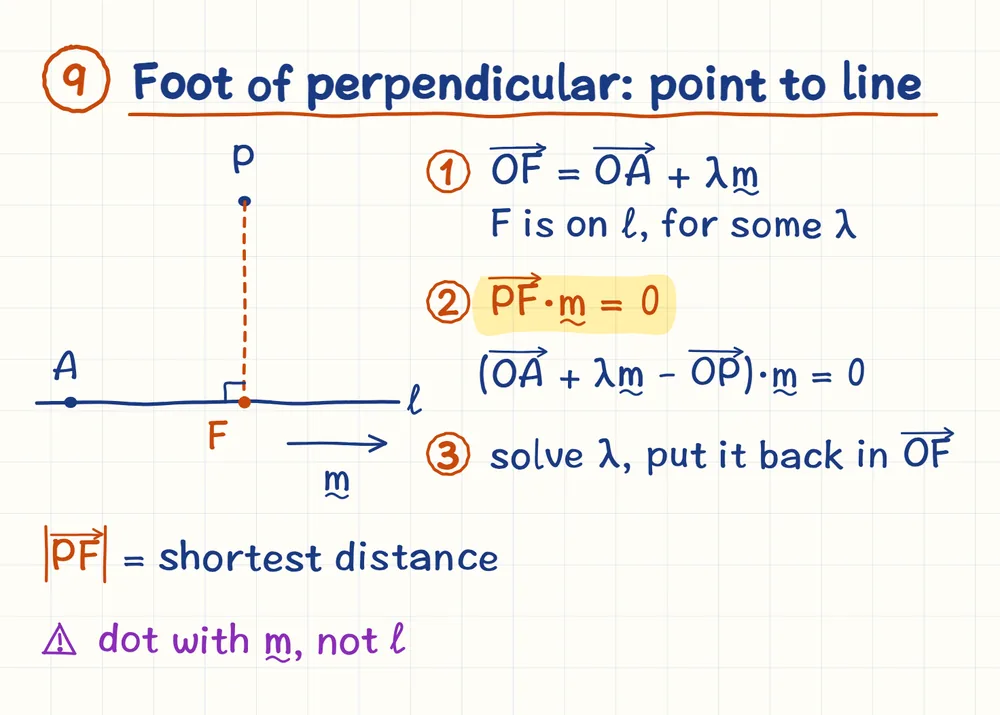
From the Vectors summary and formula sheet · page 2, section 9
Foot of the perpendicular from a point to a line
What F gives you: perpendicular distance and reflection
Perpendicular distance from a point to a line
The shortest distance from to the line is the length of :
The perpendicular distance from to is 3 units.
Reflection of a point in a line
Find the foot first: you must have before you can find the reflection . is the midpoint of , a ratio of , so
Make the subject:
The reflection of in is .
Common slips with the foot of the perpendicular
- Dotting with the line equation instead of m. Writing uses a position vector, not a direction. Fix: the right angle is between and the direction of the line, so dot with only.
- Losing a sign in PF = OF − OP. Subtracting from without brackets, so that the in is subtracted as if it were . Fix: write and as columns and subtract each row, so .
- Stopping at λ. In the example is a parameter, not the foot. Fix: substitute back into and give as a position vector or as coordinates.
- Reflecting before you have F. The reflection formula needs . Fix: find the foot first, then use .
Practice question: try one yourself
The line has equation
and is the point . Find the foot of the perpendicular from to , the perpendicular distance from to , and the reflection of in .
Show the answer
, so and . The foot is , the perpendicular distance is , and the reflection is .
Check: and .
Foot of the perpendicular FAQs
How do you find the foot of the perpendicular from a point to a line in 3D?
Write the position vector of the foot F using the line equation, so OF = OA + λm. Then use the right angle: PF · m = 0, where PF = OF − OP. Solve this for λ and substitute it back into OF.
How do you find the shortest distance from a point to a line using vectors?
Find the foot of the perpendicular F first, then the shortest distance is the length |PF|. If a question asks only for the distance, |AP × m| divided by |m| gives the same value: in the example above it is 9 divided by 3, which is 3.
How do you find the reflection of a point in a line?
Find the foot of the perpendicular F from the point P to the line. F is the midpoint of P and its reflection P′, so OP′ = 2OF − OP.
Why do you dot PF with m and not with the line equation?
The right angle is between PF and the direction of the line, and the direction is m. The line equation OA + λm is a position vector, which points from the origin to a point on the line, so its scalar product with PF does not describe the right angle.
More H2 Maths vectors practice
The foot of perpendicular and reflection section of our H2 Maths vectors notes works a second point to line example and a point to plane example. For questions from school papers with worked solutions, try JC1 H2 Maths promo questions on vectors and JC2 H2 Maths prelim questions on vectors.
Next in the Vectors films
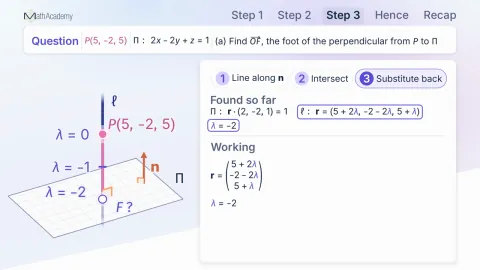
Transcript: foot of the perpendicular film
Here’s a line, and a point P that’s not on it. Drop a perpendicular from P down to the line. It hits the line at ninety degrees. That point is the foot of the perpendicular. We call it F. Finding F takes three steps. Let’s do them with an example.
The line l has equation r equals minus one, minus three, four, plus lambda, two, two, minus one. The point P has coordinates four, minus one, zero. Find the position vector of the foot of the perpendicular, F, from P to l.
Step one. F is on the line. So F takes the same equation as the line, for some lambda. Change lambda, and you get a different point on the line. F is one of these points. For some lambda means a certain fixed value of lambda that we haven’t found yet. Combine them into one vector first. It’ll make the next part easier. So O F equals minus one plus two lambda, minus three plus two lambda, four minus lambda.
Step two. At the foot, P F meets the line at ninety degrees. We want ninety degrees, so we want the dot product to be zero. P F dot m equals zero. We just go for m. Don’t go for l. P F is O F minus O P. Be careful with the brackets. That gives two lambda minus five, two lambda minus two, four minus lambda. Dot it with m, and set it to zero. Two lots of two lambda minus five. Plus two lots of two lambda minus two. Minus, bracket, four minus lambda. Nine lambda minus eighteen equals zero. So lambda equals two.
Step three. Put lambda equals two back into the equation of O F. O F is three, one, two. That’s our foot, F.
Part b. Hence find the shortest distance from P to l. The shortest distance from P to the line is the length of P F. P F is minus one, two, two. Root of one, plus four, plus four. Root nine. Three.
Part c. Find the reflection of P in l. F is the midpoint, so it’s a ratio of one to one. Start with F, the one in the middle. O F is O P plus O P prime, over two. Make O P prime the subject. So O P prime equals two O F, minus O P. That’s two, three, four.
Three steps. F on the line. P F dot m equals zero. Solve, and substitute back. Watch for two slips. Dot with m, not the whole line. And be careful with the brackets when you take away O P. And from F: the shortest distance is the length of P F, and the reflection is two O F, minus O P.
JC H2 Maths classes at Math Academy
Math Academy is run by the Ang family, three family teachers who are all NUS Mathematics graduates. Our JC1 and JC2 H2 Maths classes are taught by Mr Ian Ang, with at most 9 students in each class, in a weekly 2 hour lesson at our centre opposite Bukit Gombak MRT or live online. Every lesson is recorded, and each topic comes with his notes. To read more about our H2 maths tuition, visit the homepage, or WhatsApp us on 8859 1092.