JC · H2 Mathematics · Vectors summary video
This page explains how to use the ratio theorem in H2 Maths vectors to find the position vector of a point that divides a line segment in a given ratio. Start with the film, which runs for about 3 and a half minutes and works through one example in three steps. Below it you will find the theorem and the three steps, one fully worked example with a point between A and B, a point on AB produced and the midpoint, the common slips to watch for, and a practice question to try yourself.
Ratio theorem at a glance
- Given: points , , on a line with , and the position vectors and .
- Step 1: draw the line and write the ratio on top, with units on each part.
- Step 2: start with the point in the middle as the subject, and cross the ratio: each number multiplies the opposite vector.
- Step 3: divide by the sum of the ratio, then substitute and .
- Result: , and for the midpoint .
The ratio theorem for a point that divides a line
You are given two points and with position vectors and , and a point on the line that divides it in the ratio . The ratio theorem gives the position vector of :
Read it off the diagram: write the ratio on top of the line, connect all three points to the origin , then cross the ratio. The number multiplies the opposite vector , and the number multiplies . The denominator is the sum of the ratio. We apply the theorem and do not need its proof.
Every vector points out from : , and , never or .
How to use the ratio theorem in three steps
Step 1: draw the line with the ratio on top
Sketch , , on a line and write the number of units above each part. If , then is 3 units and is 1 unit. Connect the three points to .
Step 2: start with the point in the middle, then cross the ratio
The point in the middle is the subject, because the theorem is written for the point between the other two. Multiply each end vector by the number on the opposite part, and add them:
Step 3: divide by the sum, then substitute
The denominator is the sum of the ratio. Writing and for and , this gives . Now substitute the two position vectors and work out each row.
Worked example: ratio theorem with a point on AB produced and a midpoint
Question. Relative to the origin , the points and have position vectors
(a) The point lies on such that . Find the position vector of .
(b) The point lies on produced such that . Find the position vector of .
(c) Find the position vector of the midpoint of .
Part (a), Step 1. Draw the line with the ratio on top: is 3 units and is 1 unit.
Step 2. is in the middle, so is the subject. Cross the ratio:
Step 3. Substitute and :
So has position vector , that is .
Part (b). Produced means extended, here beyond , so lies beyond on the line .
Step 1. Write the equation as a fraction to read off the ratio:
So is 3 units and is 1 unit, which leaves as 2 units.
Step 2. The point in the middle is now , so is the subject. The ratio , and crossing it gives
Step 3. Make the subject:
So has position vector , that is .
Check. and , so , as the question says.
Part (c). The midpoint divides in the ratio , so
The midpoint is .
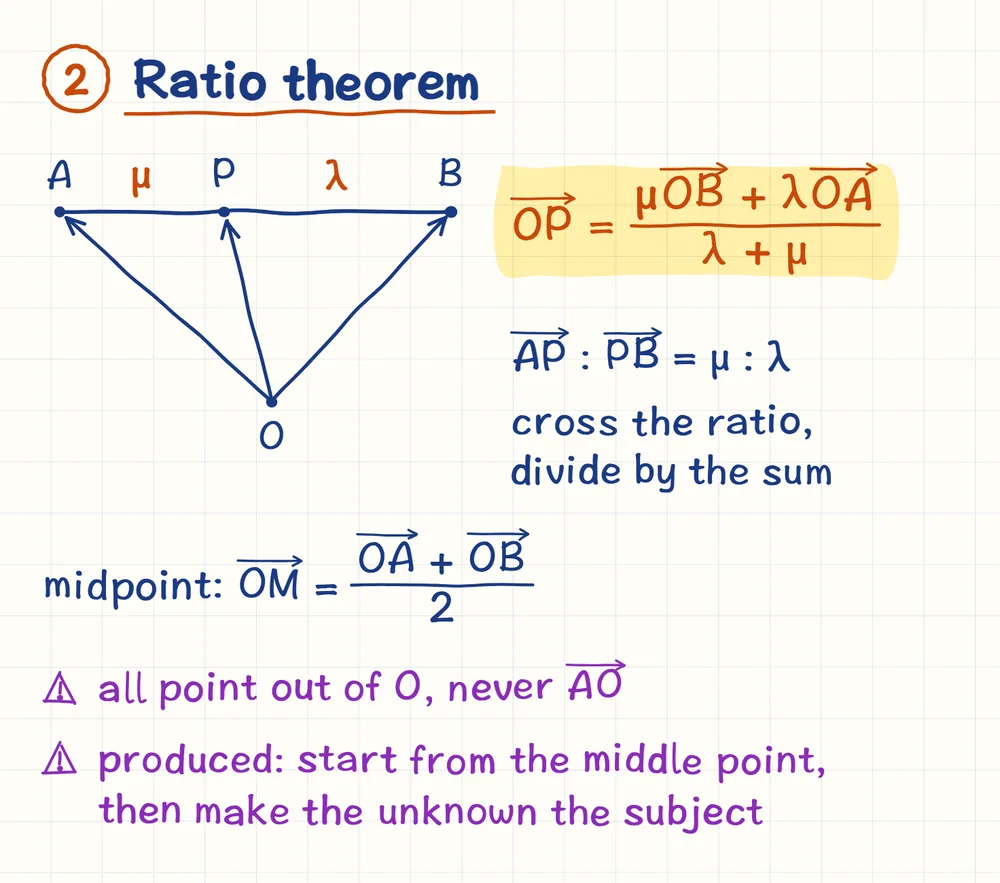
From the Vectors summary and formula sheet · page 1, section 2
Ratio theorem
Common slips with the ratio theorem
- Using the wrong vectors. Writing or , or using in the cross. Fix: every vector in the theorem points out from : , and .
- Not crossing the ratio. Multiplying with , the vector on its own side. Fix: each number multiplies the opposite vector, so with the 3 goes with .
- Missing the word produced. Treating as a point between and . Fix: produced means extended, so lies beyond . Start with the point in the middle, here , then make the new point the subject.
- Dividing by the wrong total. In part (b) the units are 2 and 1 for and , so the denominator is 3, not 4 and not 2. Fix: divide by the sum of the ratio used in the cross.
- Forgetting the midpoint is a ratio. Fix: the midpoint is the ratio , so .
Practice question: try one yourself
Relative to the origin , the points and have position vectors
(a) The point lies on such that . Find the position vector of .
(b) The point lies on produced such that . Find the position vector of .
(c) Find the position vector of the midpoint of .
Show the answer
(a) .
(b) is 5 units and is 3 units, so is 2 units and is in the middle: . Then .
(c) .
Check: in (b), and , and .
Ratio theorem FAQs
What is the ratio theorem in vectors?
It gives the position vector of a point P on the line AB when you know the ratio AP : PB = μ : λ. Cross the ratio with the opposite vector and divide by the sum of the ratio: OP = (μ OB + λ OA) divided by (λ + μ).
How do you use the ratio theorem when the point is on AB produced?
Produced means extended, so the new point lies beyond one end. Write the ratio on top, find which point is in the middle, make that point the subject, then rearrange to make the new point the subject. In the worked example B is in the middle, so OB = (2 OR + OA) divided by 3, and OR = (3b − a) divided by 2.
What is the position vector of the midpoint of AB?
The midpoint is the ratio 1 : 1, so OM = (a + b) divided by 2, where a and b are the position vectors of A and B.
How do you know which vector to multiply by which number?
Cross the ratio. With the ratio written on top of the line, the number on the AP part multiplies OB and the number on the PB part multiplies OA, so each number multiplies the vector on the opposite side.
More H2 Maths vectors practice
The ratio, scalar product and vector product section of our H2 Maths vectors notes carries more examples. For questions from school papers with worked solutions, try JC1 H2 Maths promo questions on vectors and JC2 H2 Maths prelim questions on vectors.
Next in the Vectors films
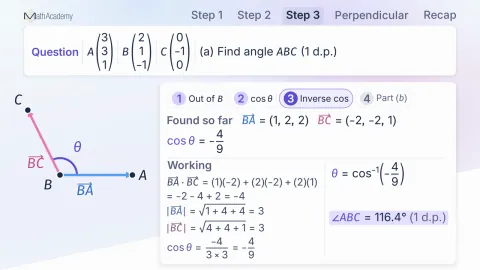
Transcript: ratio theorem film
Here are three points on a line, A, P and B, with the ratio written on top. A P to P B is mu to lambda. Connect all three to the origin O. The vectors all point out from O. Never A O or P O. The ratio theorem: cross the ratio with the opposite vector. Mu times O B, plus lambda times O A. Then divide by the sum of the ratio. We don’t need the proof. We just apply it, starting with the point in the middle.
Relative to the origin O, the points A and B have position vectors three, minus two, five, and seven, six, minus three. The point P lies on A B, such that A P to P B is three to one. Find the position vector of P.
Step one. Draw the line with the ratio on top. A P is three units, and P B is one unit. Step two. P is in the middle, so O P is the subject. Cross the ratio: three times O B, plus one times O A. Divide by the sum of the ratio, four. Writing a and b for O A and O B, O P is three b plus a, over four. Step three. Substitute a and b. Three b is twenty-one, eighteen, minus nine. Add a: twenty-four, sixteen, minus four. Divide by four. O P is six, four, minus one.
Part b. The point R lies on A B produced, such that A R equals three B R. Find the position vector of R. Produced means extended, at B. So R lies beyond B. Step one. Put the ratio on top. Write the equation as a fraction: A R over B R is three over one. So A R is three units and B R is one unit. That leaves A B as two units. Step two. Start with the point in the middle. Here that’s B, so O B is the subject. Cross the ratio: two times O R, plus one times O A, all over three. Step three. Make R the subject. Three b equals two O R plus a. So O R is three b minus a, over two. Three b minus a is eighteen, twenty, minus fourteen. Halve it. O R is nine, ten, minus seven.
Part c. Find the position vector of the midpoint M of A B. The midpoint is the ratio one to one. So O M is a plus b, over two. a plus b is ten, four, two. So O M is five, two, one.
Cross the ratio with the opposite vector, sum them up at the top, and divide by the sum of the ratio. Don’t miss the word produced. Start with the point in the middle, then make the new point the subject. And every vector points out from O: O A, O B and O P. Never A O. For a midpoint, it’s a plus b, over two.
JC H2 Maths classes at Math Academy
Math Academy is run by the Ang family, three family teachers who are all NUS Mathematics graduates. Our JC1 and JC2 H2 Maths classes are taught by Mr Ian Ang, with at most 9 students in each class, in a weekly 2 hour lesson at our centre opposite Bukit Gombak MRT or live online. Every lesson is recorded, and each topic comes with his notes. To read more about our H2 maths tuition, visit the homepage, or WhatsApp us on 8859 1092.