Complex Numbers: simultaneous equations with a modulus and an Argand-diagram conjugate argument — SAJC 2025 H2 Maths Prelim Paper 1
What this question tests
Question
Do not use a calculator in answering this question.
(a) Find the complex numbers \(z\) and \(w\) which satisfy the following simultaneous equations. \[ \begin{aligned} |z| + 5w &= 0 \\ \mathrm{i}z - 4w &= -4 + 7\mathrm{i} \end{aligned} \] Give your answers in the form \(a + b\mathrm{i}\), where \(a\) and \(b\) are real constants.
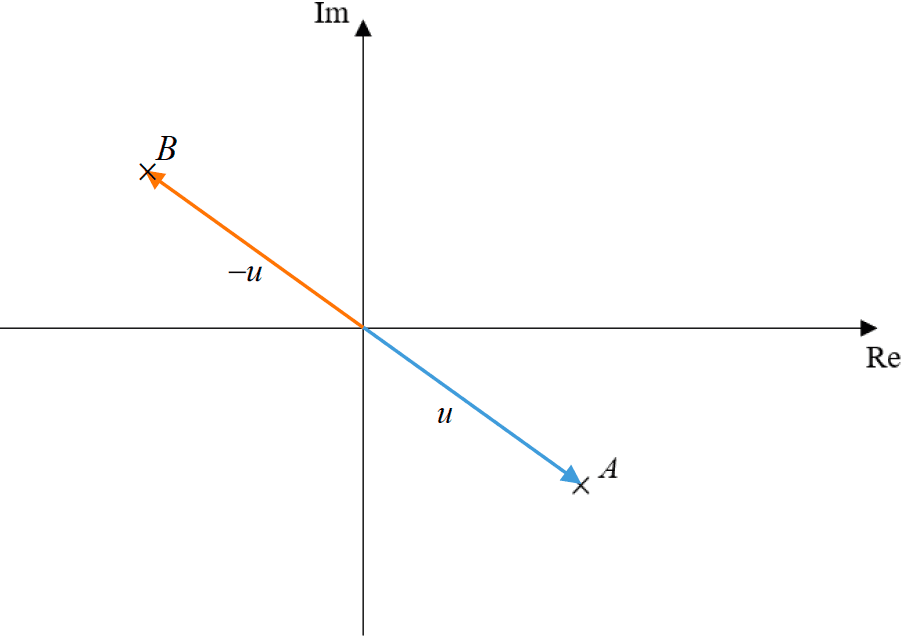
(b) The point \(A\) on the Argand diagram represents the complex number \(u\). (On the given Argand diagram, \(A\) lies in the fourth quadrant, below the real axis.)
(i) On the copy of the Argand diagram in the Printed Answer booklet, plot the point \(B\) to represent the complex number \(-u\).
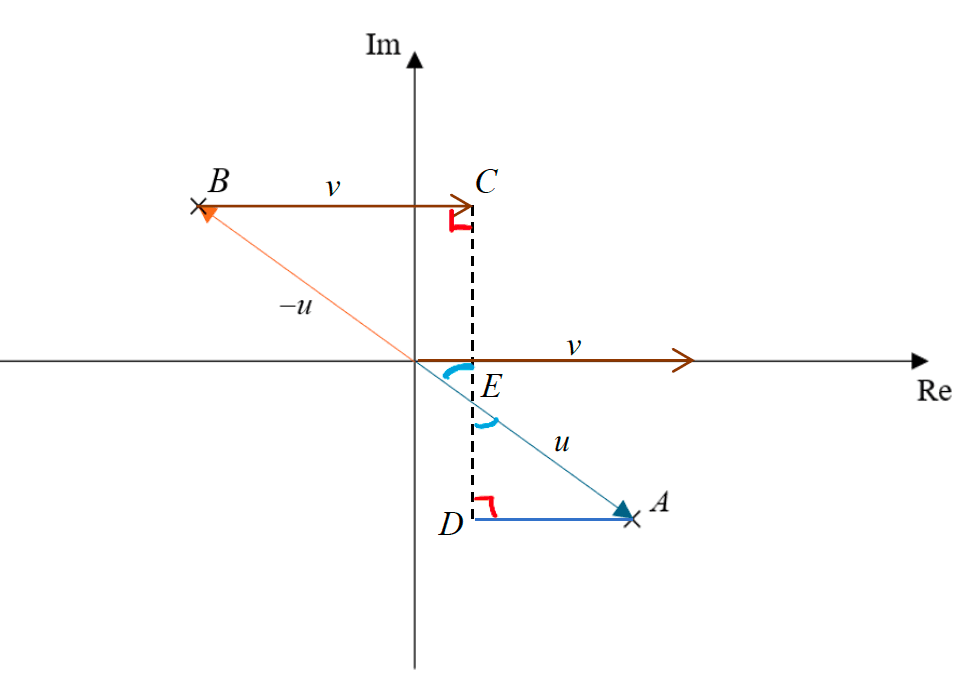
The points \(C\) and \(D\) represent the complex numbers \(v - u\) and \((v - u)^*\) respectively, where \(v\) is an unknown complex number. It is also given that \(\angle CDA = 90^\circ\).
(ii) By using the Argand diagram or otherwise, state the value of \(\mathrm{Im}(v)\) and justify your answer.
Show full worked solution▾
(a) Solve the simultaneous equations
Eliminate \(w\), then write \(z=x+y\mathrm{i}\) and compare real and imaginary parts; the modulus forces a surd equation in \(y\).
\[ \begin{aligned} |z| + 5w &= 0 \quad (1)\\ \mathrm{i}z - 4w &= -4 + 7\mathrm{i} \quad (2) \end{aligned} \]From (1): \(w = -\dfrac{1}{5}|z|\) (3). Substitute (3) into (2):
\[ \mathrm{i}z + \tfrac{4}{5}|z| = -4 + 7\mathrm{i} \]Let \(z = x + y\mathrm{i}\):
\[ \mathrm{i}(x+y\mathrm{i}) + \tfrac{4}{5}\sqrt{x^2+y^2} = -4 + 7\mathrm{i} \] \[ \left(-y + \tfrac{4}{5}\sqrt{x^2+y^2}\right) + x\mathrm{i} = -4 + 7\mathrm{i} \]Comparing imaginary parts: \(x = 7\). Comparing real parts:
\[ -y + \tfrac{4}{5}\sqrt{49+y^2} = -4 \] \[ \tfrac{4}{5}\sqrt{49+y^2} = y - 4 \implies 5(y-4) = 4\sqrt{49+y^2} \]Squaring (which requires \(y \geq 4\)):
\[ 25(y-4)^2 = 16(49+y^2) \] \[ 25(16 - 8y + y^2) = 16(49 + y^2) \] \[ 25y^2 - 200y + 400 = 784 + 16y^2 \] \[ 9y^2 - 200y - 384 = 0 \implies (y-24)(9y+16) = 0 \] \[ y = 24 \quad\text{or}\quad y = -\tfrac{16}{9} \]Since \(y \geq 4\) is required, reject \(y = -\dfrac{16}{9}\); hence \(y = 24\).
\[ \therefore\; z = 7 + 24\mathrm{i} \]Substituting into (3):
\[ w = -\tfrac{1}{5}\sqrt{7^2+24^2} = -\tfrac{1}{5}\sqrt{625} = -5 \](b)(i) Plot \(B\) representing \(-u\)
\(-u\) is the point \(A\) reflected through the origin, so \(B\) is diametrically opposite \(A\).
(b)(ii) Value of \(\mathrm{Im}(v)\)
Use the fact that \(C\) and \(D\) are conjugates (so \(CD\) is vertical) together with the right angle at \(D\).
As \(C\) and \(D\) represent a complex conjugate pair, line segment \(CD\) is vertical, and \(C\), \(D\) are equidistant from the real axis.
Given \(\angle CDA = 90^\circ\) and \(CD\) is vertical, line segment \(DA\) must be horizontal.
Since \(A\) and \(B\) are equidistant from the real axis, \(DA\) horizontal implies \(BC\) is also horizontal.
Since \(C\) represents \(v - u\), the vector \(\overrightarrow{BC}\) represents \(v\).
Since \(\overrightarrow{BC}\) is horizontal, \(v\) must be real, so \(\mathrm{Im}(v) = 0\).