Secondary 1 vs Primary Maths: What Actually Changes (2026)
By the Math Academy Team — NUS-trained, ex-MOE tutors · Updated July 2026
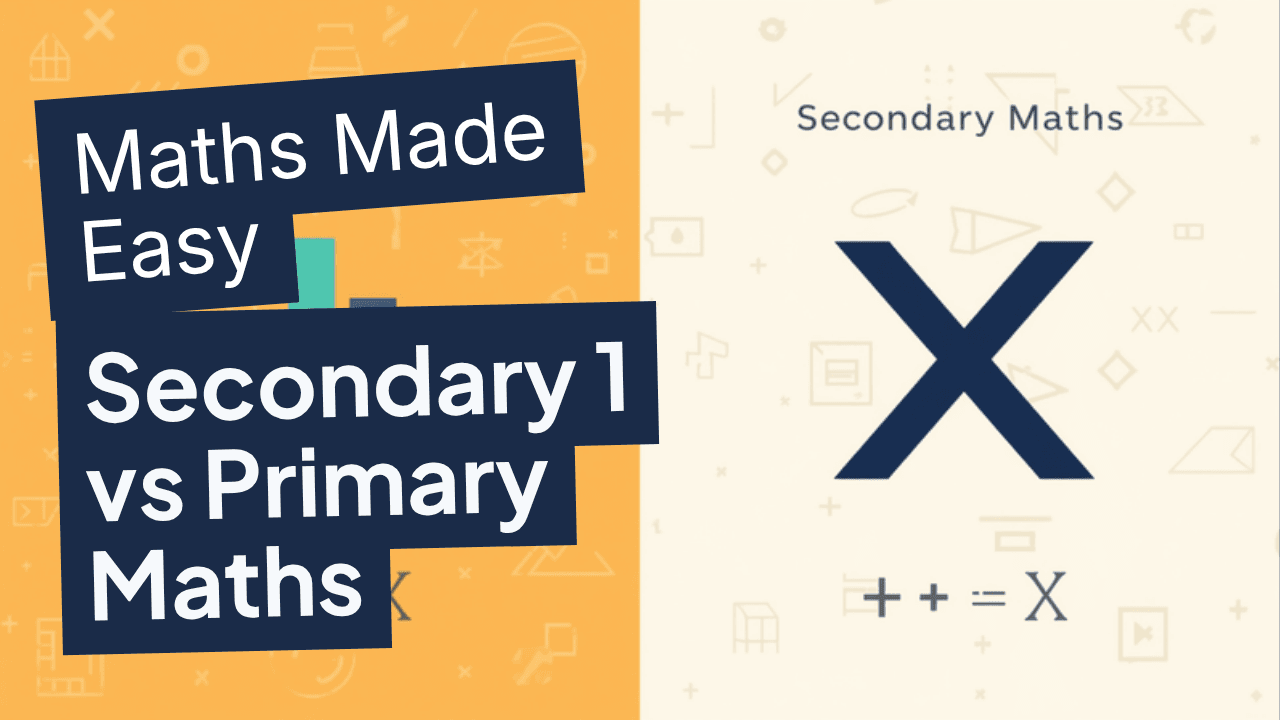
The biggest difference between Secondary 1 and primary maths is not difficulty — it is language and pace. Primary maths leans on model drawing and arithmetic; Secondary 1 maths rewrites the same reasoning in algebra, moves faster across a longer syllabus, and awards marks for clearly-shown method. Understanding what changes from primary to Secondary 1 maths lets parents prepare their child for the jump instead of being surprised by it. This guide compares the two, side by side, with a real example of the same idea before and after.
- Primary maths uses models and numbers; Secondary 1 rewrites the same problems using letters and algebra.
- The pace is quicker and the syllabus longer, so keeping up week to week matters more than at primary level.
- Secondary maths awards method marks — full working is expected, not just the final answer.
- Negative numbers and symbolic algebra are the two genuinely new ideas most pupils meet in Term 1.
From model drawing to algebra
The defining shift is from concrete models to symbolic algebra. At primary level, a “missing number” problem is often solved with a bar model; in Secondary 1, the same problem is written as an equation and solved with algebra. The thinking is the same — what changes is that a letter now stands in for the unknown. Consider the same simple problem, before and after:
“A number tripled, then increased by 4, gives 19. Find the number.”
Primary (model / reasoning): three equal units plus 4 make 19, so three units make 15, and one unit is 5.
Secondary 1 (algebra): let the number be , then
Same answer, same logic — but the secondary method generalises to far harder problems where a model would be impractical.
This is why algebra is the centrepiece of the transition. If your child is meeting it for the first time, our guide to Secondary 1 algebra basics walks through substitution, expanding and factorising with worked examples.
The pace and workload step up
Secondary 1 covers more topics, more quickly, than primary maths. A longer syllabus is taught across the year, lessons move at a faster clip, and pupils are expected to take notes and revise more independently. A child who fell a little behind at primary level could often catch up; in Secondary 1, small gaps compound faster because each topic builds on the last. This is the practical reason that steady week-to-week study matters more now — a point we cover in our guide on how to study Secondary 1 maths.
Method marks and full working
Secondary maths grades how you got there, not just the answer. Where primary papers often reward the correct number, Secondary 1 awards method marks for clearly-shown steps — so a small slip with good working can still earn most marks, and a right answer with none can lose them. Many capable pupils who “just knew” answers at primary level have to relearn how to lay out each line of working. Built early, this habit pays off all the way to the A-levels.
New ideas: negative numbers and symbols
Two genuinely new ideas catch most pupils in the first term. The first is negative numbers — adding, subtracting, multiplying and dividing across zero — where the rules are simple but easy to apply inconsistently under pressure. The second is treating letters as numbers: substituting values, simplifying expressions and solving equations. Neither is beyond a typical student, but both feel unfamiliar at first and need varied practice before they become automatic. You can build that practice on our free Secondary 1 Maths practice questions, organised by topic with full worked solutions.
How to prepare for the jump
The best preparation is to start the new habits before they are forced by a test. Over the holidays or in the first weeks, a child can get ahead of the transition by:
- Previewing basic algebra — getting comfortable with letters standing for numbers.
- Drilling negative-number arithmetic until the sign rules are automatic.
- Practising full written working on every question, even easy ones.
- Building a short, regular study routine rather than relying on cramming.
For a fuller view of what to expect, see our guide on the PSLE to Secondary 1 maths transition. If your child would benefit from structured help making the jump, our Sec 1 Maths tuition is built around exactly these transition topics.
Frequently asked questions
Is Secondary 1 maths much harder than primary maths?
It is more abstract and faster-paced rather than fundamentally harder. The main change is from model drawing and arithmetic to symbolic algebra, plus the expectation to show full working for method marks. Most pupils adjust within the first term.
What is the biggest difference between primary and Secondary 1 maths?
The shift from concrete models to algebra. Problems that were solved with bar models at primary level are rewritten as equations using letters in Secondary 1. The underlying reasoning is the same, but the symbolic method generalises to much harder problems.
What new topics appear in Secondary 1 maths?
The two genuinely new ideas are negative numbers (operations across zero) and symbolic algebra (substitution, simplifying expressions and solving linear equations). The syllabus also covers ratio, percentage, rate and speed, angles, polygons, mensuration and statistics, taught at a quicker pace than primary level.
Why is full working suddenly important in Secondary 1?
Secondary maths awards method marks for clearly-shown steps. A correct answer with no working can lose marks, while a clear method with a minor slip can still earn most of them. Building the habit of writing every step protects marks and makes mistakes easier to spot.
How can my child prepare for the jump to Secondary 1 maths?
Preview basic algebra, drill negative-number arithmetic until the sign rules are automatic, practise full written working, and build a short regular study routine. Starting these habits before the first test makes the transition much smoother.
Can a child who struggled at primary maths still do well in Secondary 1?
Yes. The transition resets many habits, and a fresh, consistent approach — regular practice, full working, and early help with foundation topics like algebra — often lets pupils improve significantly. Addressing gaps early, while the syllabus is still building, is key.
The jump from primary to Secondary 1 maths is about adapting to a new language and pace, not surviving a sudden leap in difficulty. With the right habits, nearly every child makes it smoothly. If yours would benefit from structured, transition-focused support, our Sec 1 Maths tuition is led by NUS-trained, ex-MOE tutors who guide students through exactly this change.