
Sec 1 Maths: Triangles, Quadrilaterals & Polygons — practice questions & worked solutions
Polygon questions from Singapore Secondary 1 examination papers, each with a full worked solution that states every reason — the way marks are actually awarded.
About this topic & key polygon rules
Polygons are a core part of Secondary 1 Mathematics. Almost every question below is solved with a small set of facts: the angle sum of a polygon is , the exterior angles of any polygon sum to , and each interior and exterior angle at a vertex add up to . From these you can find a missing angle, count the number of sides, or test whether a given angle could belong to a regular polygon. The questions also draw on the angle sum of a triangle, the properties of special quadrilaterals (square, rhombus, parallelogram, trapezium) and the symmetry of a regular polygon.
The marks in these questions are usually awarded for stating the correct rule, not only for the final number. Each worked solution below names the property used at every step. For a structured programme that teaches this reasoning from the ground up, see our Secondary 1 Maths tuition.
Key polygon rules
- Angle sum of a triangle is 180°; angle sum of a quadrilateral is 360°.
- Angle sum of an -sided polygon is .
- Sum of the exterior angles of any polygon is 360°.
- Interior angle + exterior angle at each vertex add up to 180°.
- Regular polygon: each interior angle is and each exterior angle is .
- Regular-polygon test: an interior angle is valid only if its exterior angle divides 360° exactly.
- Special quadrilaterals: opposite angles of a rhombus are equal, opposite sides of a parallelogram are parallel, and a square has four right angles.
- Isosceles triangle: two equal sides give two equal base angles.
Questions & worked solutions
Interior : exterior ratio of a regular polygon
In a regular -sided polygon, the ratio of the interior angle to the exterior angle is . Find the number of sides of the polygon.
Show worked solution▾
Interior exterior , split in the ratio ( parts):
Number of sides:
Polygon on a Cartesian plane
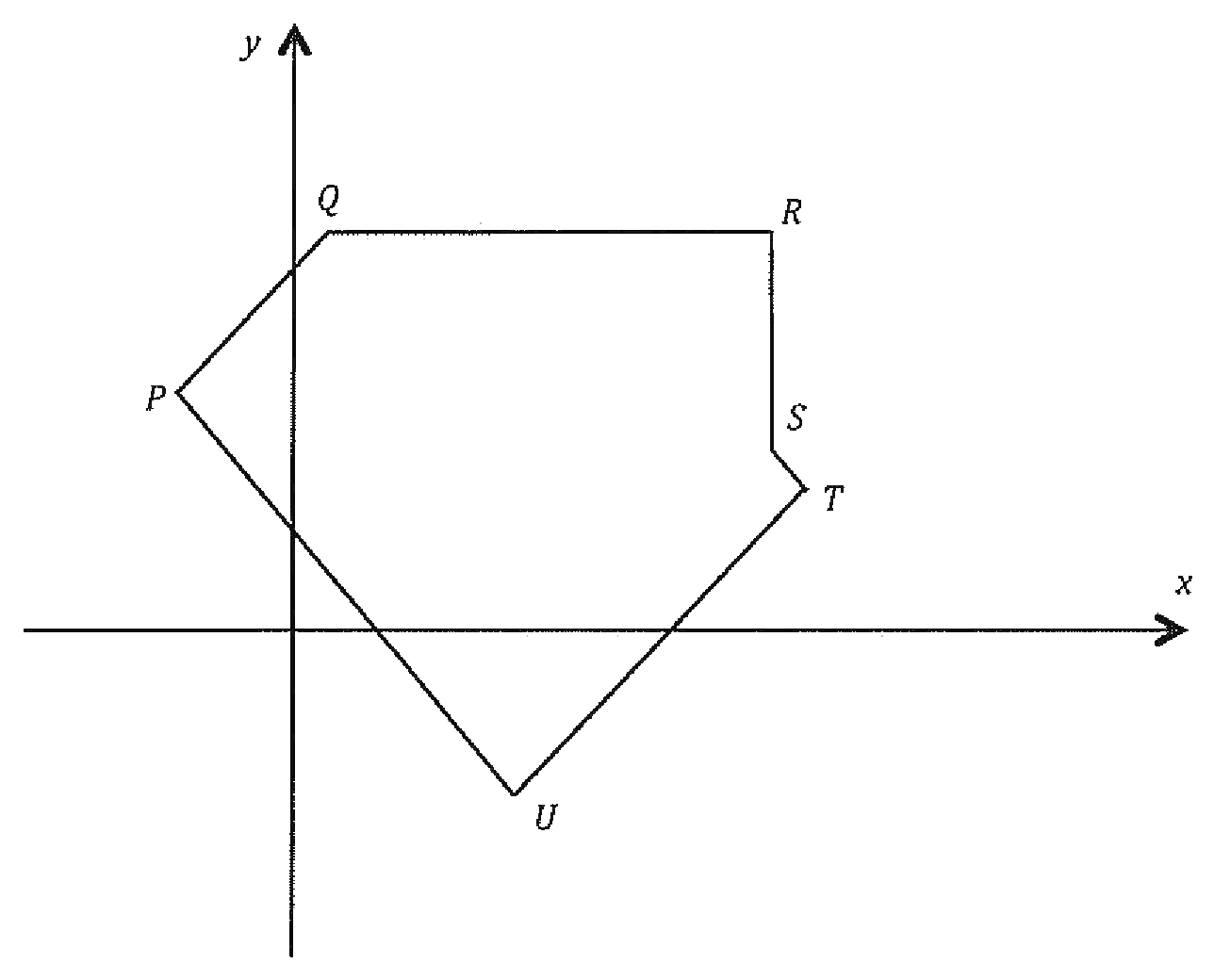
In the figure below, is a polygon on a Cartesian plane.
Find the sum of all the interior angles of the polygon .
Name the line segment of the polygon that has the equation:
.
Show worked solution▾
(i) Sum of interior angles of an -sided polygon . The polygon has sides:
(ii)(a) (the horizontal segment at height ).
(ii)(b) (the segment with gradient and -intercept ).
Find n from given interior angles
A polygon has sides. Three of its interior angles are , and . The remaining angles have an average size of each. Find the value of .
Show worked solution▾
Sum of interior angles :
Mixed interior & exterior angles
Three of the exterior angles of an -sided polygon are each, two of its interior angles are and , and the remaining interior angles are each. Find the value of .
Show worked solution▾
Convert the given interior angles to exterior angles:
Let be the number of interior angles. The exterior angles of a polygon sum to :
Total number of sides:
Triangle equation & heptagon
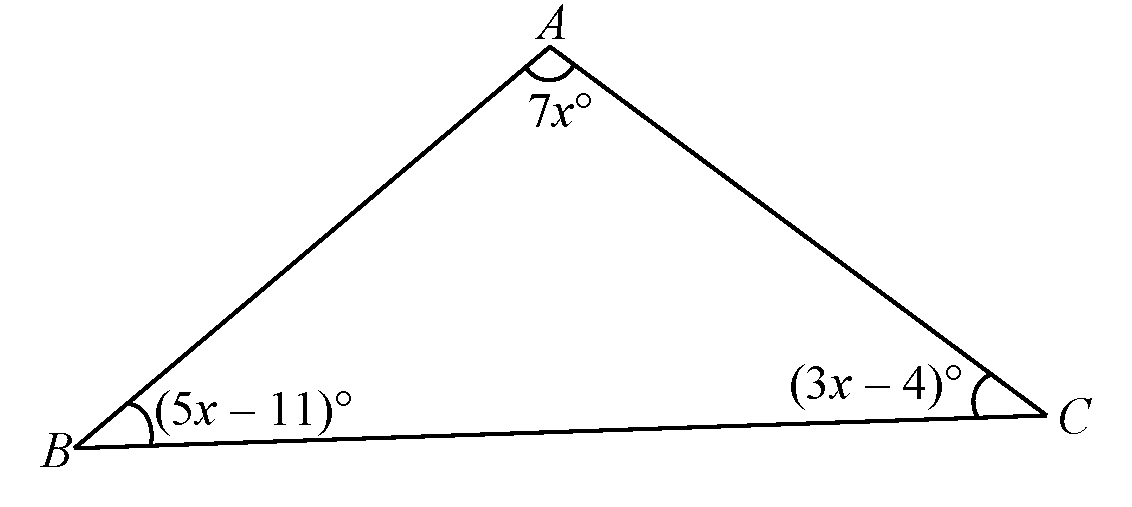
The figure below shows . By forming an equation in , find the value of .
Find the sum of the interior angles of a heptagon (a polygon with seven sides).
4 of the exterior angles of this heptagon are , while the others are , and . Find the largest interior angle of this heptagon.
Show worked solution▾
(a)
Angle sum of a triangle:
(b)(i)
Sum of interior angles :
(b)(ii)
Sum of exterior angles :
The smallest exterior angle gives the largest interior angle. Exterior angles: , , , . Smallest exterior :
Why triangle BCD is isosceles
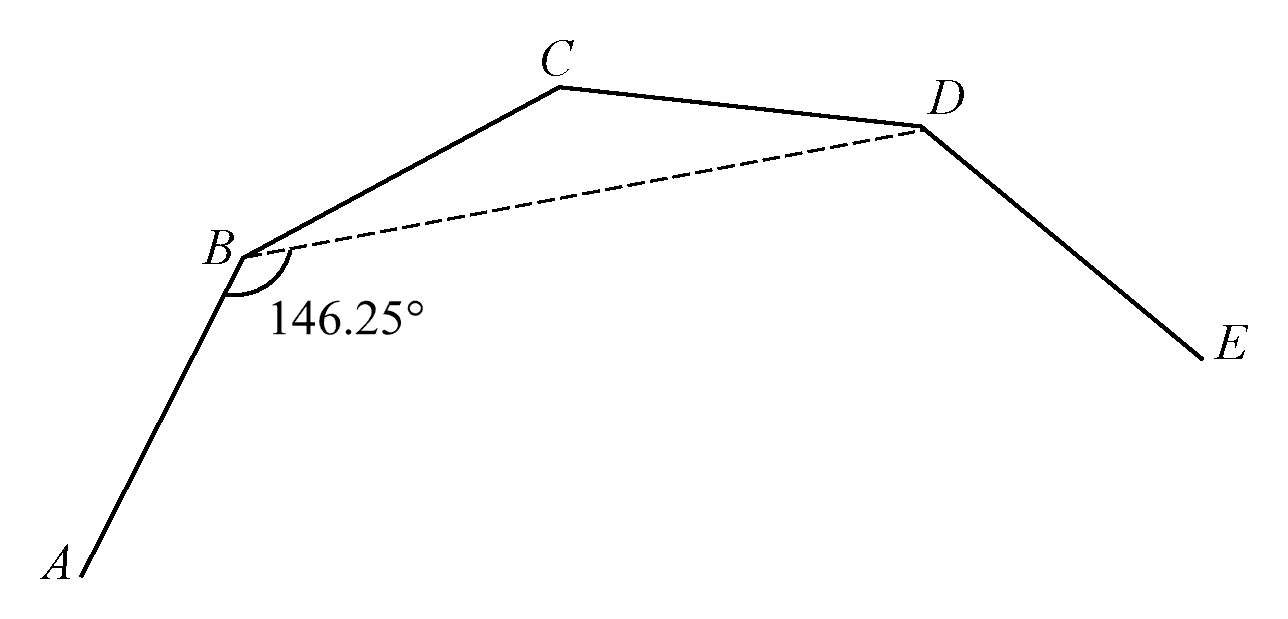
In the diagram below (not drawn to scale), is part of a regular -sided polygon where . Explain why triangle is an isosceles triangle.
Show worked solution▾
In a regular polygon all sides are equal, so . A triangle with two equal sides is isosceles; hence triangle is isosceles.
Find n of the regular polygon
Using the regular -sided polygon from Q12, where and triangle is isosceles with , find the value of .
Show worked solution▾
Let the interior angle of the regular polygon be . Triangle is isosceles with , so . With interior angle :
Since , and , let the interior angle be :
For a regular -sided polygon the interior angle is :
Test a claim about a nonagon
Tom claims that 3 of the exterior angles of an irregular nonagon (9-sided polygon) are , and , and the remaining exterior angles are each. Is his claim accurate? Justify your answer.
Show worked solution▾
The sum of exterior angles of any polygon is . There are 6 remaining exterior angles of each:
This gives , a negative angle. Since an exterior angle of a polygon cannot be negative, his claim is not accurate.
Regular polygon, produced side & rhombus
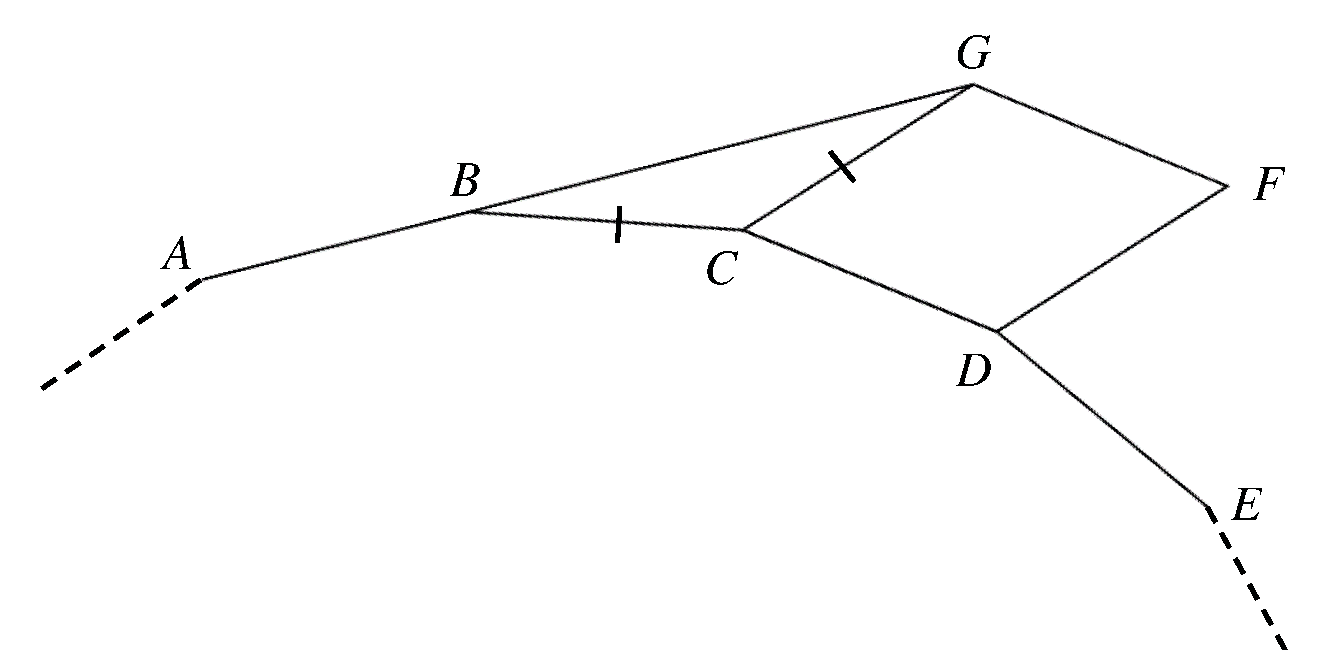
The figure below (not drawn to scale) shows part of a regular -sided polygon where points , , , and are five vertices of the polygon. is produced to such that and is a rhombus. Given that the interior angle of a regular -sided polygon is 14 times as large as its exterior angle, find
angle
angle .
Show worked solution▾
Interior angle is 14 times the exterior angle, and they sum to :
Interior angle .
(i) Angle
is the interior angle, and is its supplement on the straight line :
(ii) Angle
Triangle is isosceles with , so the base angles are equal:
At vertex the interior angle of the polygon . Angle (angle of the rhombus at ):
In rhombus , opposite angles are equal, so:
Parallelogram, regular polygon & ratio
The diagram shows a quadrilateral . is parallel to and is parallel to . is a straight line and angle .
Calculate the angle , giving a reason for each step.
and are two sides of a regular polygon. By showing your calculations clearly, find the number of sides of this regular polygon.
The interior angles of another polygon are in the ratio . Find the difference between the largest and smallest interior angles of the polygon.
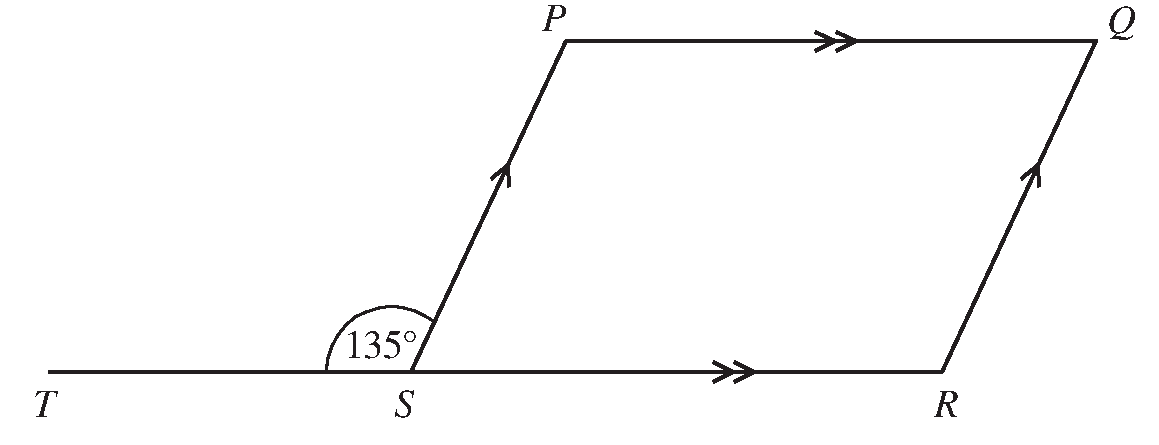
Show worked solution▾
(a)(i) Angle
(Equivalently, by alternate angles.)
(a)(ii) Number of sides
Interior angle of the regular polygon , so exterior angle :
(b)
The five interior angles (5-sided polygon) sum to :
Triangle construction & equidistant point
Construct a triangle such that cm and angle . The line has been provided.
Construct the perpendicular bisector of line .
Construct the angle bisector of angle .
Label the point which is equidistant from the lines and and equidistant from the points and .
Show worked solution▾
(a) At , use a protractor to draw a ray making with ; mark on this ray with cm, then join .
(b) With compass radius more than half of , draw arcs centred at and at above and below ; the line through the two arc intersections is the perpendicular bisector of .
(c) With centre , draw an arc cutting and ; from those two points draw equal arcs that intersect; the line from through this intersection bisects angle .
(d) The point equidistant from lines and lies on the angle bisector of ; the point equidistant from and lies on the perpendicular bisector of . Label their intersection as .
Number of sides & pentagon/hexagon angle
A polygon has eight interior angles each of size and the remaining exterior angles are each of size . Find the number of sides.
The figure below shows a regular pentagon and a regular hexagon which shares a common side .
Find .
Explain why cannot be an interior angle of a regular polygon.
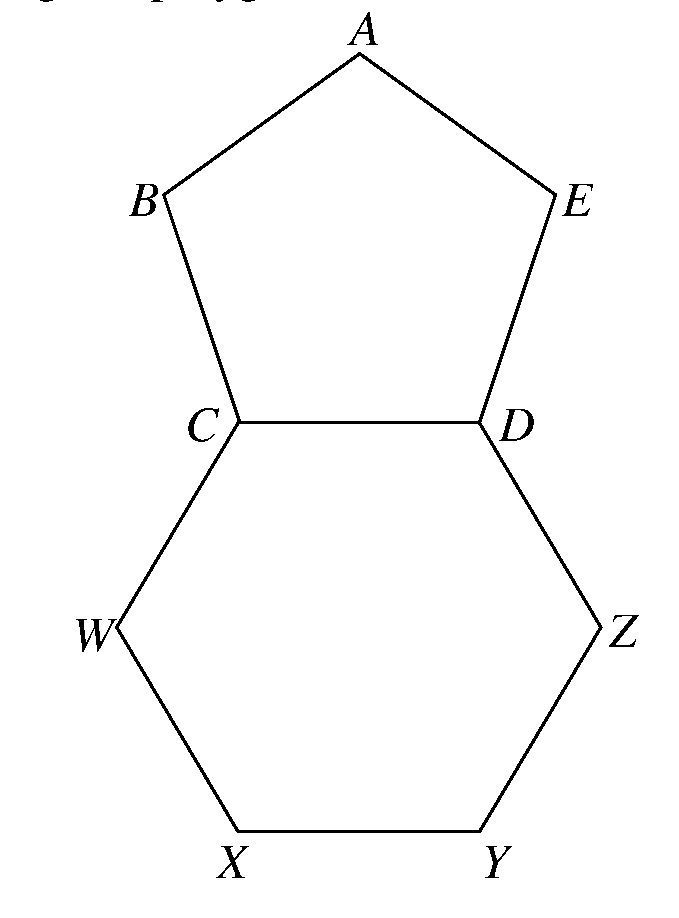
Show worked solution▾
(a)
Exterior angle of each interior angle . Sum of all exterior angles . Let there be exterior angles of :
Number of sides .
(b)(i)
Interior angle of regular pentagon , so . Interior angle of regular hexagon , so . Angles round the point :
(b)(ii)
For a regular polygon the exterior angle must divide exactly:
Since this is not a whole number, cannot be an interior angle of a regular polygon.
Construct a triangle & measure EF
Construct such that cm, cm and .
Measure and write down the length of .
Show worked solution▾
Construct cm. At draw . From mark an arc of radius cm to cut the ray at ; join .
Measuring the constructed side:
Regular n-gon & mixed exterior angles
The interior angle of a regular -gon is . Find the value of .
A polygon has four interior angles each of size , six exterior angles each of size and the remaining exterior angles are each of size . Find the number of sides of the polygon.
Show worked solution▾
(a)
Each exterior angle :
(b)
The four interior angles of give exterior angles of each. Let be the number of exterior angles. Sum of exterior angles :
Number of sides .
Construct a triangle from three sides
Using the line provided, construct such that cm, cm and cm.
Measure and write down the size of .
Show worked solution▾
Construct with cm: with centre draw an arc of radius cm, and with centre draw an arc of radius cm; their intersection is .
Measuring the constructed angle:
Secondary 1 Maths programme — every method behind these questions, taught step by step.