
Sec 1 Maths: Linear Equations & Inequalities — practice questions & worked solutions
Linear equations and inequalities questions from Singapore Secondary 1 examination papers, each with a full worked solution that shows every algebraic step — the way method marks are actually awarded.
About this topic & key methods
Linear equations are the algebraic backbone of Secondary 1 Mathematics. The questions below cover the full range tested in Singapore schools: solving linear equations with brackets and fractions, clearing algebraic denominators, forming equations from word problems, solving pairs of simultaneous equations, working with linear graphs (gradient, intercepts and points of intersection), and solving and representing linear inequalities on a number line.
Most marks in these questions are awarded for correct, complete working — each line of algebra a marker can credit — not only for the final answer. Every worked solution below sets out one step per line so you can see exactly where each mark is earned. For a structured programme that builds this algebraic fluency from the ground up, see our Secondary 1 Maths tuition.
Key methods
- Solving linear equations: collect the variable on one side, constants on the other, then divide through.
- Equations with brackets: expand first, then solve — watch signs when a minus sits outside the bracket.
- Equations with fractions: multiply every term by the LCM of the denominators to clear fractions, then solve.
- Forming equations from word problems: define the unknown, translate each sentence into algebra, then solve and interpret.
- Simultaneous equations: solve a pair by elimination or substitution.
- Linear graphs: read off values, find the gradient and intercepts, and interpret the point of intersection.
- Solving inequalities: solve like an equation, but reverse the inequality sign when multiplying or dividing by a negative.
- Representing inequalities: show the solution on a number line (filled dot for or , open dot for or ).
Questions & worked solutions
Solve a linear equation with brackets
Solve .
Show worked solution▾
Solve an equation with a fraction
Solve
.
Show worked solution▾
Equation with two algebraic fractions
Show worked solution▾
Cross-multiplying a fractional equation
Show worked solution▾
Write down an equation from a statement
Half the sum of and is equal to the result of subtracted from .
Write down an algebraic equation to represent this statement.
Show worked solution▾
“Half the sum of and ” is ; “ subtracted from ” is :
Hence solve the equation
Hence, solve for .
Show worked solution▾
Substitute into a conversion formula
The conversion formula between degree Fahrenheit (F) and degree Celsius (C) is given by Stuart’s body temperature is C. Find his body temperature in F.
Show worked solution▾
Form and solve an equation
Maryann spent a total of 18 on 3 notebooks, 4 pens and 2 rulers. Each notebook costs 4 times the cost of a pen, and 3 more than a ruler. If the cost of each notebook was
form an equation in , and solve for .
Show worked solution▾
A pen costs and a ruler costs :
Use the value of x to answer
Find how much Maryann spent on the 2 rulers.
Show worked solution▾
Cost of one ruler .
Form & solve simultaneous equations
Good News Cafe sells two drinks, Refreshing and Cheerful, costing cents and 1.05 each to prepare.
On Monday the cafe sold cups of Refreshing and cups of Cheerful with total production cost 62.30. Form an equation in and and show it reduces to .
A total of cups was sold that Monday. Form another equation and hence find the number of cups of each drink sold.
Show worked solution▾
(i)
(ii) Second equation:
Multiply by :
Subtract from :
Then . So cups of Refreshing and cups of Cheerful.
Simultaneous equations from a fraction
A fraction is such that when is added to the numerator, it becomes . One fifth of the sum of the numerator and denominator is .
Write down two equations relating and .
Solve the simultaneous equations and find the original fraction.
Show worked solution▾
(i)
(ii) From the first equation:
From the second equation:
Substitute:
The original fraction is .
Taxi fare linear graph & intersection
Taxi Company A charges y for a journey of km by . The table gives with .
Find .
Draw the graph of for .
Explain the significance of the number .
Company B is modelled by .
Explain what means.
By adding a line, solve simultaneously and .
Advise a friend who wants to hire a taxi.
Show worked solution▾
(a)(i) Substitute :
(iii) The number is the fixed starting (flag-down) charge of 4 before any distance is travelled.
(b)(i) The number is the rate of charge: the fare increases by 0.30 for every additional km travelled.
(ii) Solving the two equations:
The lines intersect at .
(iii) For journeys shorter than km, Company A is cheaper; for journeys longer than km, Company B is cheaper; at exactly km both cost 8.40.
Solve an equation with brackets
Solve the equation .
Show worked solution▾
Simultaneous equations by elimination
Solve the following pair of simultaneous equations.
Show worked solution▾
Rearrange the second equation:
Label the equations:
Add and :
Substitute into :
Cost line graph & intersection
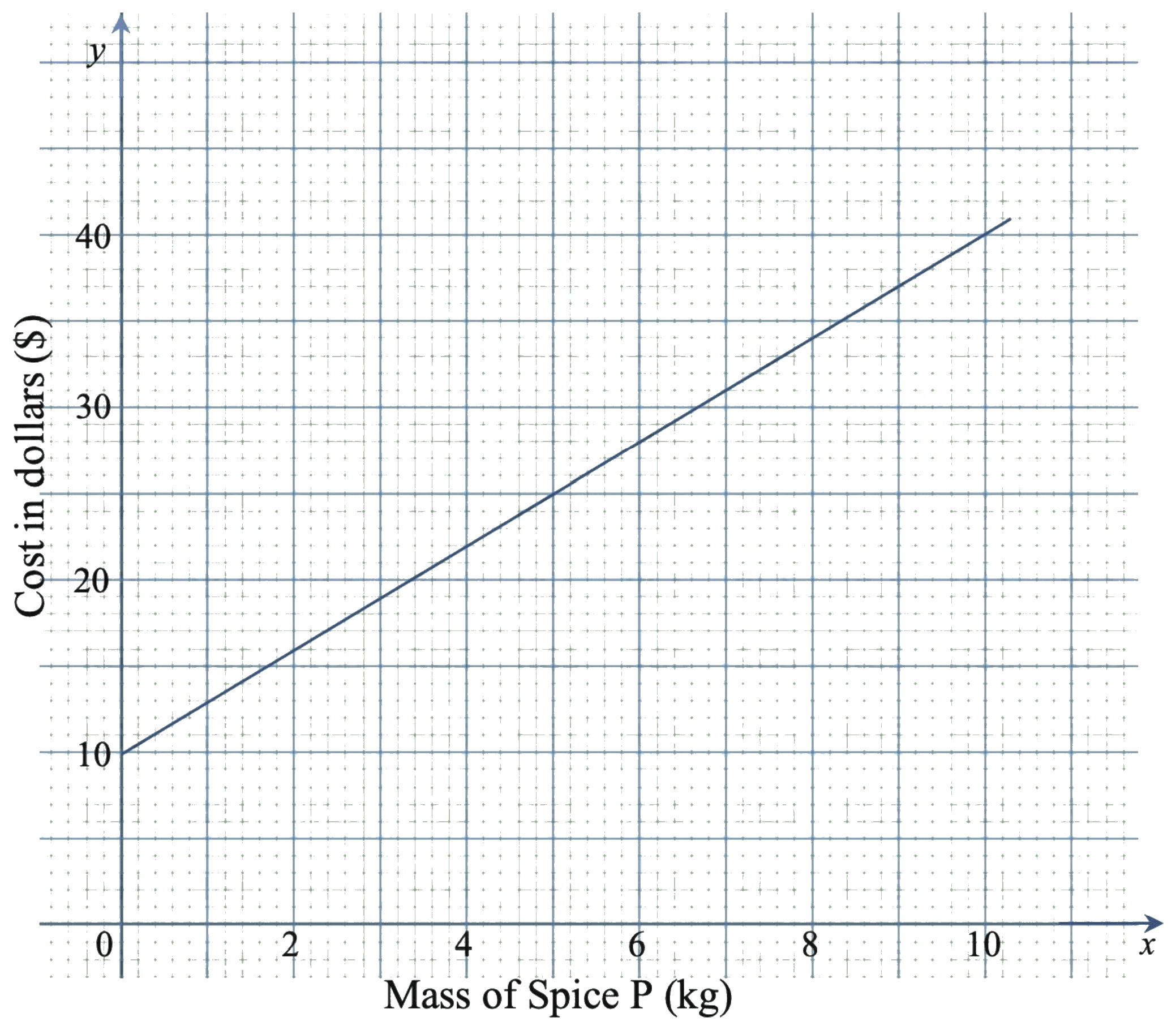
The manufacturing cost () of Spice P by Company S is modelled by , where is the mass in kilograms.
Using the graph
find the cost of kg
find the mass when the cost is 34
determine
explain what represents.
Company T uses .
Complete the table for .
Plot and label the line.
Write down the solution of and .
Explain the significance of the point of intersection.
Show worked solution▾
(i)(a) Reading the graph at :
The manufacturing cost is 26.50.
(i)(b) Reading the graph at :
(i)(c) The line passes through and :
(i)(d) represents the manufacturing cost per kilogram of Spice P, that is 3 per kg.
(ii)(a) For : when , ; when , . The missing value (where ) is .
(ii)(b) Plot , , and join with a straight line labelled .
(iii)(a) Solving gives , so , . The solution is , .
(iii)(b) The point of intersection is the mass of Spice P ( kg) for which both companies charge the same cost (25).
Equation with fractions; hence solve
Solve the equation .
Hence, or otherwise, solve .
Show worked solution▾
(i) Multiply throughout by :
(ii) The second equation is the first with replaced by , so
Form an equation from a wage table
A senior waiter earns a basic 200 plus 0.16 per customer; a junior waiter earns a basic 150 plus 0.10 per customer. In a week the junior served customers and the senior served 50 more than the junior.
Express in terms of the amount earned by
the senior waiter
the junior waiter.
Given that the senior earned 76 more than the junior, calculate the number of customers served by the senior waiter.
Show worked solution▾
(i)(a) Senior served customers.
(i)(b)
(ii)
Senior served customers.
Electricity bill graph: gradient & intercept
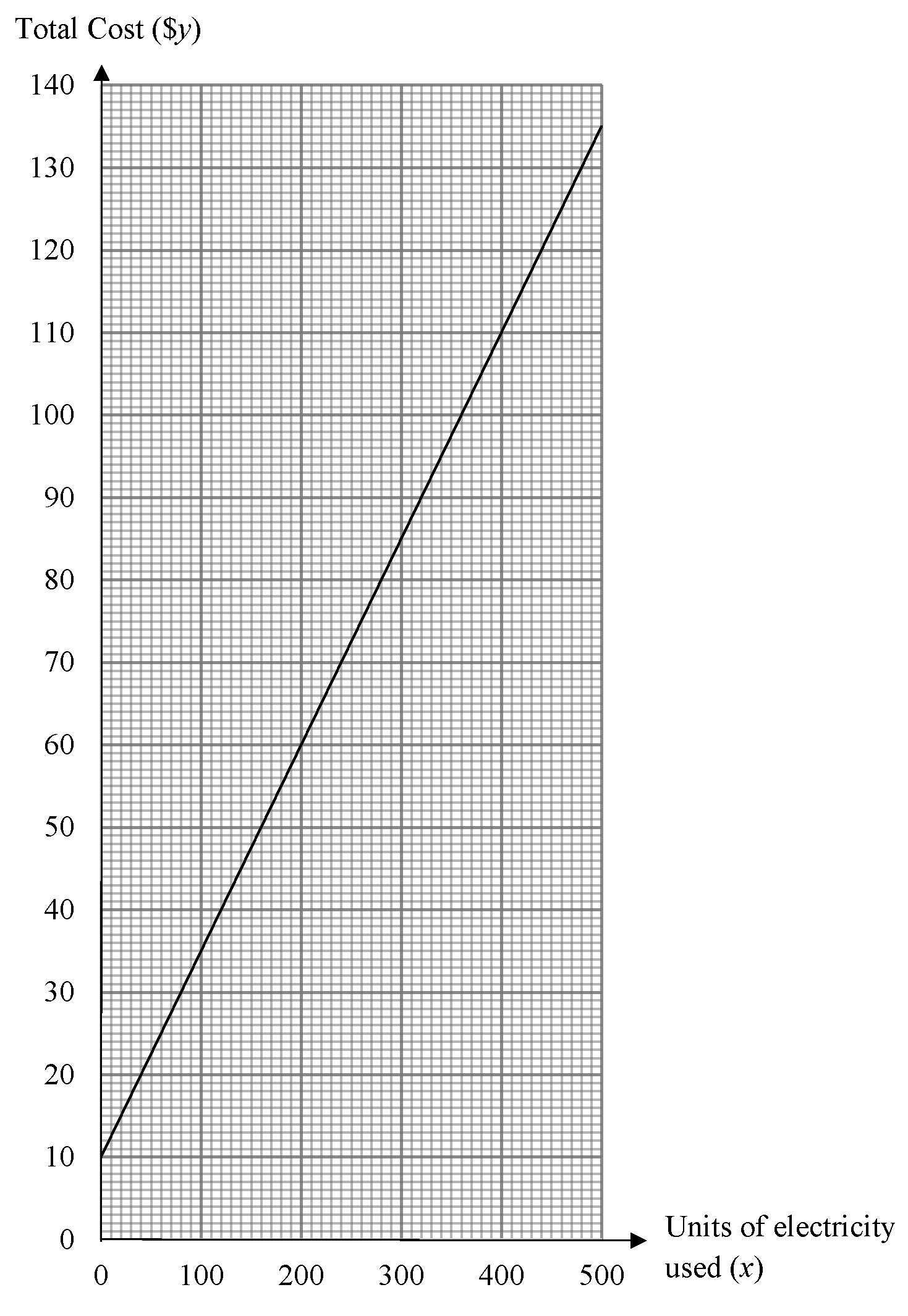
The graph shows the relation between the number of units of electricity used, , and the total cost, , of the bill.
Use the graph to find the number of units used when the bill costs 110.
Given
state the value of and explain its significance
calculate and explain its significance.
Show worked solution▾
(i) Reading from the graph at :
(ii)(a) is the -intercept.
It represents the basic/fixed cost incurred even if no electricity is used.
(ii)(b) Gradient using two points, e.g. and :
It represents the cost of 0.25 for each unit of electricity used.
Plot a line & find triangle area
Plot the graph of for from to .
By drawing the line , state the coordinates of the point of intersection, .
Plot and .
Find the area of triangle .
Show worked solution▾
(i) Table of values for :
Plot these points and join with a straight line.
(ii) Solving :
(iii) Plot and .
(iv) is horizontal of length unit (base). Height is the vertical distance from to line (): .
Clear fractions and solve
Solve the equation .
Show worked solution▾
Multiply throughout by :
Form an equation from a money problem
Bruno has some money to buy textbooks and workbooks. If he buys textbooks at 12 each, he will have 2 left. If he buys workbooks at 16 each, he will have 6 left. Form an equation in terms of and solve it to find the amount of money Bruno has.
Show worked solution▾
Both expressions equal Bruno’s total money:
Amount of money:
How many workbooks can he buy?
Bruno decides to buy 2 textbooks at 12 each. He uses the remaining money to buy workbooks at 16 each. How many workbooks can he buy?
Show worked solution▾
Money remaining after 2 textbooks:
Number of workbooks:
Since only whole workbooks can be bought, he can buy workbooks.
Find the equation of a line from a grid
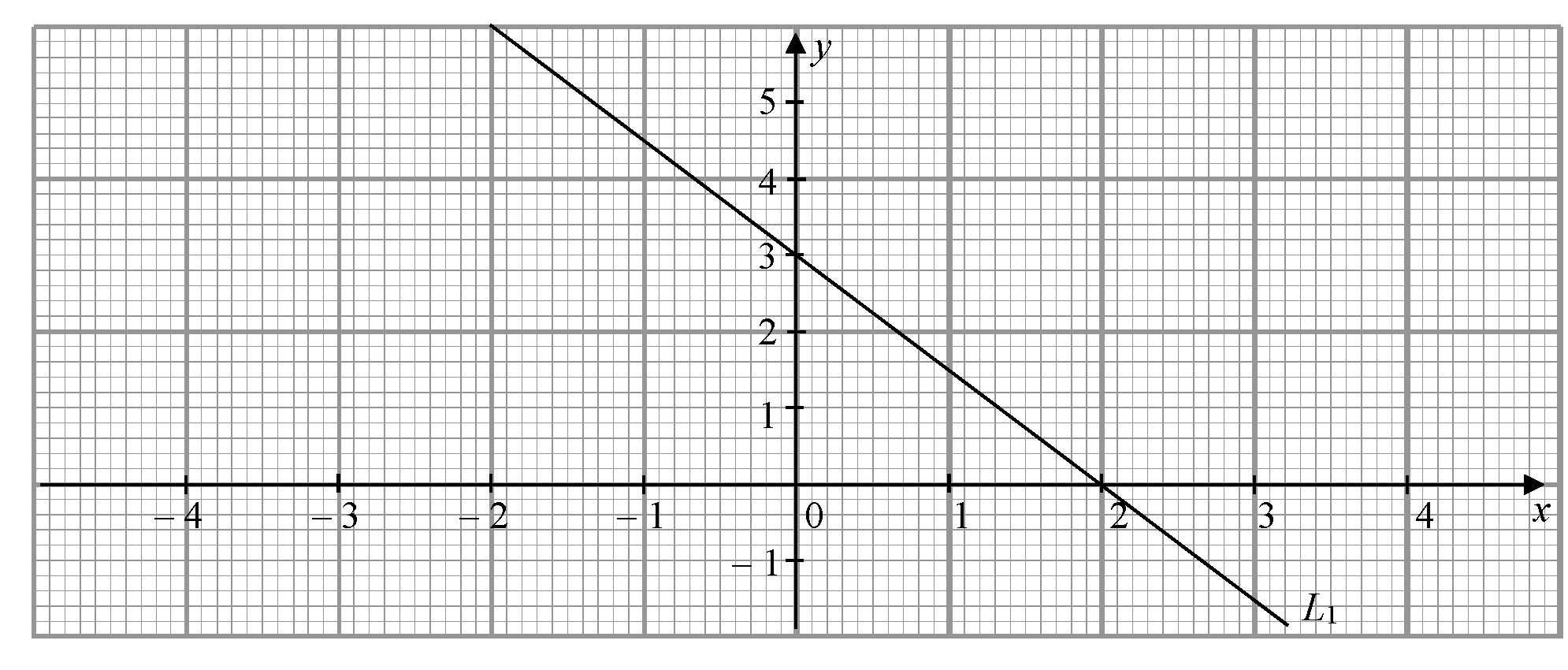
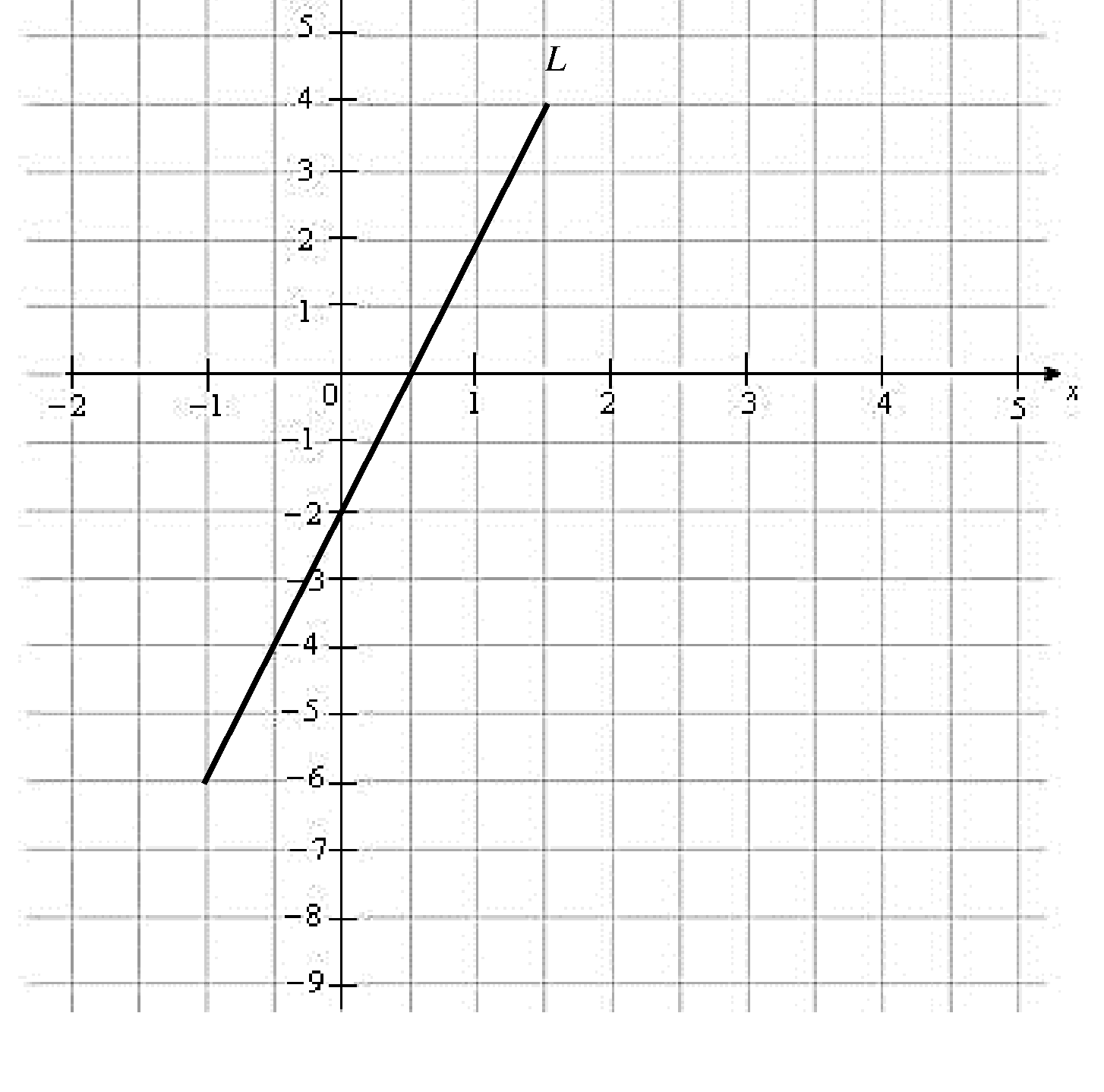
A straight line, , is given in the grid below. Find the equation of the straight line .
Show worked solution▾
From the graph, cuts the -axis at and passes through . Gradient:
Equation:
Does a point lie on the line?
The equation of another straight line, , is . Determine if the point lies on the straight line .
Show worked solution▾
Substitute into :
Since the computed -value equals , the point lies on . (Yes)
Draw a straight line on a grid
On the same grid above, draw the straight line for .
Show worked solution▾
Plot through the endpoints:
Draw the straight line joining and .
Estimate a bounded triangle’s area
Estimate the area of the triangle bounded by , and the -axis.
Show worked solution▾
meets the -axis at and meets the -axis at , giving a base of units. The two lines intersect where , i.e. , , so the height is units.
Fractional equation & a ratio
Solve the equation .
Given that , find the value of .
Show worked solution▾
(a) Multiply throughout by 30:
(b)
Car rental graph & comparison
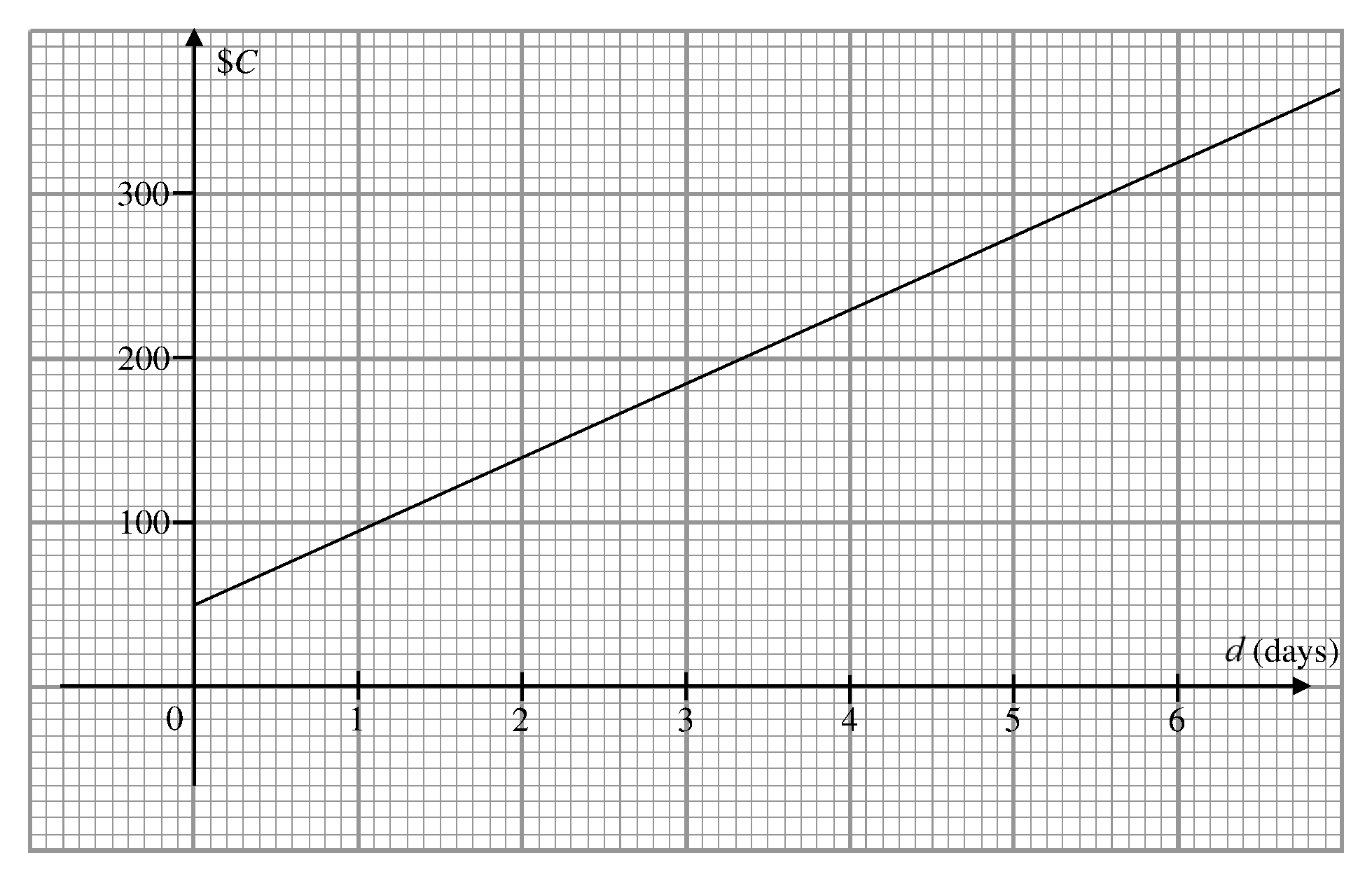
The graph shows the cost, , of renting a car from Company A for days. Find
the cost of renting for 5 days
the maximum number of days possible with 140. There is a fixed charge of and an additional per day.
Find and . Company B charges .
Lewis claims Company A is always cheaper than Company B — explain to what extent you agree.
Show worked solution▾
(i) Reading off the graph at :
(ii) Reading off the graph at gives . The maximum whole number of days is
(iii) The graph is a straight line. The -intercept (fixed charge) is
Gradient (charge per day): using and ,
So and .
(iv) Company A: ; Company B: .
Company A is cheaper only when (i.e. renting for 6 or more days). For 5 days or fewer, Company B is cheaper or equal, so Lewis is wrong; A is not always cheaper.
Find a line equation & bounded shape
A straight line is given in the grid; the point lies on .
Find the equation of . The lines and are given, and and intersect at .
Sketch and , labelling all axial intercepts.
State the shape bounded by , , and the -axis.
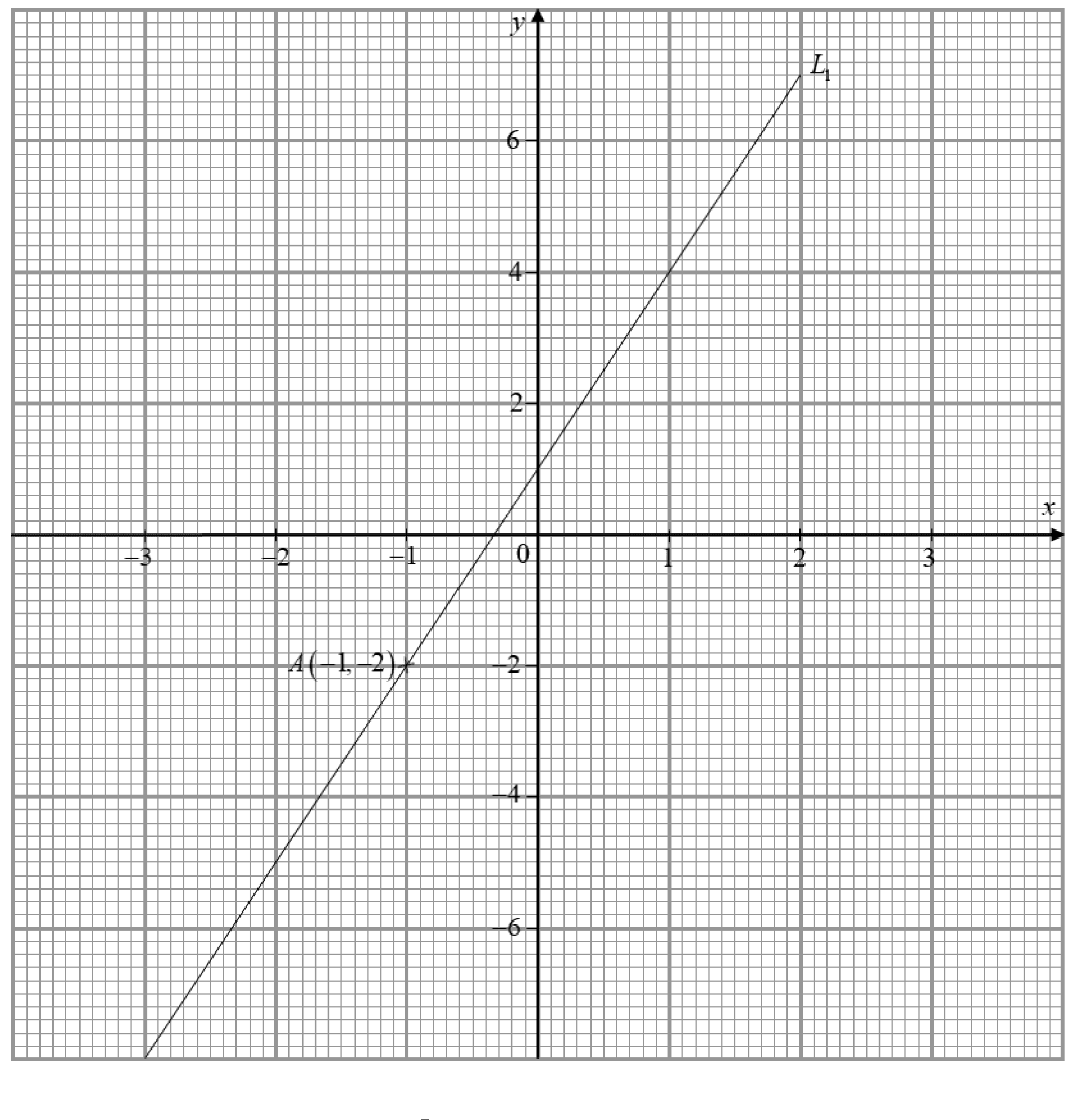
Show worked solution▾
(i) From the graph, has -intercept 1 and passes through . Gradient:
(ii) : has -intercept and -intercept . : is a vertical line. Draw both on the grid (intercepts labelled).
(iii) The region bounded by , , and the -axis is a
Equation with algebraic fractions; no real roots
Solve the equation .
Hence explain why the equation has no real solutions.
Show worked solution▾
(i) Combine the left side over :
Cross-multiply:
(ii) Replacing with gives the second equation, so by part (i):
Since a square can never be negative, there is no real value of . Hence the equation has no real solutions.
Gradient, equation & graph comparison
The graphs show the cost, , of poplin cloth of length m from Shops A and B; delivery fees are 30 and 15 respectively.
Calculate the gradient of Shop A’s line.
Explain the significance of that gradient.
Hence state the equation of Shop A’s line.
Estimate the extra cost of buying 44 m from Shop B instead of Shop A.
Jesse claims Shop B is always cheaper than Shop A — justify whether this is accurate.
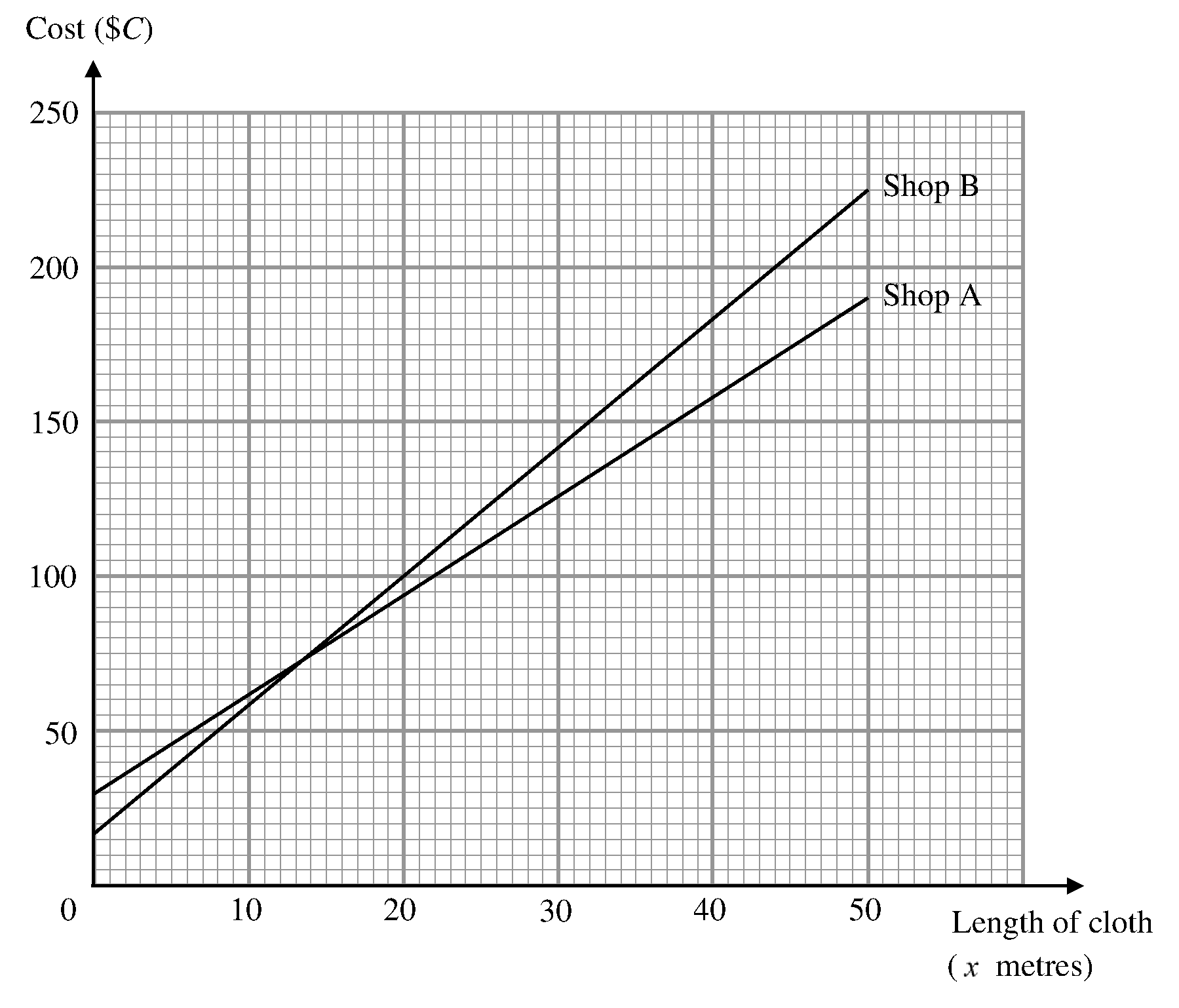
Show worked solution▾
(i) Shop A line passes through and .
(ii) The cost of each metre of poplin cloth from Shop A is 3.20.
(iii) With -intercept (delivery fee) :
(iv) Reading from the graphs at , Shop B costs about 30 more than Shop A. Additional cost .
(v) Not accurate. The two lines intersect at about ; for lengths shorter than the intersection point, Shop B is cheaper, but for longer lengths Shop A is cheaper. Hence Shop B is not always cheaper.
Gradient, intercept & isosceles triangle
Solutions using accurate drawing will not be accepted.
State the gradient and the -intercept of the line .
Show that the point does not lie on the line.
The line meets the -axis at . Given with positive, the area of isosceles triangle () is units. Find and .
Show worked solution▾
(i) Rewrite in the form :
Gradient , -intercept .
(ii) Substitute :
Since , the point does not lie on the line.
(iii) is the -intercept, so and ; lies along the -axis. For isosceles triangle with , is level with the midpoint of , so . Area :
Hence and .
Solve a double inequality & number line
Solve the inequality .
Illustrate the solution on a number line.
State the smallest prime value of that satisfies the inequality.
Show worked solution▾
(a) Left part, :
Right part, :
Combined:
(b) A number line with a filled circle at , an open circle at , and the segment between them shaded.
(c) The primes in are and , so the smallest prime value is .
Form an equation from cost per item
Andy bought pencils for cents. If he buys erasers using the same amount of money, he would have erasers more than pencils.
Express the cost of one pencil in terms of .
Express the cost of one eraser in terms of .
An eraser costs cents less than a pencil.
Write down an equation in terms of .
Solve the equation and find the cost of one pencil.
Show worked solution▾
(a) Cost of one pencil cents.
(b) Number of erasers , so cost of one eraser cents.
(c)(i) An eraser costs cents less than a pencil:
(c)(ii) Multiply through by :
Cost of one pencil cents.
Plot a line, find gradient & equation
The values of and in the table are related by a straight line: with .
Plot the points and join them with a straight line.
The point lies on the graph; find .
Using your graph, find the
gradient and
equation of the line.
Show worked solution▾
(a) Plot , , , and join with a straight line.
(b) Reading from the line at :
(c)(i) Using points and :
(c)(ii) The line cuts the -axis at :
Solve a double inequality
Solve the inequality .
Hence, write down the smallest integer which satisfies the inequality above.
Show worked solution▾
(a) From :
From :
Combining:
(b) Smallest integer: .
Line through three points; find a and b
The straight line passes through , and .
Plot the points and draw the line.
Using your graph, find
the -intercept
the value of when .
Determine the value of and of .
Write down the equation of the horizontal line that cuts at .
Show worked solution▾
(c) Gradient:
Using :
So .
(b)(i) At the -intercept, :
(b)(ii) When :
(d) A horizontal line through :
Two lines on a grid; point of intersection
In the grid provided, line has been drawn.
The equation of is . State .
For , the table gives with ; calculate .
Plot the points and draw .
Using your graph of , find when .
The point lies on both and line ; write down the coordinates of .
Show worked solution▾
(a)
(b) Substituting into :
(c) Plot and draw the line through the points.
(d) Reading from the graph:
(e) The intersection of the two lines:
Solve an inequality with a negative
Solve the inequality .
Hence if is a perfect cube, state the smallest value of .
Show worked solution▾
(a)
(b) Perfect cubes near : , . Since , the smallest perfect cube is
Clear a fraction and solve
Solve .
Show worked solution▾
Multiply both sides by :
Form an equation from a pen problem
Alvin bought Toyo pens at each. If he had bought Miffy pens (cheaper by cents each), he could have bought the same number with two thirds of what he spent on Toyo pens.
Form an equation in and show that .
Given that Alvin received cents change when he paid for the Toyo pens, how much did Alvin pay the cashier?
Show worked solution▾
(a) Cost of Toyo pens . Miffy pen each.
(b) Cost of Toyo pens . With cents change:
Solve an inequality with a negative
Solve the inequality .
Hence, state the largest value of , given that is a perfect square.
Show worked solution▾
(a)
(b) Largest perfect square less than :
Gradient & equation of a line from a graph
Find the gradient of the line .
Hence state the equation of .
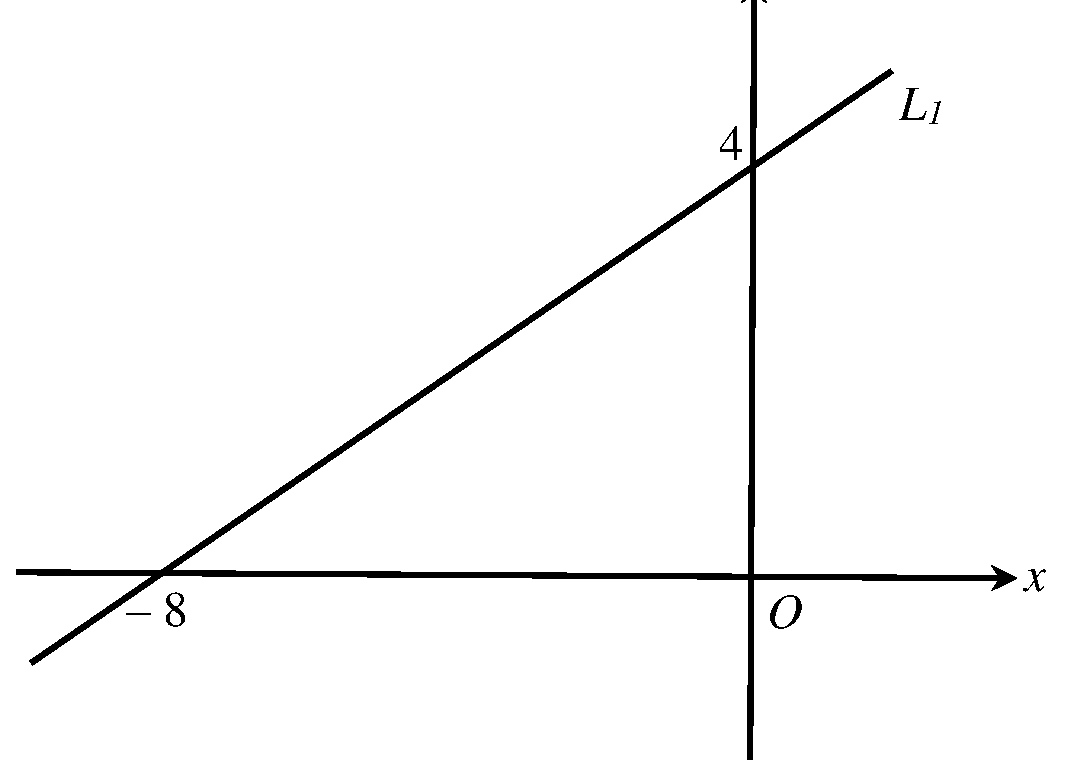
Show worked solution▾
(a) The line passes through and :
(b) -intercept :
Clear fractions and solve
Solve .
Show worked solution▾
Multiply through by :
Draw a line & read off coordinates
Some values of and are given: with , related by .
Find .
Draw the graph of .
Use your graph to find
where the graph cuts the -axis
the value of given lies on the graph.
The line cuts the graph at .
Draw .
Hence state the coordinates of .
Show worked solution▾
(a) Substitute into :
(b) Plot , , , and join with a straight line.
(c)(i) The graph cuts the -axis where :
Coordinates .
(c)(ii) For , set :
(d)(ii) At :
.
Secondary 1 Maths programme — every method behind these questions, taught step by step.