Free practice / Secondary 2 Maths
Sec 2 Maths: Direct & Inverse Proportion, practice questions & worked solutions
Direct and inverse proportion questions from 2021 to 2025 Singapore Secondary 2 End-of-Year examination papers. They run from checking a table for direct proportion to percentage changes when varies with or , and every question has a full step-by-step worked solution.
About this topic & key formulas
In Secondary 2 Mathematics, two quantities are in direct proportion when one is a constant multiple of the other, , and in inverse proportion when their product is constant, . The questions below extend this to powers and roots such as , and , to real contexts like springs, printing costs, workers and water pipes, and to the percentage change in when changes.
Every question follows the same three steps: write the equation with , use the given pair of values to find , then substitute. The worked solutions below show each step on its own line. For a structured programme covering this topic, see our Sec 2 Maths tuition.
Key formulas and methods
- Direct proportion: , so is constant; the graph of against is a straight line through the origin.
- Inverse proportion: , so is constant.
- Powers and roots: “ is directly proportional to the square of ” means ; “to the square root of ” means ; “inversely proportional to ” means .
- Percentage change: replace by the new value (for example or ), write the new as a multiple of the old , then use .
- Workers and pipes: the total work (for example workers days) stays the same, so the time is inversely proportional to the number of workers.
Questions & worked solutions
Showing direct proportion from a table
A printing company charges $ for printing number of pages. The table below shows the cost of printing and the corresponding number of pages printed.
| Pages () | 20 | 50 | 80 | 100 |
|---|---|---|---|---|
| Cost ($) | 2.40 | 6.00 | 9.60 | 12 |
Show that and are directly proportional.
Write down an equation connecting and .
Find the number of pages printed if the cost of printing is $27.
Show worked solution▾
(a)
Divide each cost by its number of pages:
Since is the same constant for every pair, and are directly proportional.
(b)
(c)
pages were printed.
Direct proportion with a change of units (Hooke's Law)
In a physics experiment using Hooke's Law, the force in Newtons (N) required to stretch a spring is directly proportional to its extension , in metres. When the spring is stretched by 5 cm, a force of 2.5 N is needed.
Find the equation connecting and .
Hence, calculate the force needed to stretch the same spring by 8 cm.
Show worked solution▾
(a)
is in metres, so convert first: cm m.
(b)
cm m.
Inverse proportion: the equation, a value, and testing a claim about a change
is inversely proportional to . It is given that when .
Form an equation connecting and .
Find the value of when .
‘When increases by 300%, is half its original value.’ Determine if the above statement is true or false.
Show worked solution▾
(a)
(b)
(c)
An increase of 300% makes the new value .
becomes a quarter of its original value, not half. The statement is false.
Direct proportion to the square root of x
It is given that is directly proportional to the square root of and when . Find
an equation connecting and ,
the value of when ,
the value of when .
Show worked solution▾
(a)
(b)
(c)
Testing a table for inverse proportion to a square root
The following table shows some values of and .
| 6 | 4 | 3 | |
| 3 | 8 | 15 |
Determine whether is inversely proportional to the square root of .
Show worked solution▾
If is inversely proportional to , then has the same value for every pair in the table.
The product is 12 every time, so is inversely proportional to , with .
Direct proportion to the square of x
It is given that is directly proportional to , and when . Find
the value of when .
the value of when the value of is multiplied by 9.
Show worked solution▾
(a)
When :
(b)
Starting from the given pair when , the new value of is .
Check: multiplying by multiplies by , and .
Braking distance proportional to the square of the speed
In an experiment to test the braking system of a new car, engineers found that the braking distance, metres, is directly proportional to the square of the speed, km/h, of the car. In one test, the braking distance is 18 metres when travelling at 60 km/h.
Calculate
the braking distance of the car when it is travelling at a speed of 70 km/h,
the speed of the car when the braking distance is 15 m.
Show worked solution▾
Let . When , :
(a)
(b)
The negative square root is rejected because a speed cannot be negative.
Note: the school’s answer key gives km/h. Since , it rounds to km/h to 3 significant figures.
Direct proportion to the cube of (x + 1)
Given that is directly proportional to the cube of and that when ,
express in terms of ,
find the value of when ,
find the value of when .
Show worked solution▾
(a)
(b)
(c)
Inverse proportion to a square root, and the effect of multiplying t by 4
is inversely proportional to . It is known that when .
Write the equation connecting and .
Find the value of when .
A moving object travels metres in seconds. It is given that is directly proportional to . If the object travels 75 metres when seconds, find the new value of when seconds.
Show worked solution▾
(a)(i)
(a)(ii)
(b)
Let . When , . When :
Direct proportion to t² and percentage increase
is directly proportional to the square of . When , .
Find an equation connecting and .
When , find
the value of ,
the percentage increase in if this value of is increased by 50%.
Show worked solution▾
(a)
(b)(i)
(b)(ii)
Increasing by gives .
Check: is multiplied by , so is multiplied by , an increase of .
Percentage increase when y is proportional to x²
is directly proportional to . If is increased by 300%, find the percentage increase in .
Show worked solution▾
Let the original values be and . Increasing by gives (not ).
Inverse proportion to (x² + 2)
It is given that is inversely proportional to and when .
Find
an equation connecting and ,
the value of when .
Show worked solution▾
(a)
(b)
Inverse proportion: workers and days
12 workers can complete a job in 10 days. How many additional workers will be required to complete the job in 8 days instead?
Show worked solution▾
The number of workers is inversely proportional to the number of days, so workers days is constant.
Workers, houses and days: two proportions at once
It takes 8 men to paint 2 houses in 4 days. Given that all the men work at the same rate, how many days would it take for 6 men to paint 3 houses?
Show worked solution▾
Count the work in man-days. Painting 2 houses takes man-days, so one house takes man-days.
With 6 men sharing the work:
Direct proportion for mass, then workers, days and units of work
76 identical cartons of goods have a combined mass of 1672 kg. Find the mass of 49 identical cartons of goods.
An interior company is installing fixtures in a new condominium development with a total of 112 units. In the first 2 days, 12 workers completed the installation in 16 units.
Assuming all workers work at the same rate, how many days will it take for 9 workers to complete the installation in the remaining units?
Show worked solution▾
(a)
The mass is directly proportional to the number of cartons.
(b)
There are units left. In 2 days, 12 workers did 16 units, which is worker-days for 16 units.
Inverse proportion: water pipes and filling time
The time taken ( minutes) to fill up a swimming pool is inversely proportional to the number of water pipes () used. 6 water pipes take 25 minutes to fill up the swimming pool.
Find
an equation connecting and ,
the extra amount of time needed to fill the swimming pool if two pipes are faulty and not working.
Show worked solution▾
(a)
(b)
With two pipes faulty, .
Inverse proportion: workers, assumptions and percentage change
If 12 workers take 100 days to build a house, how long will it take 16 workers to build the same house.
Name one assumption made in part (i) for you to work out the answer.
is inversely proportional to . Find the percentage change in when is reduced by 50%.
Show worked solution▾
(a)(i)
Let be the number of workers and the number of days. Then is constant.
(a)(ii)
All the workers work at the same rate (for example, every worker builds the same amount each day, and conditions such as the weather do not change).
(b)
. Reducing by gives .
increases by .
Inverse square law for a force, and the percentage change when the distance shrinks
The force, , between two objects is inversely proportional to the square of the distance, , between them. When the force is 10 N, the distance between the two objects is 2 cm. Find
the formula for in terms of .
when cm.
The distance between the two objects is reduced to 20%. Find the percentage increase of the force between the two objects.
Show worked solution▾
(a)(i)
(a)(ii)
(b)
Reduced to 20% means the new distance is .
Recognising the graph of an inverse square relationship
In an experiment, the resistance between two particles is known to be inversely proportional to the square of the distance between them.
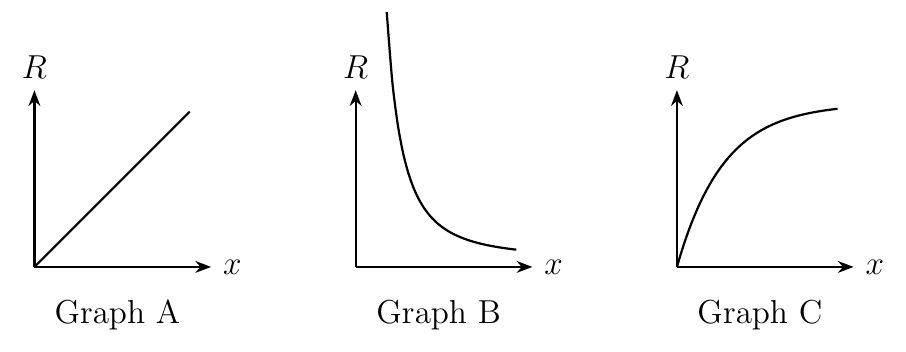
Which of the following graphs could be the representation of the relationship between the resistance and the distance ?
Given that when , find an equation connecting and .
Describe how the value of changes when is halved, assuming all other factors remain the same in the experiment.
Show worked solution▾
(a)
For , is large when is small and falls towards as grows, without ever reaching an axis. Graph A shows direct proportion and Graph C increases, so the answer is
(b)
(c)
becomes 4 times its original value, an increase of 300%.
Inverse square proportion and reading a proportion graph
is inversely proportional to the square of . It is known that for a particular value of . When is increased by , find
the value of ,
the percentage decrease in the value of .
The graph below shows the relationship between two variables and .
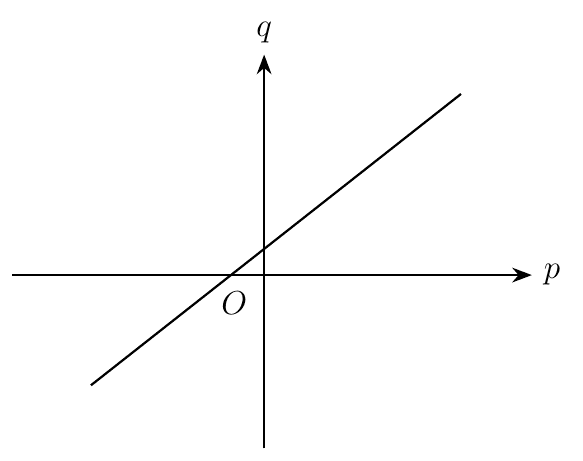
Dan claims that is directly proportional to . Do you agree? Explain your answer with reference to the graph.
Show worked solution▾
(a)
Let the particular value of be , so with when :
Increasing by doubles it, so the new value is :
(b)
(c)
No, I disagree. If were directly proportional to , then and the graph would be a straight line passing through the origin. This line cuts the -axis above , so it does not pass through the origin, and is not directly proportional to .