Free practice / JC2 H2 Maths Prelim
Hypothesis Testing: Multi-part hypothesis test — DHS 2025 H2 Math Prelim Paper 2
Attempt the question on paper, then open the worked solution to check your method.
What this question tests
Question
Mr Dough's factory produces packets of flour for sale in local supermarkets packed in 2 sizes — Regular-sized packets and Large-sized packets. Automated machines weigh and pack the flour. A recent major power outage resulted in all his machines being needed to be recalibrated upon restarting.
Regular-sized packets are supposed to have a mean mass of 1 kg. Mr Dough suspects that his machines now pack Regular-sized packets that are underweight. He took a sample of his Regular-sized packets and measured their masses, \(x\) g (correct to nearest 5 g). The results are recorded as follows:
| Mass, \(x\) (g) | No. of Regular-sized packets |
|---|---|
| 980 | 5 |
| 985 | 6 |
| 990 | 7 |
| 995 | 7 |
| 1000 | 9 |
| 1005 | 6 |
| 1010 | 5 |
| 1015 | 3 |
| 1020 | 2 |
- Determine the unbiased estimate of the population variance of the mass of Regular-sized packets.
- Explain whether Mr Dough should conduct a one-tail or a two-tail test.
- Carry out the test at 5% level of significance and give your conclusion in context. Explain whether it is necessary to assume that the mass of Regular-sized packets of flour follow a normal distribution.
Large-sized packets of flour are known to have a normal distribution with a mean mass of 2 kg. Mr Dough also suspects that his machines are now not packing the Large-sized packets according to the required mass correctly. A sample of 15 Large-sized packets of flour gave a total mass of 30075 g.
Assuming Large-sized packets of flour have a population variance of \(\sigma^2\,\mathrm{g}^2\), an appropriate test was carried out which gave a \(p\)-value of 0.0529.
- Showing all necessary workings, prove that \(\sigma = 10.0\) correct to 3 significant figures.
- Another packet of Large-sized packet of flour with mass \(h\) g is then added to the sample of 15. The combined sample of Large-sized packets resulted in a rejection of the claim that the mean mass of a Large-sized packet of flour is 2 kg at 4% level of significance.
Using \(\sigma = 10.0\), find the possible range of values of \(h\), giving your answer to the nearest gram.
Show full worked solution▾
(a)
Using GC, unbiased estimate of the population variance:
\(s^2 = 123\) g\(^2\) (3 s.f.)
(b)
A one-tail (lower-tail) test, as \(H_1: \mu < 1000\).
(c)
Let \(\mu\) be the population mean mass (g) of a Regular-sized packet of flour.
\(H_0: \mu = 1000\) \(H_1: \mu < 1000\)Perform 1-tail test at 5% level of significance.
Under \(H_0\), by Central Limit Theorem (since \(n = 50\) is large): \[\bar{X} \sim \mathrm{N}\!\left(1000,\,\frac{122.69}{50}\right) \text{ approximately}\]
\(\bar{x} = 997.4\) (exact), \(n = 50\).
\(p\)-value \(= 0.0485\) (3 s.f.).
Since \(p\)-value \(= 0.0485 < 0.05\), we reject \(H_0\).
There is sufficient evidence at 5% level of significance to conclude that the mean mass of a Regular-sized packet of flour is less than 1000 g.
(d)
Let \(Y\) g be the mass of a Large-sized packet, \(\mu_Y\) be the population mean.
\(H_0: \mu_Y = 2000\) \(H_1: \mu_Y \neq 2000\)Under \(H_0\): \(\bar{Y} \sim \mathrm{N}\!\left(2000,\,\dfrac{\sigma^2}{15}\right)\).
\(\bar{y} = \dfrac{30075}{15} = 2005\).
Since \(2005 > 2000\), \(p\)-value \(= 2\mathrm{P}(\bar{Y} \ge 2005) = 0.0529\).
\[\mathrm{P}(\bar{Y} \ge 2005) = 0.0529/2\] \[\frac{2005 - 2000}{\sigma/\sqrt{15}} = z_{\text{cal}}\] \[\frac{5\sqrt{15}}{\sigma} = 1.935736\ldots\](e)
\(\text{H}_0\): \(\mu_Y = 2000\)
\(\text{H}_1\): \(\mu_Y \neq 2000\)
Perform 2-tail test at 4% level of significance
Under \(\text{H}_0\), \(\bar{Y}_{\text{new}} \sim \mathrm{N}\!\left(2000,\ \dfrac{10.0^2}{16}\right)\)
\[ \bar{y}_{\text{new}} = \frac{\sum y + h}{16} = \frac{30075 + h}{16} \]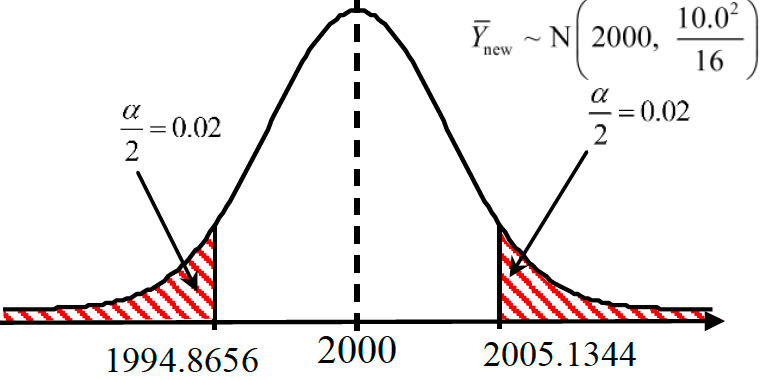
Since \(\text{H}_0\) is rejected: \(\bar{y}_{\text{new}}\) lies in critical region
| p{0.45\linewidth} l p{0.45\linewidth}@{}} \(\bar{y}_{\text{new}} \leq 1994.8656\) | or | \(\bar{y}_{\text{new}} \geq 2005.1344\) [6pt] \(\dfrac{30075+h}{16} \leq 1994.8656\) | or | \(\dfrac{30075+h}{16} \geq 2005.1344\) [10pt] \(h \leq 1842.85\) | or | \(h \geq 2007.15\) [6pt] \(\therefore h \leq 1842\) (nearest g) | or | \(h \geq 2008\) (nearest g) |
|---|