
Sec 1 Maths: Number Patterns & Sequences — practice questions & worked solutions
Number-pattern and sequence questions from Singapore Secondary 1 examination papers, each with a full worked solution that shows how to find the term-to-term rule and the th term — the way marks are actually awarded.
About this topic & key methods
Number patterns and sequences are a staple of Secondary 1 Mathematics. Almost every question below is solved by the same routine: spot how each term relates to the one before (the term-to-term rule), then find a formula that gives any term directly from its position (the nth term or general term). The sequences here are arithmetic, geometric, or built from squares and figural patterns of sticks and circles, and the skill being tested is turning a list of numbers into an algebraic expression.
The marks in these questions are usually awarded for showing how the general term is built and for using it correctly — not only for the final number. Each worked solution below states the first term and the common difference (or ratio), forms the th term, and then uses it to test whether a value belongs to the sequence. For a structured programme that teaches this reasoning from the ground up, see our Secondary 1 Maths tuition.
Key methods
- Spot the pattern — list the differences between consecutive terms; a constant difference means an arithmetic sequence, a constant ratio means a geometric one.
- Term-to-term rule tells you how to get the next term from the current one (e.g. “add 6”, “double it”).
- Position-to-term rule (the th term) gives any term directly from its position , without listing the ones before it.
- nth term of an arithmetic sequence: , where is the first term and is the common difference.
- nth term of a geometric sequence: , where is the common ratio.
- Find and use the general term — once you have , substitute a value to test membership ( must be a positive whole number) or solve for .
- Figural patterns (sticks, circles, dots): count each figure, find the term-to-term rule, then write the th term.
Questions & worked solutions
Sticks & circles figural pattern
A series of figures is formed using sticks and circles. The first three figures are as shown.
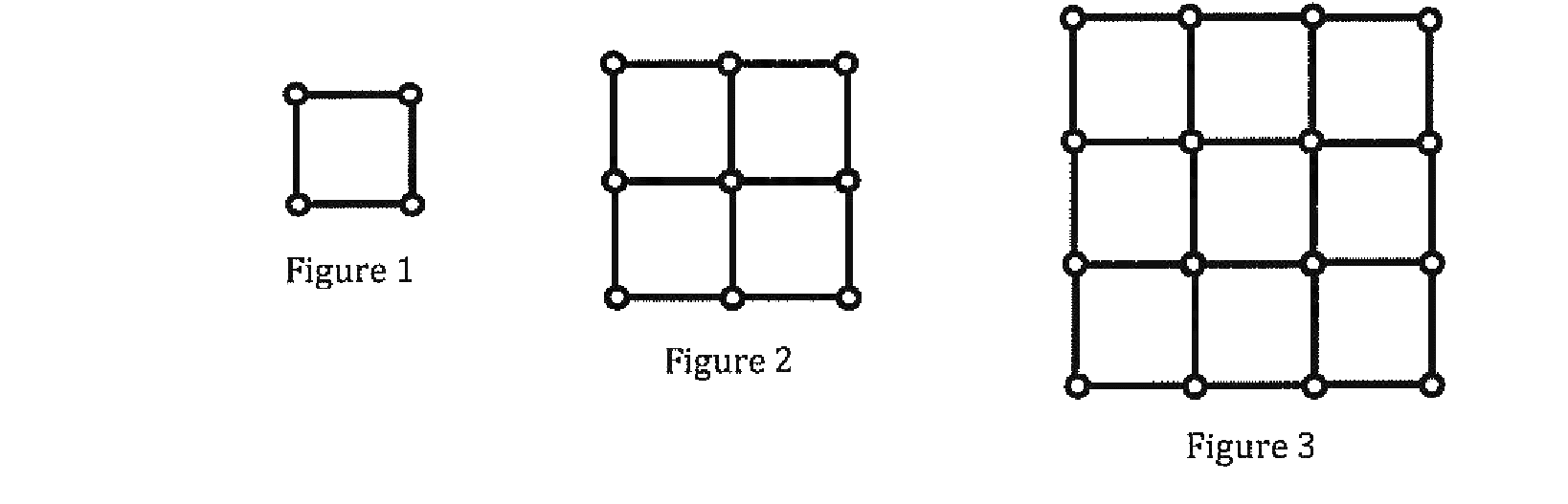
Draw Figure 4.
Complete the table (Figures 1–3 give sticks and circles ; find Figures 4 and 5).
Is it possible to form a figure with sticks in this series? Explain.
Write down, in terms of , an expression for the number of circles in Figure .
If there is an unlimited supply of sticks, what is the largest Figure that could be formed with circles?
Show worked solution▾
(i) Figure 4 is a grid of squares: a array of circles joined by sticks.
(ii) Figure 4: sticks, circles. Figure 5: sticks, circles.
Number of sticks in Figure is and number of circles is . Figure 4 sticks , circles . Figure 5 sticks , circles .
(iii) Set sticks :
Since and , there is no whole number with . Hence it is not possible.
(iv)(a) Number of circles in Figure is .
(b) Set circles :
The largest Figure is Figure .
nth term & a square-number pattern
The first four terms in a sequence are . Find an expression, in terms of , for the th term.
Consider the number pattern with Row : ; Row : ; Row : ; Row : ; and so on.
Fill in the blanks for rows and .
Explain whether is a term in this sequence.
Given that the difference between two consecutive terms in this sequence is , find these two consecutive terms.
Show worked solution▾
(a)
Arithmetic sequence, first term , common difference .
(b)(i)
The pattern is . Row :
Row :
(b)(ii)
The sequence here is the squares (i.e. ). For to be a term it must be a perfect square; is not a whole number, so is not a term.
(b)(iii)
Consecutive squares and differ by
The two consecutive terms are and .
Arithmetic training schedule
John trains for a 21-km half marathon. The distance he runs each day is km on Days Complete the table by finding the distance on Day and on Day .
Show worked solution▾
The distances increase by km each day (arithmetic sequence with first term ). Day 5:
Day :
Geometric sequence: nth term
Tom trains for the same 21-km half marathon with a different programme. The distance he runs each day is km on Days Find, showing your working clearly, the distance Tom ran on the day, leaving your answer in terms of .
Show worked solution▾
The distances double each day (geometric, first term , ratio ):
Solving a geometric inequality
Using Tom’s sequence from Q5, find the value of such that the distance Tom runs on Day is at least the km required to complete the half marathon.
Show worked solution▾
Require . Testing powers of :
So , giving .
General term of a fraction sequence
Let be the term of the sequence
Find an expression for . Let and be the terms of two other sequences, with beginning
By considering , or otherwise, show that .
is increasing; there are two terms and ( a positive integer) whose difference is . Form an equation in and solve it.
Show worked solution▾
(i)
The sequence is arithmetic with first term 1 and common difference 3.
(ii)
Writing the terms of with numerators and denominators :
(iii)
Since is increasing, .
Difference of squares pattern
The first four lines of a number pattern are ; ; ; .
Complete the table (lines 5, 6 and the th line). A second pattern begins ; ; ; .
Complete the table (the th line).
Using your answers in (i) and (ii), find the value of without a calculator.
Show worked solution▾
(i)
The pattern for line :
(ii)
For the second pattern:
(iii)
In general , so:
nth term & testing membership
The first four terms of a sequence are , , and .
Write down the seventh term.
Write down an expression, in terms of , for the th term.
Determine, with a reason, if the number is in the sequence.
Show worked solution▾
(a)
Common difference .
(b)
(c)
Set :
Since is not a whole number, is not in the sequence.
Using a given nth term formula
The th term of a sequence is .
Find .
Given that , find the value of .
Explain why is always positive.
Hence or otherwise, find the least value of for which .
Show worked solution▾
(a)
(b)
(c)(i)
is a positive integer, so , hence and therefore for all such .
(c)(ii)
Since , requires , i.e. .
Two sequences: fractions & linear
Write down the next two terms in the sequence
Write down an expression, in terms of , for the th term of the sequence
Show worked solution▾
(a)
The numerators are and the denominators are , i.e. Next two terms:
(b)
First term , common difference :
nth term & explaining non-membership
Consider the sequence
Write down an expression, in terms of , for the th term.
Hence explain why is not part of the sequence. Show your working clearly.
Show worked solution▾
(a)
Common difference , first term .
(b)
Set :
Since is not a positive integer, is not a term of the sequence.
nth term & explaining non-membership
Consider the sequence
Write down, in terms of , a formula for the term.
Hence explain why is not a term in the sequence. Show your working clearly.
Show worked solution▾
(a)
Common difference , first term :
(b)
Set :
Since is not a positive integer, is not a term in the sequence.
Secondary 1 Maths programme, method by method, on real exam questions like these.