
Sec 1 Maths: Ratio, Rate & Proportion — practice questions & worked solutions
Ratio, rate and proportion questions from Singapore Secondary 1 examination papers, each with a full worked solution that shows every step — the way marks are actually awarded.
About this topic & key methods
Ratio, rate and proportion is a core strand of Secondary 1 Mathematics and feeds directly into percentage, speed and algebra later in the year. The questions below cover the whole spread of the topic: simplifying and forming equivalent ratios, combining two ratios into a three-part ratio, sharing a quantity in a given ratio, working with rates (unit price, best value, currency conversion) and using direct and inverse proportion to scale quantities up or down.
Most marks here are awarded for clear, ordered working — converting units before comparing, keeping ratio “units” consistent, and stating the rate you are using. Each worked solution below lays out that working line by line. For a structured programme that teaches this reasoning from the ground up, see our Secondary 1 Maths tuition.
Key methods
- Simplify a ratio: convert to the same unit first, then divide all parts by their HCF.
- Equivalent ratios: multiply or divide every part by the same number; combine and by matching the common term.
- Share a quantity in a ratio: add the parts to find the total number of units, find the value of one unit, then scale.
- Rate & unit rate: divide to get cost per item, distance per unit time, or currency per unit, then compare.
- Direct proportion: if one quantity increases, the other increases in the same ratio ().
- Inverse proportion: if one quantity increases, the other decreases so that the product stays constant.
- Currency conversion: chain exchange rates through a common currency.
- Estimation: round each quantity to a sensible figure, then check the exact value against a budget.
Questions & worked solutions
Simplest-form ratio & rate conversion
Express the following ratio in the simplest form.
Convert m/s to km/h.
Show worked solution▾
(a)
Convert to the same unit (centimetres), then simplify:
(b)
Sharing in a ratio with an unknown part
balls were initially sorted and put into boxes , and in the ratio . If the balls are rearranged such that there are equal numbers of balls in each box, box would have an additional balls as compared to the initial amount. Find the value of .
Show worked solution▾
When rearranged equally, each box has:
Box initially had:
Since corresponds to parts:
Total number of parts:
Currency conversion & best deal
Sarah was planning to buy some products online from either Korea or Japan. She did some research on the exchange rates. The exchange rates between Singapore dollars (SGD), Korean Won (KRW) and Japanese Yen (JPY) were SGD JPY and KRW JPY.
Find the exchange rate between Singapore dollars (SGD) and Korean Won (KRW).
A pack of masks was sold for KRW on a Korean website and JPY on a Japanese website. If the order qualifies for free shipping, which one offered a better deal? Show your working clearly.
Show worked solution▾
(a)
Convert via JPY:
(b)
Convert both prices to JPY for comparison. Korean website:
Japanese website JPY. Since:
the Korean website offered the better deal.
Combining two ratios
A rope is cut into three parts, , and . Given that and , find .
Show worked solution▾
Make the terms equal (LCM of and is ):
Using a ratio difference to find a total
If the length of is cm more than , find the total length of the original rope.
Show worked solution▾
Difference between and in units units.
Estimation against a budget
Mr Goh is planning a learning journey to a museum for a group of students. The organiser charges per student. Mr Goh budgeted for the learning journey.
By approximating both the cost and the number of students, estimate the cost of the learning journey. Show your working clearly.
Explain if Mr Goh has sufficient funds for this activity.
Show worked solution▾
(i)
Round to and to :
The estimated cost is about .
(ii)
The actual cost is:
Since , Mr Goh has sufficient funds.
Sharing profit in the ratio of investments
Amy, Xinyee and Shruti invested , and respectively in a start-up business.
Express the ratio of Amy’s share : Xinyee’s share : Shruti’s share in the simplest form.
Three years later, they sold the business for . They agreed to share the profit in the ratio of their investments.
How much profit did Amy receive? Leave your answer in dollars correct to the nearest cent.
Show worked solution▾
(i)
Divide each amount by :
(ii)
Total investment .
Amy’s units out of :
Amy received .
Changing ratio & percentage change
Jack and Jill went to fetch a pail of water each from a well. The ratio of the amount of water that Jack fetched to Jill’s amount is . After pouring litres of water from Jack’s pail to Jill’s pail, the ratio of the amount of water is now . Find
the total amount of water that both of them had fetched
the percentage change in the amount of water in Jack’s pail after pouring the water into Jill’s pail.
Show worked solution▾
(i)
The total amount is unchanged, so before and after, giving .
(ii)
The amount decreased by .
Find a ratio from a fraction equation
Given that , find the value of .
Show worked solution▾
Cross-multiply:
Currency conversion
Given that the exchange rate between the Singapore dollar (S) and the Canadian dollar (C) is S1 = C0.93, convert C10\,000 into Singapore dollars. Leave your answer correct to the nearest cent.
Show worked solution▾
Multi-part ratio, percentage & bill problem
Bob, Celia and Mei take part in a run for charity.
The times taken for them to complete the run are in the ratio Bob : Celia : Mei . Find the time taken by Celia as a percentage of the time taken by Mei.
The time taken for Bob to complete the run is minutes seconds. Find the time taken by Mei to complete the run. Give your answer in minutes and seconds.
Celia collects for charity.
Bob collects more than Celia. Find the amount Bob collects.
Celia collects less than Mei. Find how much more money Mei collects than Celia.
They dine at Tikea Restaurant and the bill they received after their meal is shown below.
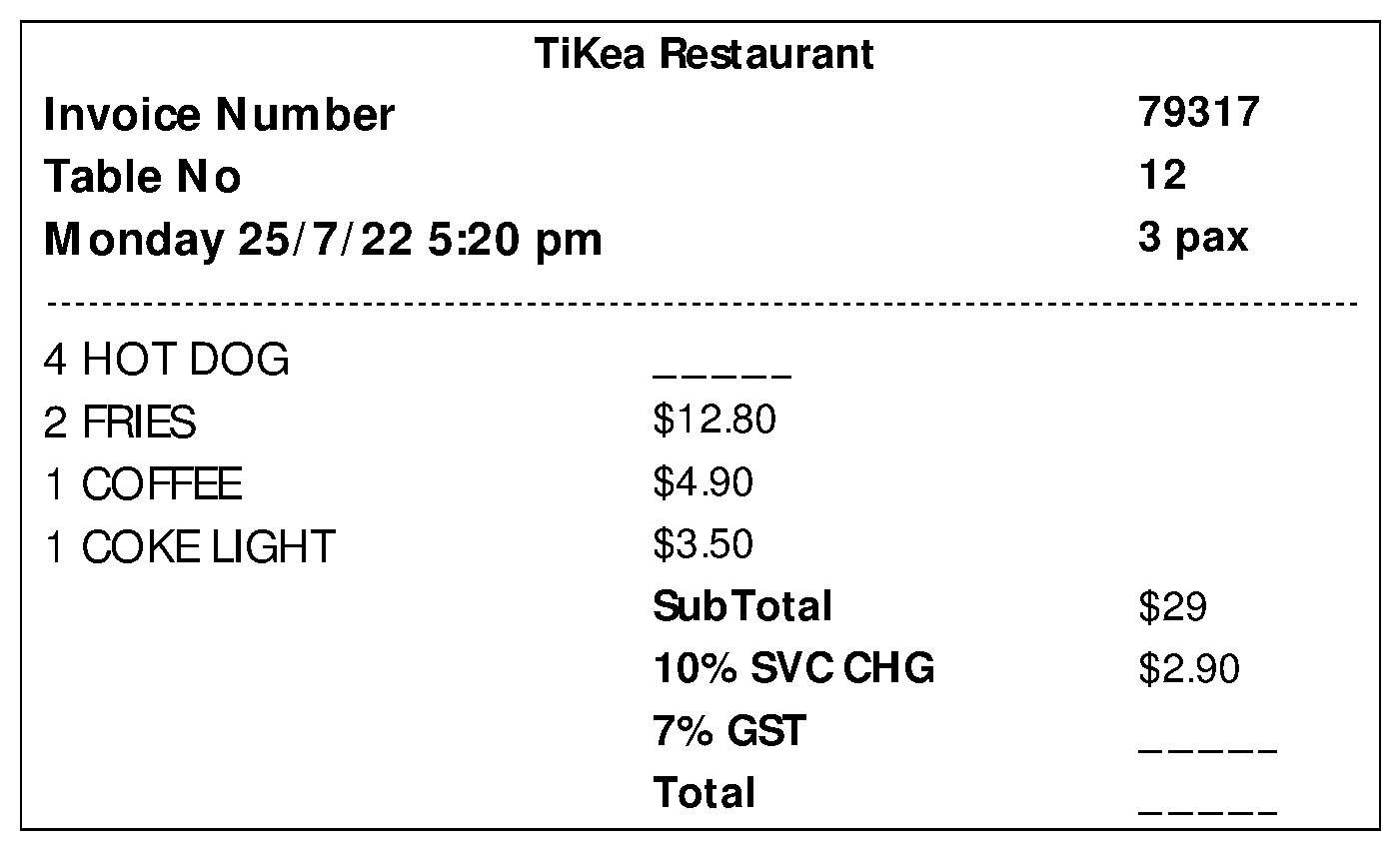
Calculate the cost of one hot dog.
Find the amount of GST payable.
Hence, calculate the total bill.
Show worked solution▾
(a)(i)
(a)(ii)
Bob’s time min s s.
(b)(i)
(b)(ii)
Celia is less than Mei, so Celia of Mei.
(c)(i)
Cost of hot dogs .
(c)(ii)
(c)(iii)
Find a ratio from a fraction equation
Given that , find the ratio of .
Show worked solution▾
Cross-multiply and collect terms:
Then:
Combining ratios via a common term
Given that and , find .
Show worked solution▾
From , . Given . Make the terms equal:
Secondary 1 Maths programme — every method behind these questions, taught step by step.