
Sec 2 Maths: Direct & Inverse Proportion, practice questions & worked solutions
Direct and inverse proportion questions from 2025 Singapore Secondary 2 End-of-Year examination papers. They run from checking a table for direct proportion to percentage changes when varies with or , and every question has a full step-by-step worked solution.
About this topic & key formulas
In Secondary 2 Mathematics, two quantities are in direct proportion when one is a constant multiple of the other, , and in inverse proportion when their product is constant, . The questions below extend this to powers and roots such as , and , to real contexts like springs, printing costs, workers and water pipes, and to the percentage change in when changes.
Every question follows the same three steps: write the equation with , use the given pair of values to find , then substitute. The worked solutions below show each step on its own line. For a structured programme covering this topic, see our Sec 2 Maths tuition.
Key formulas and methods
- Direct proportion: , so is constant; the graph of against is a straight line through the origin.
- Inverse proportion: , so is constant.
- Powers and roots: “ is directly proportional to the square of ” means ; “to the square root of ” means ; “inversely proportional to ” means .
- Percentage change: replace by the new value (for example or ), write the new as a multiple of the old , then use .
- Workers and pipes: the total work (for example workers days) stays the same, so the time is inversely proportional to the number of workers.
Questions & worked solutions
Showing direct proportion from a table
A printing company charges $ for printing number of pages. The table below shows the cost of printing and the corresponding number of pages printed.
| Pages () | 20 | 50 | 80 | 100 |
|---|---|---|---|---|
| Cost ($) | 2.40 | 6.00 | 9.60 | 12 |
Show that and are directly proportional.
Write down an equation connecting and .
Find the number of pages printed if the cost of printing is $27.
Show worked solution▾
(a)
Divide each cost by its number of pages:
Since is the same constant for every pair, and are directly proportional.
(b)
(c)
pages were printed.
Direct proportion with a change of units (Hooke's Law)
In a physics experiment using Hooke's Law, the force in Newtons (N) required to stretch a spring is directly proportional to its extension , in metres. When the spring is stretched by 5 cm, a force of 2.5 N is needed.
Find the equation connecting and .
Hence, calculate the force needed to stretch the same spring by 8 cm.
Show worked solution▾
(a)
is in metres, so convert first: cm m.
(b)
cm m.
Direct proportion to the square root of x
It is given that is directly proportional to the square root of and when . Find
an equation connecting and ,
the value of when ,
the value of when .
Show worked solution▾
(a)
(b)
(c)
Direct proportion to the square of x
It is given that is directly proportional to , and when . Find
the value of when .
the value of when the value of is multiplied by 9.
Show worked solution▾
(a)
When :
(b)
Starting from the given pair when , the new value of is .
Check: multiplying by multiplies by , and .
Direct proportion to t² and percentage increase
is directly proportional to the square of . When , .
Find an equation connecting and .
When , find
the value of ,
the percentage increase in if this value of is increased by 50%.
Show worked solution▾
(a)
(b)(i)
(b)(ii)
Increasing by gives .
Check: is multiplied by , so is multiplied by , an increase of .
Percentage increase when y is proportional to x²
is directly proportional to . If is increased by 300%, find the percentage increase in .
Show worked solution▾
Let the original values be and . Increasing by gives (not ).
Inverse proportion: workers and days
12 workers can complete a job in 10 days. How many additional workers will be required to complete the job in 8 days instead?
Show worked solution▾
The number of workers is inversely proportional to the number of days, so workers days is constant.
Inverse proportion: water pipes and filling time
The time taken ( minutes) to fill up a swimming pool is inversely proportional to the number of water pipes () used. 6 water pipes take 25 minutes to fill up the swimming pool.
Find
an equation connecting and ,
the extra amount of time needed to fill the swimming pool if two pipes are faulty and not working.
Show worked solution▾
(a)
(b)
With two pipes faulty, .
Inverse proportion: workers, assumptions and percentage change
If 12 workers take 100 days to build a house, how long will it take 16 workers to build the same house.
Name one assumption made in part (i) for you to work out the answer.
is inversely proportional to . Find the percentage change in when is reduced by 50%.
Show worked solution▾
(a)(i)
Let be the number of workers and the number of days. Then is constant.
(a)(ii)
All the workers work at the same rate (for example, every worker builds the same amount each day, and conditions such as the weather do not change).
(b)
. Reducing by gives .
increases by .
Inverse square proportion and reading a proportion graph
is inversely proportional to the square of . It is known that for a particular value of . When is increased by , find
the value of ,
the percentage decrease in the value of .
The graph below shows the relationship between two variables and .
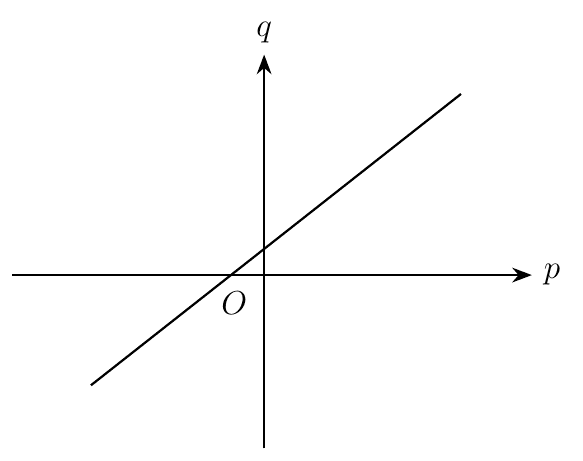
Dan claims that is directly proportional to . Do you agree? Explain your answer with reference to the graph.
Show worked solution▾
(a)
Let the particular value of be , so with when :
Increasing by doubles it, so the new value is :
(b)
(c)
No, I disagree. If were directly proportional to , then and the graph would be a straight line passing through the origin. This line cuts the -axis above , so it does not pass through the origin, and is not directly proportional to .