
Sec 2 Maths: Mensuration of Pyramids, Cones & Spheres practice questions with worked solutions
Volume and surface area questions on pyramids, cones, spheres, hemispheres, frustums and composite solids from 2025 Singapore Secondary 2 End-of-Year papers. Every part comes with a full step-by-step worked solution.
About this topic & key formulas
Secondary 2 mensuration extends volume and surface area from prisms and cylinders to pyramids, cones and spheres. Most questions combine these with Pythagoras’ theorem, which links the vertical height, the slant height and the base of a pyramid or cone.
The later questions below work with composite solids (a cone on a hemisphere, a hemisphere carved out of a frustum) and with frustums, where a small cone is removed from a large one and similar triangles give the missing height. For guided lessons on this chapter, see our Sec 2 Maths tuition.
Key formulas
- Pyramid: volume ; total surface area base area of the triangular faces.
- Cone: volume ; curved surface area ; slant height .
- Sphere: volume ; surface area .
- Hemisphere: volume ; curved surface area ; total surface area of a solid hemisphere .
- Frustum: volume and curved surface area large cone minus small cone.
- Composite solids: add only the surfaces that are exposed; faces that are joined together are not painted.
Questions & worked solutions
Volume of a sphere and percentage change in surface area
The radius of a spherical ballon is 10 cm.
Find the volume of the spherical ballon.
When the radius is increased by 20%, find the percentage increase in its surface area.
Show worked solution▾
(a) Volume
(b) Percentage increase in surface area
The new radius is . Surface area depends on , so it is multiplied by .
Slant height and total surface area of a square pyramid
is a pyramid with a square base of side 24 cm. is the centre of square . The vertical height, of the pyramid is 16 cm.
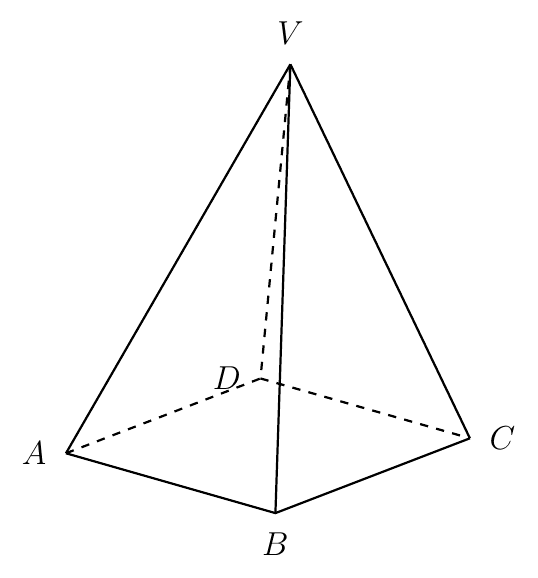
Find the slant height of .
Find the total surface area of the pyramid.
Show worked solution▾
(a) Slant height
The slant height runs from to the midpoint of . The distance from to that midpoint is half the side, 12 cm. By Pythagoras’ theorem:
(b) Total surface area
Four congruent triangular faces plus the square base.
Volume, slant height and surface area of a square pyramid
The diagram shows a solid glass paperweight made in the shape of a square pyramid. is the square base of a pyramid with side 12 cm. The height of the pyramid is 8 cm. is the midpoint of .
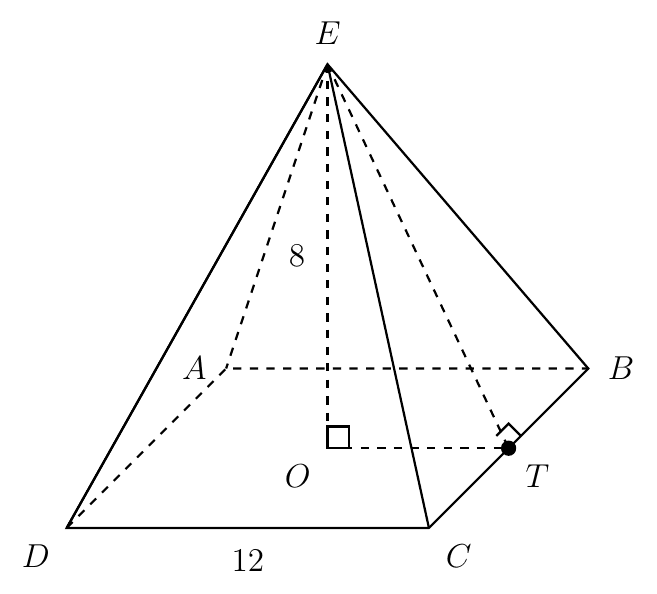
Calculate the volume of the paperweight.
Show that the slant height is 10 cm.
Find the total surface area of the paperweight.
Show worked solution▾
(a) Volume
(b) Slant height
is half the side, 6 cm, and triangle is right-angled at .
(c) Total surface area
Volume, slant height and surface area of a square pyramid
The figure shows a square pyramid with vertical height cm.
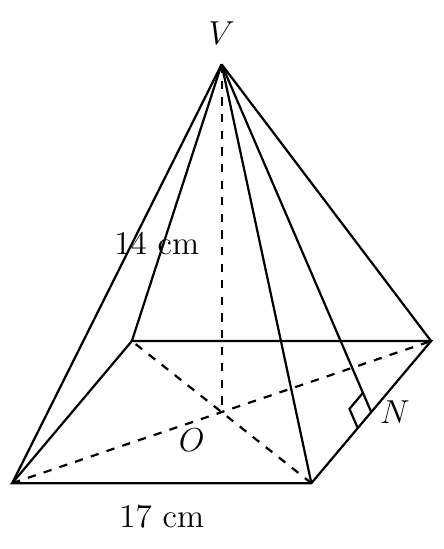
Find
the volume of the square pyramid
the length
the total surface area of the square pyramid
Show worked solution▾
(a) Volume
The base is a square of side 17 cm.
(b) Length
is the midpoint of a base edge, so cm. By Pythagoras’ theorem in triangle :
(c) Total surface area
Base of a pyramid from its volume, then total surface area
A right pyramid has a vertical height of 35 m, slant height of 37 m and occupies a volume of 6720 m. The pyramid has a square base of length m.
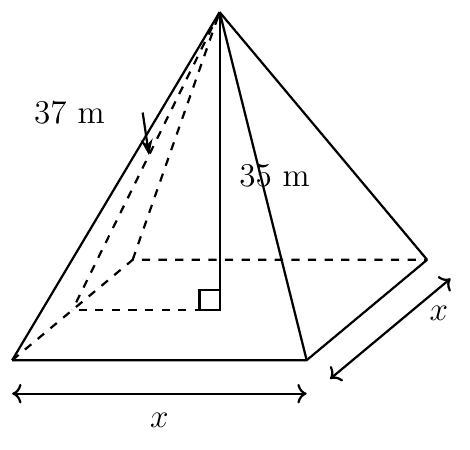
Show that .
Calculate the total surface area of the pyramid.
Show worked solution▾
(a)
(b) Total surface area
Each triangular face has base 24 m and height equal to the slant height, 37 m.
Two slant heights of a rectangular-based pyramid
An upright solid pyramid with a rectangular base measuring 14 m by 8 m has a height of 20 m.
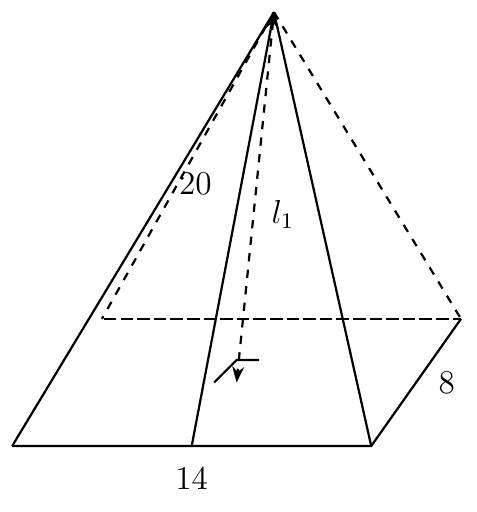
Show that the slant height m, correct to 3 decimal places.
Calculate the total surface area of the pyramid.
Show worked solution▾
(a) Slant height
is the slant height of the faces on the 8 m edges. From the centre of the base to the midpoint of an 8 m edge is half of 14 m, which is 7 m. By Pythagoras’ theorem:
(b) Total surface area
The faces on the 14 m edges have a different slant height , using half of 8 m, which is 4 m.
Volume of a pyramid through a quadratic equation
A gift box is in the shape of a right pyramid with square base of side 4 cm less than the vertical height.
Given that the height of the gift box is cm, write down an expression, in terms of , for the side of the gift box.
The base area of the gift box is 36 cm. Write down an equation to represent this information and show that it simplifies to
Solve the equation .
Explain why one of the solutions in (c) must be rejected.
Calculate the volume of the gift box.
Show worked solution▾
(a) Side of the base
(b) Forming the equation
(c) Solving
(d) Rejecting a solution
is rejected because is the height of the box, and a length cannot be negative. (It would also make the side cm.)
(e) Volume
Composite solid: cone on a hemisphere
The diagram shows a solid made from a cone and a hemisphere. The slant height of the cone is 13 cm and the radius of the hemisphere is 5 cm.
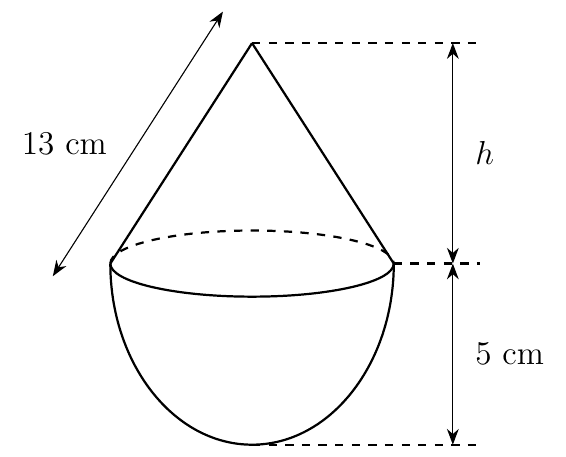
Show that the height, , of the cone is 12 cm.
Calculate the volume of the solid.
Find the total surface area of the solid.
Show worked solution▾
(a) Height of the cone
The cone’s radius is the hemisphere’s radius, 5 cm. By Pythagoras’ theorem:
(b) Volume
(c) Total surface area
The exposed surfaces are the curved surface of the cone and the curved surface of the hemisphere; the joined circular faces are hidden.
Hemisphere on a conical support: volume and paint needed
The diagram below shows a solid metallic sculpture. The solid metallic sculpture consists of a hemisphere and a conical support. The radius of the hemisphere is 6 cm and the diameter of the cone is 8 cm. The slant height of the cone is 7 cm. Taking to be 3.142, find
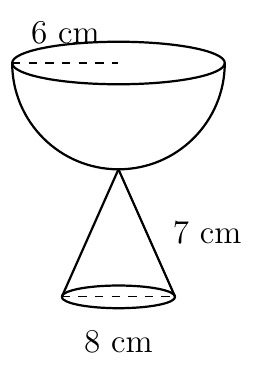
the volume of the hemisphere,
the amount of paint needed to paint the metallic sculpture completely if 1 litre of paint is needed to paint an area 400 cm.
Show worked solution▾
(a) Volume of the hemisphere
(b) Paint needed
The cone touches the hemisphere only at its tip, so every surface is exposed: the hemisphere’s curved surface and flat top (), and the cone’s curved surface and circular base (, with cm).
Composite solid: cone on a cylinder
A solid made of wax consists of a cone and a cylinder. The cylinder has a height of 4 cm and its base area is 150 cm.
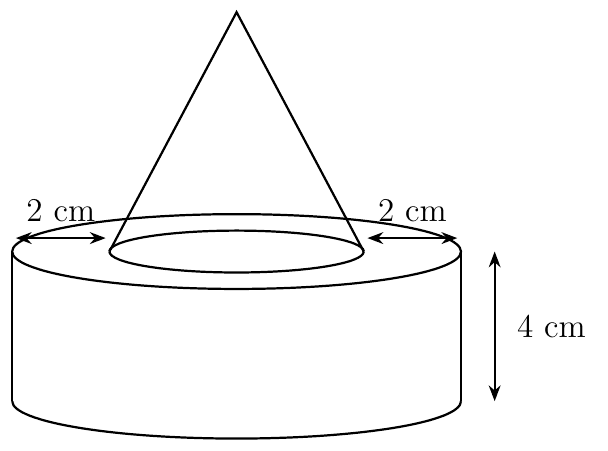
Find the radius of the cylinder.
Find the radius of the cone.
Given that the height of the cone is 12 cm, calculate the volume of the solid.
Show worked solution▾
(a) Radius of the cylinder
(b) Radius of the cone
From the diagram, the cone’s base is 2 cm in from the cylinder’s edge.
(c) Volume of the solid
Melting and recasting: hemisphere and cylinder into spheres
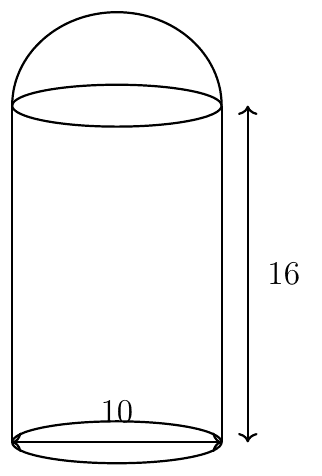
A solid metal structure consists of a hemisphere and a cylinder which share a common base. The cylinder has a base diameter of 10 cm and a height of 16 cm. An engineer calculated that the metal structure can be melted to form at least 360 spheres of 2cm diameter. Is his calculation correct?
Show worked solution▾
The radius of the structure is cm and each small sphere has radius 1 cm. Melting keeps the volume the same.
Only whole spheres count, so 362 spheres can be made. Since , the engineer’s calculation is correct.
Cone and sphere of equal volume: height, radius and paint
A company is producing two separate exhibition display structures, one in the shape of a cone and the other in the shape of a sphere, both with radius m. The cone has a height of m, and a slant height of m.
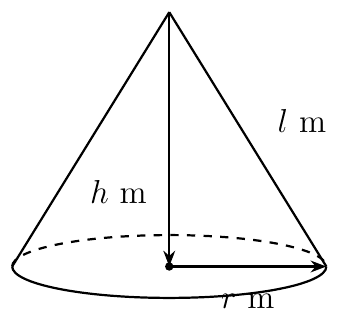
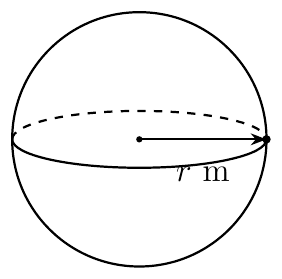
Both structures have the same volume. Form an equation to show that .
Given that the slant height, , of the cone is 5.4 m, calculate the value of .
The company is selling the exhibition display structure in sets, each comprising of one conical and one spherical structure. Find the number of tins of paint needed to paint 10 sets if each tin of paint covers 30 m.
Show worked solution▾
(a)
(b) Value of
By Pythagoras’ theorem, with .
(c) Tins of paint
One set is a solid cone (curved surface and base) and a sphere.
16 tins are not enough, so 17 tins are needed.
Hemisphere with a cone removed: volume, ratio and mass
The diagram shows a concrete sculpture formed by removing a cone, with a diameter of 1.2m and a slant height of 1m, from a solid hemisphere of diameter 2m.
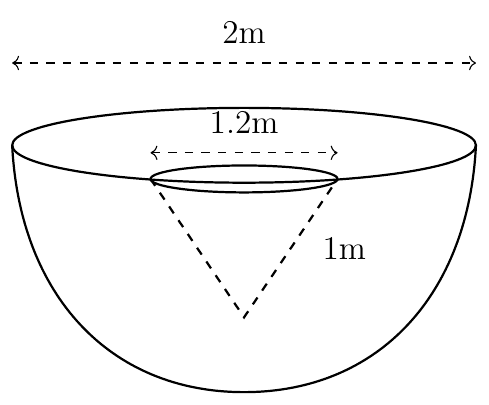
Show that, correct to three significant figures, the volume of the sculpture is 1.79 m
The concrete is a mixture of cement, sand and stones in the ratio of by volume.
Find the volume of sand needed to make the sculpture.
The mass of 1 cubic metre of sand is 1530 kg.
Calculate the mass of sand needed to make the sculpture.
Sand is sold in bags, each of which contains 25 kg of sand.
Do you think that 36 bags are sufficient to make the sculpture? Explain your answer.
Show worked solution▾
(a) Volume of the sculpture
Hemisphere radius 1 m; cone radius 0.6 m. The cone’s height comes from Pythagoras’ theorem.
(b) Volume of sand
Sand is 5 parts out of .
(c) Mass of sand
(d) Are 36 bags enough?
No. 36 bags hold only 900 kg, less than the 914 kg needed, so 37 bags are required.
Frustum of a cone: height, volume and surface area in terms of
A closed water container is made from a section of a cone with radius 9 m and height 12 m as shown in the diagram below. The top of the container is a circle of radius 6 m.
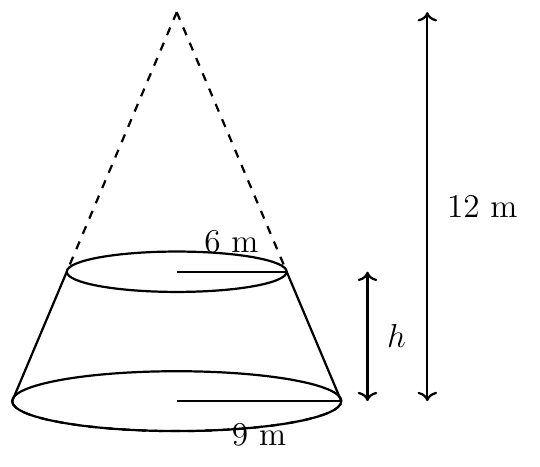
Show that the height of the container is 4 m.
The container is filled completely with water. Find the volume of water in the container.
The entire container, including its base, is to be painted with a reflective coat of paint. Find the total surface area that needs to be painted, giving your answer in terms of .
Show worked solution▾
(a) Height
The removed small cone is similar to the full cone, with radii in the ratio .
(b) Volume of water
Note: the school’s answer key prints this as m; the working gives m, which is 716 m, so the in the key is a slip.
(c) Total surface area
Slant heights by Pythagoras’ theorem, then curved surface of the frustum plus the top and base circles (the container is closed).
Frustum by similar triangles, with a hemisphere carved out
The figure below shows a conical frustum which is obtained by removing the smaller cone from the larger cone . The base radius of cone is 6 cm and the base radius of cone is 12 cm. The height of the frustum is 10 cm.
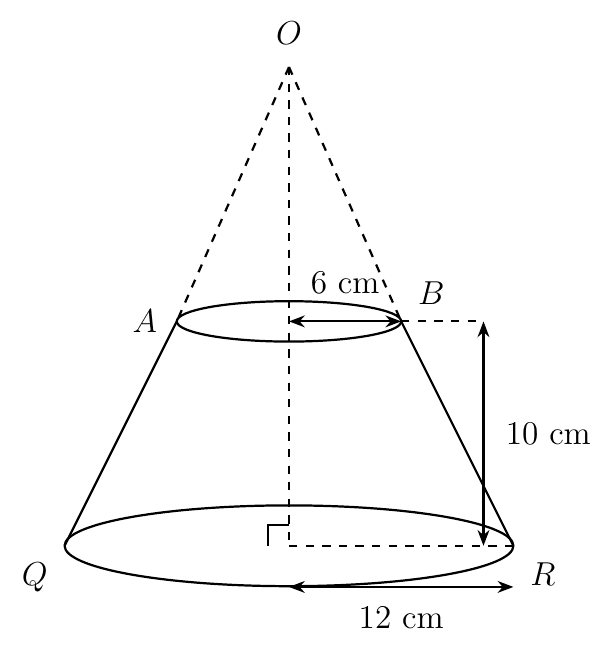
Using similar triangles, show that the height of the cone is 10 cm.
Calculate the total surface area of the conical frustum.
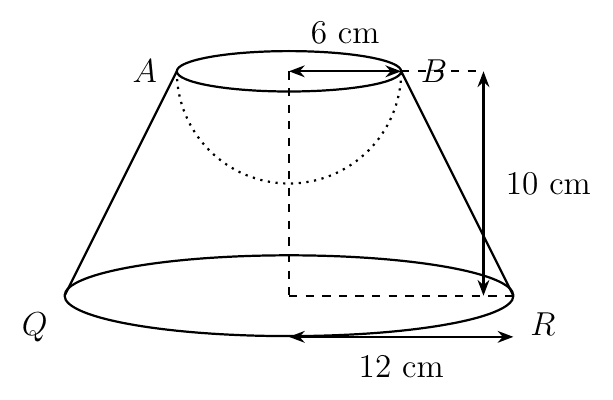
A solid flowerpot made of clay is modelled by the frustum with a hemisphere carved out. Find the amount of clay required to make one flowerpot.
Show worked solution▾
(a) Height of cone
Let the height of cone be cm, so cone has height . The two cones are similar, so radius and height are in the same ratio.
(b) Total surface area of the frustum
Large cone: radius 12, height 20. Small cone: radius 6, height 10. Slant heights by Pythagoras’ theorem.
(c) Clay required
Volume of the frustum minus the hemisphere of radius 6 cm.