
Sec 2 Maths: Solving Quadratic Equations by Factorisation, practice questions & worked solutions
Quadratic equations questions from 2025 Singapore Secondary 2 End-of-Year examination papers. They cover solving by factorisation, finding an unknown coefficient from a given root, and forming quadratic equations from word problems, and every question has a full step-by-step worked solution.
About this topic & key methods
In Secondary 2 Mathematics, quadratic equations are solved by factorisation: rearrange so one side is , factorise, and use the fact that if a product is zero then one of its factors is zero. The questions below go from equations like , through finding an unknown coefficient when one root is given, to word problems where you form the equation yourself from an area, a right-angled triangle, a number grid or a speed and time.
In word problems a quadratic usually gives two solutions, and one of them often has to be rejected because a length, time or speed cannot be negative. The worked solutions below show the equation being formed, reduced, solved and checked against the context. For a structured programme covering this topic, see our Sec 2 Maths tuition.
Key methods
- Make one side zero: never divide both sides by ; move every term to one side instead, or a solution such as is lost.
- Zero product rule: if , then or .
- Given root: substitute the known value of to find the unknown coefficient, then solve the full equation for the other root.
- Equations with fractions: multiply both sides by the denominator first, noting any value of that makes it zero.
- Forming an equation: write each quantity in terms of , set up the relationship (area, Pythagoras, distance), expand and simplify to the given form.
- Rejecting a solution: check each root in context; lengths, times and speeds must be positive.
Questions & worked solutions
Solving by factorisation and a substitution
Solve .
Hence, solve
Show worked solution▾
(a)
Bring every term to one side rather than dividing by , which would lose the root :
(b)
Note: the paper prints the right-hand side as , but the word “Hence” and the school answers or fit , which is solved here.
This is the equation in (a) with , so or :
Finding a coefficient from a given root
One solution of the equation is .
Find the value of .
Hence, find the other solution of the equation.
Show worked solution▾
(a)
Substitute :
(b)
The other solution is .
Finding a coefficient and the other root
It is given that is one of the solutions of , where is a constant.
Find
the value of .
the other solution of the equation.
Show worked solution▾
(a)
Substitute :
(b)
The other solution is .
Equation with a fraction leading to a quadratic
Solve the equation .
Show worked solution▾
Multiply both sides by , where :
Forming a quadratic from Pythagoras’ theorem
The diagram shows a right-angled triangle . cm, cm and cm.
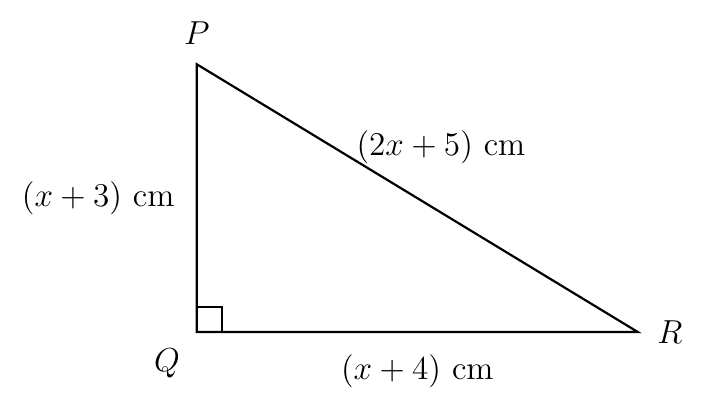
Write down an equation in and show that it reduces to .
Solve the equation .
Explain why one of the solutions in part (b) must be rejected.
Hence, find the area of triangle .
Show worked solution▾
(a)
The right angle is at , so is the hypotenuse. By Pythagoras’ theorem:
(b)
(c)
If , then cm and cm. A side of a triangle must have positive length, so is rejected.
(d)
With : cm and cm.
Forming a quadratic from the area of a trapezium
The diagram shows a trapezium with all the length given in centimetres. is parallel to and angle .
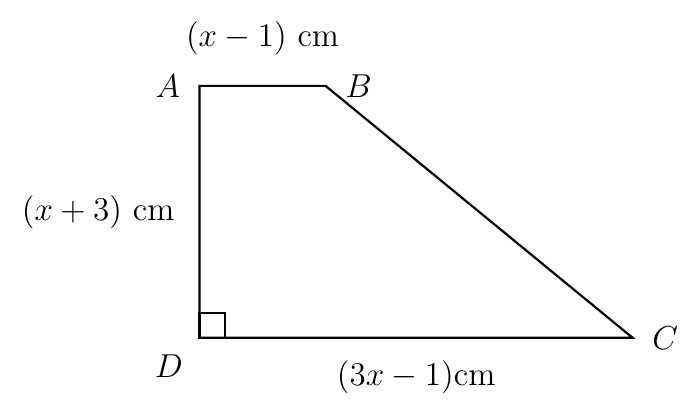
Given that the area of the trapezium is 15 cm, form an equation in and show that it reduces to .
Solve the equation .
Explain why one of the solutions in part (b) must be rejected.
Show worked solution▾
(a)
Area of a trapezium . The parallel sides are and , and the height is :
(b)
(c)
If , then cm, and a length cannot be negative. So is rejected and .
Forming a quadratic from the area of a parallelogram
is a parallelogram. The dimensions are measured in centimetre.
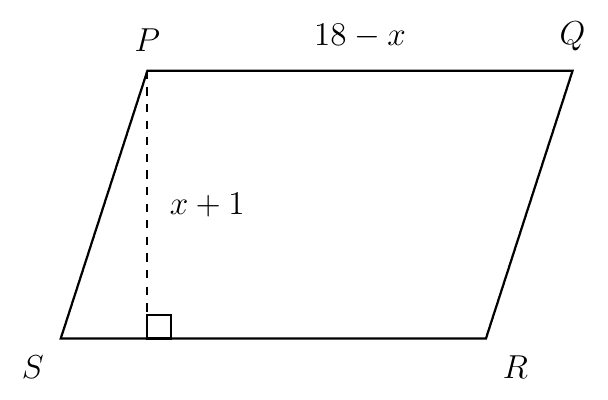
Given that the area of is 78 cm, find an expression in terms of and show that it reduces to .
Hence solve , given that is less than 10.
Show worked solution▾
(a)
Area of a parallelogram :
(b)
Since is less than , is rejected, so .
Number grid pattern leading to a quadratic
The diagram shows part of a number grid.
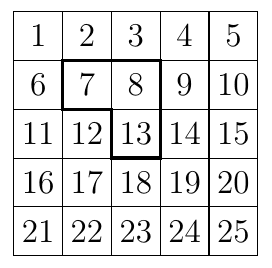
A shape outlining 3 numbers, as shown, is placed on the grid.
The shape is placed in a different position on the grid. Complete the shape below to show the numbers outlined.
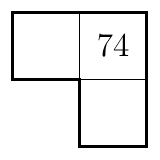
The shape is now placed in another position on the grid. The smallest number on this shape is , as shown below.
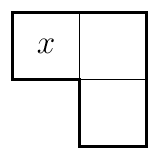
Write down the largest number in this shape in terms of .
The product of the largest and smallest number in this shape is 135. Form an equation, in terms of , and show that it reduces to .
Solve the equation .
Hence, find the total of the three numbers in this shape.
Show worked solution▾
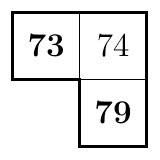
Each row has numbers, so moving one square right adds and moving one square down adds . In the shape, the top-right number is more than the top-left, and the bottom number is more than the top-right.
(a)
Top-left and bottom .
(b)(i)
The three numbers are , and , so the largest is .
(b)(ii)
(b)(iii)
(b)(iv)
The numbers on the grid are positive, so . The three numbers are , and :
Forming a quadratic from speed, distance and time
The distance between Singapore and Kuala Lumpur is 300 km.
James drove from Singapore to Kuala Lumpur and it took him hours.
Write down an expression, in terms of , for James’ average speed in km/h.
Ben took a train from Singapore to Kuala Lumpur. Ben took 2 hours longer than James to cover the same distance.
Write down an expression, in terms of , for Ben’s average speed in km/h.
The train travelled at 40 km/h slower than James’ car.
Form an equation in and show that it reduces to .
Solve the equation .
Find the average speed, in km/h, of the train.
Show worked solution▾
(a)
(b)
(c)
James’ speed minus the train’s speed is km/h:
(d)
(e)
Time cannot be negative, so . The train takes hours:
Forming a quadratic from two stages of a journey
In a race, John walks at an average speed of km/h for hours and cycles at an average speed of km/h for hours.
Write down an expression, in terms of , for the distance he walks.
Write down an expression, in terms of , for the distance he cycles.
Given that John covers a distance of 97 km, write down an equation, in terms of , and show that it reduces to
Solve the equation .
Explain why the negative value of is rejected.
Show worked solution▾
Distance speed time.
(a)
(b)
(c)
(d)
(e)
is the walking time in hours, and a time cannot be negative. So is rejected.
(f)
Total time hours. With :