Free practice / Secondary 2 Maths
Sec 2 Maths: Linear Inequalities, practice questions & worked solutions
Linear inequalities questions from 2021 to 2025 Singapore Secondary 2 End-of-Year examination papers. They cover solving an inequality, showing the solution on a number line, picking out the greatest or smallest integer, prime or perfect square, and forming an inequality from a word problem, and every question has a full step-by-step worked solution.
About this topic & key methods
In Secondary 2 Mathematics, a linear inequality such as is solved much like a linear equation: expand brackets, clear fractions, and collect the unknown on one side. The one extra rule is that multiplying or dividing both sides by a negative number reverses the inequality sign.
The answer is a range of values, not a single number, so questions often go on to ask for it on a number line, or for the largest or smallest integer, prime number or perfect square in that range. The last question below forms the inequality from a word problem about bank notes. For a structured programme covering this topic, see our Sec 2 Maths tuition.
Key methods
- Same as equations: you may add or subtract the same amount on both sides, and multiply or divide by a positive number, without changing the sign.
- Negative divisor: dividing or multiplying by a negative number reverses the sign: from you get .
- Fractions: multiply every term by the denominator first, e.g. multiply by .
- Number line: a solid (filled) circle means the end value is included ( or ); a hollow circle means it is not ( or ).
- Integer answers: for the smallest integer is ; for the greatest prime is itself because is included.
- Word problems: let the unknown be the quantity asked for, write the total as an expression, and turn “less than” or “at most” into the matching sign.
Questions & worked solutions
Solving an inequality and testing whether a value satisfies it
Solve the inequality .
fulfils the inequality . Determine if this statement is true or false.
Show worked solution▾
(a)
(b)
The solution is , and is not greater than . Substituting confirms it:
is not true, so the statement is false.
Solving an inequality with a negative coefficient
Solve the inequality .
Show worked solution▾
Divide both sides by and reverse the sign:
Solving an inequality and the smallest integer
Solve the inequality .
Hence write down the smallest integer value of .
Show worked solution▾
(a)
(b)
must be greater than , and itself is not allowed. The smallest integer is
Solving an inequality and showing it on a number line
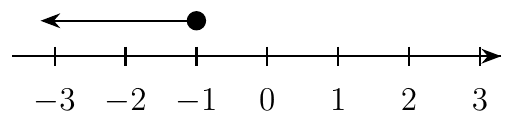
Solve the inequality .
Represent the solution on the number line below.

Show worked solution▾
(a)
Divide both sides by and reverse the sign:
(b)
Draw a solid circle at , because is included, with an arrow pointing to the left:
Dividing by a negative number, a number line and the largest integer
Solve .
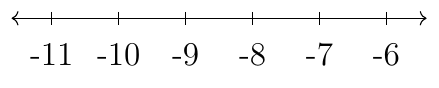
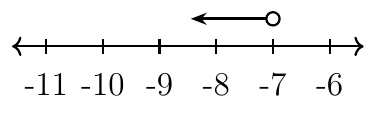
Represent the solution in (a) on the number line provided below.
Write down the largest possible integer that satisfies the solution in (a).
Show worked solution▾
(a)
Divide both sides by and reverse the sign:
(b)
Draw a hollow circle at , because is not included, with an arrow pointing to the left:
(c)
The integers less than are The largest is
Inequality with brackets, number line and the largest prime
Solve the inequality .
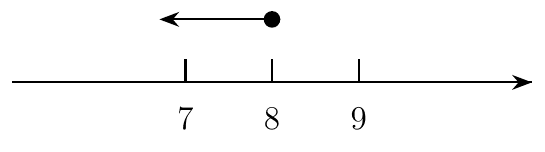
Represent the answer in (a) on the number.

Write down the largest prime number of .
Show worked solution▾
(a)
Multiply both sides by and reverse the sign:
(b)
Draw a solid circle at , because is included, with an arrow pointing to the left:
(c)
The primes up to are , , and . The largest is
Inequality with a fraction, a number line, the smallest prime and perfect square
Solve the inequality .
Represent the solution on a number line.

Hence write down the smallest possible value of if is
a prime number,
a perfect square.
Show worked solution▾
(a)
Multiply both sides by 3 (positive, so the sign stays):
(b)
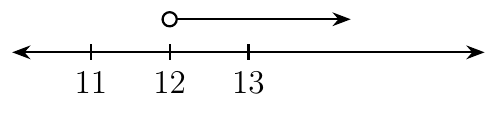
Draw a hollow circle at , because is not included, with an arrow pointing to the right:
(c)(i)
The first prime greater than is
(c)(ii)
is too small, so the first perfect square greater than is
Fractions on both sides, then the smallest prime
Solve the inequality .
Hence write down the smallest prime number which satisfies the inequality .
Show worked solution▾
(a)
Multiply both sides by 4 (positive, so the sign stays):
(b)
Every prime is greater than , so the smallest prime that satisfies the inequality is the smallest prime of all:
Inequality with a fraction and the smallest integer
Solve .
Represent the solution in (a) on the number line.

Hence, state the smallest integer that satisfies the inequality
Show worked solution▾
(a)
Multiply both sides by to clear the fraction:
Divide both sides by and reverse the sign:
(b)
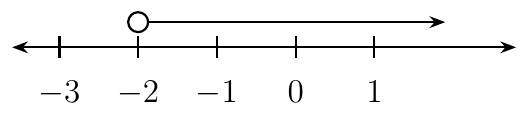
Draw a hollow circle at , because is not included, with an arrow pointing to the right:
(c)
must be greater than , so is excluded. The smallest integer is
Inequality with a fraction and the smallest prime
Solve the inequality .
Hence, state the smallest prime number that satisfies the inequality.
Show worked solution▾
(a)
Multiply both sides by and reverse the sign:
(b)
Every prime number is greater than , so the smallest prime that satisfies the inequality is the smallest prime of all:
An inequality with a negative denominator and the smallest integer
Solve the inequality and state the smallest possible that is an integer.
Show worked solution▾
Multiply both sides by . This is positive, so the sign stays; the on the right becomes :
is just below , so the smallest integer value of is
Greatest perfect square and greatest prime in a solution set
Given that , find the greatest possible value of if is
a perfect square,
a prime number.
Show worked solution▾
First solve the inequality. Multiply both sides by :
(a)
The perfect squares up to are , and . The greatest is
(b)
is included (the sign is ) and is prime, so the greatest prime is
Linear and quadratic equations, then an inequality
Solve the following equations.
Solve the inequality .
Show worked solution▾
(a)(i)
Multiply every term by the LCM of the denominators, :
(a)(ii)
Bring every term to one side and factorise:
(b)
Multiply both sides by and reverse the sign:
Primes in a range, and the smallest product of two bounded integers
List all the prime numbers that satisfy .
Given that and are integers such that and , find the smallest possible value of .
Show worked solution▾
(a)
Primes are positive, so look at to . The primes are
(b)
List the integers allowed: can be and can be . Every is positive, so the product is smallest when is negative and is as large as possible:
Reading a range from a number line, then the greatest values of a + b and b² − a²
A range of values of is represented on the number line below.

Write down the inequalities that represent this range of values for .
Given that and find
the greatest value of ,
the greatest value of .
Show worked solution▾
(a)
The hollow circle at means is not included; the solid circle at means is included.
(b)(i)
Take the greatest and the greatest :
(b)(ii)
Make as large as possible and as small as possible. The largest is . Since is allowed, the smallest is (not ).
Least prime, rational and square numbers in a range, solving, and reading a number line
It is given that .
Write down the least possible value of if is
a prime number,
a rational number,
a square number.
Solve the inequality .
A range of values for is represented on the number line below.
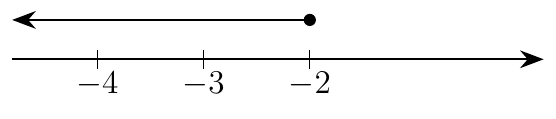
Write down an inequality that represents this range of values for .
Show worked solution▾
(a)(i)
Check the integers from : and is even, but is prime.
(a)(ii)
is itself a rational number and is included (), so the least value is
(a)(iii)
is too small, so the least square number is
(b)
Multiply both sides by and reverse the sign:
(c)
The solid circle at means is included, and the arrow points to the left:
Two inequalities, a number line and the least integer
Solve , representing the solution on the number line below.

Solve the inequality .
Write down the least possible integer value for
Show worked solution▾
(a)
Draw a hollow circle at , because is not included, with an arrow pointing to the left:

(b)(i)
Multiply both sides by 10, the lowest common multiple of 5 and 2:
(b)(ii)
is just below , so the least integer is
Solving an inequality, then the range for the third side of a triangle
Solve the inequality .
Two of the sides of a triangle are 14 cm and 8 cm and the third side has a length of cm where is an integer. Write down an inequality that must be satisfied by .
Show worked solution▾
(a)
Multiply both sides by 5:
(b)
In a triangle, any two sides add up to more than the third side.
Since is an integer, this is the same as .
Forming an inequality from cost and takings to avoid a loss
Wendy bought 20 boxes of strawberries at $6 each. She later threw away boxes which were spoilt and sold the remaining boxes at $8 each.
Write down an expression in terms of to represent the amount Wendy received from selling the strawberries and show that it simplifies to .
By forming and solving an inequality, find the maximum number of spoilt boxes if Wendy did not make a loss.
Show worked solution▾
(a)
She sells boxes at $8 each:
(b)
She paid dollars. No loss means the amount received is at least the cost:
The maximum number of spoilt boxes is 5. Check: with 5 spoilt she sells 15 boxes for $120, exactly what she paid.
Forming an inequality from a money problem
Annabelle has 12 pieces of $20 notes and $5 notes in her wallet. The total value of these notes is less than 16,000 cents. By forming an inequality in , where represents the number of $20 notes, find the maximum number of $20 notes.
Show worked solution▾
There are notes of $20, so there are notes of $5. Work in dollars: cents $160.
is a whole number of notes less than , so the maximum number of $20 notes is .
Check: notes of $20 and of $5 total $150, which is less than $160; and would total $165.