A Maths Formula Sheet (SEC K341): Given vs Memorise
By the Math Academy teachers, all NUS Mathematics graduates · Updated December 2026
In the G3 Additional Mathematics (K341) exam you are given one page of formulae, and it is short: the quadratic formula, the binomial expansion, the trigonometric identities (the three Pythagorean identities, the compound angle formulae and the double angle formulae), and the sine rule, cosine rule and area of a triangle. Nothing else is printed. Every derivative and integral, the laws of indices and logarithms, the partial fraction forms, the special angle values, the R-formula and the equations of a circle must come from memory. This page sets out the official list exactly, then everything you must memorise, topic by topic, with a note on when each result is used.
A Maths formula sheet at a glance
- Subject: G3 Additional Mathematics, syllabus K341, examined in the Singapore-Cambridge Secondary Education Certificate (SEC) from 2027.
- In the exam: the syllabus says relevant formulae “will be provided for candidates”. You do not bring your own sheet.
- What is on it: 15 results in two groups, Algebra (2 formulae and the binomial coefficient) and Trigonometry (9 identities and 3 triangle formulae).
- What is not on it: all of calculus, logarithms, partial fractions, coordinate geometry and circles, special angles and the R-formula.
- Printable version: one A4 page with every formula on this page, in two columns. Download the one page A Maths formula sheet (PDF)
- Official K341 syllabus PDF (SEAB)
SEAB groups A Maths into 10 topics (A1 to A6, G1 to G3 and C1). At Math Academy we teach the same content as 14 topics, and Part 2 below follows our 14.
A Maths formulae given in the exam (K341 list)
Every formula below is typed from page 9 of the official SEAB syllabus, under SEAB’s own headings. If anything here ever differs from SEAB’s copy, SEAB’s copy is the one that counts.
Official source: the formula list is printed in SEAB’s syllabus document for G3 Additional Mathematics (K341), on page 9. Open the SEAB syllabus (PDF)
1. Algebra
Quadratic Equation. For the equation ,
Binomial expansion.
where is a positive integer and
2. Trigonometry
Identities.
Formulae for .
Given, so do not spend revision time memorising them word for word
- The quadratic formula, the binomial expansion and the formula for . The general term is printed inside the expansion too.
- All nine identities above, including all three forms of .
- The sine rule, cosine rule and .
Do practise until you can find each one in seconds and spot it inside a question. Proofs and equations often need in a particular form, or read backwards.
A Maths formulas to memorise, topic by topic
Everything in this part is not printed in the exam. The topics follow the order of our 14 A Maths chapters. Each line says when the result is used or the slip it prevents.
Often thought to be given, but not on the list
- The partial fraction forms. The JC list (MF27) prints them; the A Maths list does not.
- and . Only and its two partners are printed.
- The exact values of , and at , and .
- The R-formula for .
- Every derivative and every integral, including those of , , and .
- The laws of logarithms and the change of base formula.
- The centre and radius of .
- and factorised.
- Arc length and sector area : the E Maths paper prints them, the A Maths paper does not.
1. Simultaneous equations
| Result | When you use it |
|---|---|
| From the linear equation, make one unknown the subject, for example | Substitute into the non-linear equation, never back into the linear one. and give . |
2. Indices and surds
| Result | When you use it |
|---|---|
| , | Simplifying before solving. Add or subtract powers only when the bases match. |
| , | , not . |
| , | Rewriting as before differentiating or integrating. |
| . Take the root first to keep numbers small. | |
| , | Simplifying surds. The slip: is not . |
| Rationalising the denominator: . | |
| Square both sides, then check every answer | Equations with surds. Squaring can create an answer that does not satisfy the original equation. |
3. Polynomials
| Result | When you use it |
|---|---|
| Long division and finding unknown coefficients. The remainder has lower degree than the divisor. | |
| Remainder theorem: leaves remainder | divided by leaves . |
| Factor theorem: is a factor if and only if | Finding the first factor of a cubic by trying |
| Named in the syllabus, not printed. | |
| . |
4. Partial fractions
| Result | When you use it |
|---|---|
| Two different linear factors. | |
| A repeated factor needs both and . Leaving one out is the usual slip. | |
| The quadratic factor takes on top, not just . | |
| Divide first if the degree of the numerator is at least the degree of the denominator | Improper fractions: long division, then split the proper part. |
5. Quadratic equations and inequalities
| Result | When you use it |
|---|---|
| : two real distinct roots; : two equal roots; : no real roots | “Real roots” with no other word means . |
| Line and curve: substitute the line into the curve, then use of the new quadratic | meets at two points, tangent, does not meet. “Intersects” means . |
| Always positive: and ; always negative: and | Questions that ask for so that a quadratic is positive for all real . |
| Maximum or minimum value and the turning point: , minimum at . | |
| For : | Quadratic inequalities. Sketch the curve to be sure. |
| For : or | The answer is two separate ranges, not one. |
6. Exponential and logarithmic functions
| Result | When you use it |
|---|---|
| Turning an exponential equation into a log equation and back. | |
| , | Simplifying: , . |
| Combining logs into one. The slip: cannot be split. | |
| Combining a difference of logs. | |
| Bringing down an unknown power: gives . | |
| , so | Equations with logs to different bases. |
| , , | Solving : . |
| passes through ; passes through and exists only for | Sketching graphs, and rejecting answers that make a log of zero or a negative number. |
7. Coordinate geometry
| Result | When you use it |
|---|---|
| Gradient | Every line question. |
| Length | Lengths, isosceles triangles, radius of a circle. |
| Midpoint | Midpoints, diagonals of parallelograms, perpendicular bisectors. |
| Parallel: ; perpendicular: | Perpendicular gradient of is : flip and change sign. |
| Equation of a line through a known point. | |
| Area , where and | Area of a rectilinear figure. List the vertices in order round the figure. For , , : . |
8. Linear law
| Result | When you use it |
|---|---|
| Plot against : gradient , vertical intercept . | |
| Plot against : gradient , vertical intercept . | |
| Write the relation as | and may contain only and ; the unknown constants go into and . |
9. Further coordinate geometry (circles)
| Result | When you use it |
|---|---|
| : centre , radius | Writing the equation from a centre and radius. |
| : centre , radius | The slip is the sign of the centre. Completing the square gives the same answer. |
| Tangent is perpendicular to the radius at the point of contact | Gradient of the tangent . |
| The perpendicular bisector of a chord passes through the centre | Finding the centre from two points on the circle. |
| A circle touching the -axis has radius equal to the size of the -coordinate of its centre | Setting up the equation from a tangency condition. |
10. Binomial expansions
| Result | When you use it |
|---|---|
| The th term is | Printed inside the given expansion. Remember it is the th term, not the th. |
| Term independent of : set the power of to | In the power is , so and the term is . |
11. Trigonometric functions, identities and equations
| Result | When you use it |
|---|---|
| , | Named in the syllabus but not printed. Step 2 of almost every proof. |
| , , | Rewriting sec, cosec and cot before solving. |
| radians | Set the calculator to radians when the interval is in terms of . |
| Quadrants: all positive in the 1st, sin in the 2nd, tan in the 3rd, cos in the 4th | Finding every angle in the interval from one basic angle . |
| Other angles: , , | Second, third and fourth quadrant solutions. |
| , , | Simplifying with negative angles. |
| , | Complementary angles in proofs and graphs. |
| Principal values: , , | What the calculator returns, and why you must look for the other solutions. |
| : amplitude , period or , centre line | Sketching graphs. Same for cos. The range is to . |
| : period or , no amplitude | The tan graph has asymptotes, not a maximum. |
with and () | The R-formula. . Maximum , minimum . For other forms, expand or and compare coefficients. |
| , | The printed rearranged. Useful when an expression has and you need . |
Special angles. Not given. Key the ratio into your calculator and square the answer to see the exact fraction, then take the square root yourself. For example, shows , and its square is , which is , so .
12. Differentiation
| Result | When you use it |
|---|---|
| Any rational : rewrite as and as first. | |
| in radians. The minus sign on is the usual slip. | |
| Simplify with the log laws before differentiating. | |
| , . | |
| Chain rule: | A function of a function: . |
| Product rule: | Two functions multiplied, such as . |
| Quotient rule: | The order on top matters: first. |
| Tangent: with at ; normal gradient | Tangents and normals at a point on a curve. |
| Increasing: ; decreasing: | Showing a function is increasing for all , often by completing the square. |
| Stationary point: ; minimum, maximum | If the second derivative is , check the sign of on each side; no change of sign means a point of inflexion. |
| Connected rates: | Rates of change of area, volume or depth. |
13. Integration
| Result | When you use it |
|---|---|
| , | Any rational except . Rewrite roots and fractions as powers first. |
| , | Divide by : the slip is forgetting it. |
| The case , for and . | |
| The minus sign is now on the integral of . | |
| Often after using from the list. | |
| . | |
| . | |
| If , then | “Differentiate, and hence find the integral” questions. |
| Definite integrals: no . | |
| Area between a curve and the -axis | A region below the -axis gives a negative integral: take its size, and split the interval where the curve crosses the axis. |
| Area between a curve and a line | Or find the area under the curve and add or subtract a triangle or trapezium. |
Kinematics (taught with differentiation and integration):
| Result | When you use it |
|---|---|
| , | Going down from displacement to velocity to acceleration. |
| , | Going up. Find from the starting values, such as when . |
| Instantaneous rest: | Also where the particle may change direction. |
| Distance travelled: split the time at each and add the sizes of the displacements | Distance and displacement differ whenever the particle turns back. The constant-acceleration formulae from Physics are not in K341; use calculus. |
14. Proofs in plane geometry
| Result | When you use it |
|---|---|
| Tangent-chord (alternate segment) theorem: the angle between a tangent and a chord equals the angle in the alternate segment | Named in K341 and the most tested circle result in A Maths proofs. |
| Midpoint theorem: the line joining the midpoints of two sides of a triangle is parallel to the third side and half its length | Proving lines parallel or lengths in ratio . |
| Angle at the centre angle at the circumference; angles in the same segment are equal; the angle in a semicircle is | Circle properties from E Maths, used as reasons in proofs. |
| Opposite angles of a cyclic quadrilateral add up to ; tangent radius; tangents from an external point are equal | Same; write the property as the reason for each step. |
| The perpendicular from the centre to a chord bisects the chord | Proving midpoints and equal lengths. |
| Congruent triangles: SSS, SAS, AAS, RHS. Similar triangles: two equal angles, or three sides in the same ratio, or two sides in ratio with the included angle equal | Most “prove that” questions end in a pair of congruent or similar triangles. |
| Parallel lines: alternate angles equal, corresponding angles equal, interior angles add up to | Reasons for angle steps. |
How to prove a trigonometric identity
Proving identities is part of G3 Additional Mathematics (K341). Four habits make most proofs short:
- Start from the side that looks more complicated, or that contains rather than a product or quotient.
- Rewrite everything in sine and cosine.
- Combine into a single fraction and factorise where you can.
- Then apply an identity from the formula list. The list is given in the exam, so know where each identity sits rather than searching for it.
Steps 2 to 4 are not a fixed order; look at both sides and choose.
Example 1. Prove that .
Example 2. Show that .
Numerator:
Denominator:
So
A Maths formula sheet FAQs
Is a formula sheet provided in the A Maths exam?
Yes. The K341 syllabus states that relevant mathematical formulae “will be provided for candidates”, so the list is provided in the exam and you do not bring your own.
What formulas are on the A Maths formula sheet?
Fifteen results: the quadratic formula, the binomial expansion with the formula for , nine trigonometric identities (, , , and the compound and double angle formulae), and the sine rule, cosine rule and area of a triangle. There are no derivatives, integrals, log laws or circle formulae.
Is the A Maths formula sheet the same as the E Maths one?
No. The E Maths (G3 Mathematics, K310) list gives compound interest, the cone and sphere formulae, arc length and sector area, the triangle formulae, and the mean and standard deviation. The two lists share only the sine rule, the cosine rule and the area of a triangle. The A Maths paper does not print arc length or sector area, and the E Maths paper does not print the trigonometric identities.
Is it the same as the old O-Level A Maths formula list?
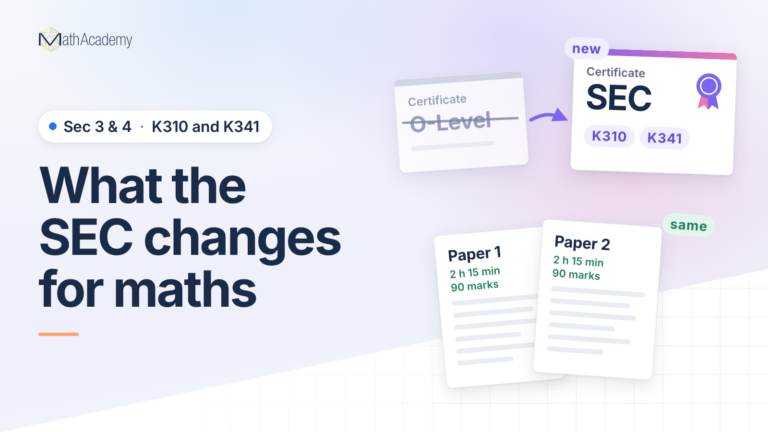
Yes. From 2027 the O-Level is replaced by the SEC, and A Maths is examined as G3 Additional Mathematics (K341). We compared the 2027 SEC syllabus with the 2026 O-Level one: the content and the formula list are the same. Only the name of the certificate changed.
Do I need to memorise the formulas that are given?
Not word for word, but know them well enough to recognise them inside a question. Spend most of your memorising time on the results that are not printed: derivatives and integrals, log laws, partial fraction forms, special angles and the R-formula.
A Maths study guides and practice by topic
The one-page printable sheet has every formula on this page: Download the one page A Maths formula sheet (PDF). To go further on a topic:
- Course: A Maths tuition (K341): small classes of at most 9, taught by three family teachers, all NUS Mathematics graduates.
- Study guides: Trigonometric identities, Surds, indices and logarithms, Polynomials and partial fractions, Circles, Differentiation, Integration, Kinematics.
- Practice with worked solutions: Sec 3 trigonometric identities, Sec 3 surds, indices and logarithms, Sec 4 differentiation techniques, Sec 4 integration, or the full Sec 3 A Maths and Sec 4 A Maths question banks.
- JC students: the H2 list is on our MF27 formula sheet page.