Free practice / Secondary 2 Maths
Sec 2 Maths: Solving Quadratic Equations by Factorisation, practice questions & worked solutions
Quadratic equations questions from 2021 to 2025 Singapore Secondary 2 End-of-Year examination papers. They cover solving by factorisation, finding an unknown coefficient from a given root, and forming quadratic equations from word problems, and every question has a full step-by-step worked solution.
About this topic & key methods
In Secondary 2 Mathematics, quadratic equations are solved by factorisation: rearrange so one side is , factorise, and use the fact that if a product is zero then one of its factors is zero. The questions below go from equations like , through finding an unknown coefficient when one root is given, to word problems where you form the equation yourself from an area, a right-angled triangle, a number grid or a speed and time.
In word problems a quadratic usually gives two solutions, and one of them often has to be rejected because a length, time or speed cannot be negative. The worked solutions below show the equation being formed, reduced, solved and checked against the context. For a structured programme covering this topic, see our Sec 2 Maths tuition.
Key methods
- Make one side zero: never divide both sides by ; move every term to one side instead, or a solution such as is lost.
- Zero product rule: if , then or .
- Given root: substitute the known value of to find the unknown coefficient, then solve the full equation for the other root.
- Equations with fractions: multiply both sides by the denominator first, noting any value of that makes it zero.
- Forming an equation: write each quantity in terms of , set up the relationship (area, Pythagoras, distance), expand and simplify to the given form.
- Rejecting a solution: check each root in context; lengths, times and speeds must be positive.
Questions & worked solutions
Factorising a quadratic, then solving it
Factorise .
Hence solve .
Show worked solution▾
(a)
We need two numbers whose product is and whose sum is : these are and . Split the middle term and group:
(b)
Use the factors from (a). If a product is zero, one of its factors is zero:
Difference of two squares, and an equation with no real solutions
Solve the following equation .
Explain why has no real solutions.
Show worked solution▾
(a)
is a difference of two squares, so it factorises as :
(b)
For any real number , , so and . The left-hand side can never equal .
Equivalently, gives , and no real number has a negative square. So the equation has no real solutions.
Expanding and rearranging before factorising
Solve the equation .
Show worked solution▾
The right-hand side is , not , so the zero product rule cannot be used yet. Expand, bring every term to one side, then factorise:
Check : . Correct.
Spotting the error: dividing both sides by x
Alina and Chloe were asked to solve the equation . The following showed the partial workings presented by Alina and Chloe:
| Alina’s partial working |
|---|
| Chloe’s partial working |
|---|
Whose partial working is correct?
Complete the working for the one you have chosen in part (a) and solve equation to find the value(s) for .
Show worked solution▾
(a)
Alina’s working is correct. In her last line Chloe divides both sides of by . That is only allowed when , so it throws away the solution .
(b)
Continue from by taking out the common factor :
Solving by factorisation and a substitution
Solve .
Hence, solve
Show worked solution▾
(a)
Bring every term to one side rather than dividing by , which would lose the root :
(b)
Note: the paper prints the right-hand side as , but the word “Hence” and the school answers or fit , which is solved here.
This is the equation in (a) with , so or :
Finding a coefficient from a given root
One solution of the equation is .
Find the value of .
Hence, find the other solution of the equation.
Show worked solution▾
(a)
Substitute :
(b)
The other solution is .
Finding a coefficient and the other root
It is given that is one of the solutions of , where is a constant.
Find
the value of .
the other solution of the equation.
Show worked solution▾
(a)
Substitute :
(b)
The other solution is .
Equation with a fraction leading to a quadratic
Solve the equation .
Show worked solution▾
Multiply both sides by , where :
Expanding a product equal to a number, then rejecting a negative time
The time difference, , in minutes, taken for an object to travel from point A to B and the return journey is given by the equation . By solving the equation , find the time difference , in minutes.
Show worked solution▾
The product equals , not , so expand and make one side zero first:
A time difference cannot be negative, so is rejected. Check: .
The time difference is minutes.
Forming a quadratic from Pythagoras’ theorem
The diagram shows a right-angled triangle . cm, cm and cm.
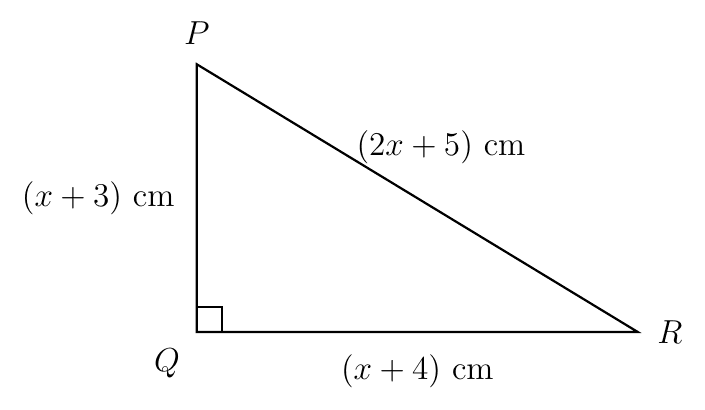
Write down an equation in and show that it reduces to .
Solve the equation .
Explain why one of the solutions in part (b) must be rejected.
Hence, find the area of triangle .
Show worked solution▾
(a)
The right angle is at , so is the hypotenuse. By Pythagoras’ theorem:
(b)
(c)
If , then cm and cm. A side of a triangle must have positive length, so is rejected.
(d)
With : cm and cm.
Forming a quadratic from the areas of a square and a rectangle
The side of a square is cm and the length and breadth of a rectangle are cm and cm respectively.
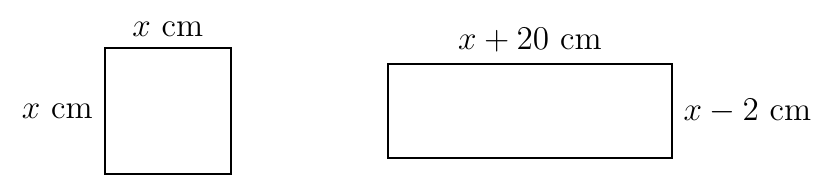
Write down an expression for the
area of the square,
area of the rectangle.
If the area of the rectangle is three times the area of the square, form an equation in and show that it reduces to .
Solve the equation .
Show worked solution▾
(a)(i)
(a)(ii)
(b)
Area of the rectangle area of the square:
The last step divides every term by 2.
(c)
Two numbers with product and sum are and :
Both values make every side positive (the breadth is cm or cm), so both are valid.
Forming a quadratic from a frame with a border of uniform width
A rectangular photo frame has a dimension of 37 cm by 26 cm. The frame has a border with uniform thickness of cm, such that the photo within the frame has an area of 726 cm.
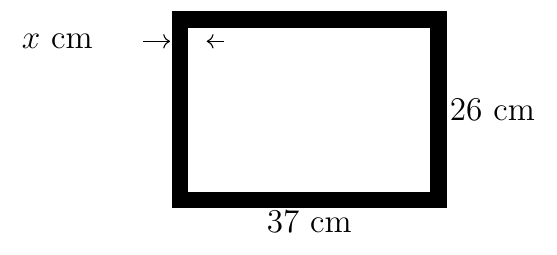
Write down an expression, in terms of , for the
length of the photo,
width of the photo.
Form an equation in and show that it reduces to .
Solve the equation to find the thickness of the border.
Show worked solution▾
(a)(i)
The border takes cm off each end, so the length loses cm:
(a)(ii)
(b)
(c)
Two numbers with product and sum are and :
If , the width would be cm, which is impossible, so is rejected. The border is cm thick. Check: .
Forming a quadratic from the area of a trapezium
The diagram shows a trapezium with all the length given in centimetres. is parallel to and angle .
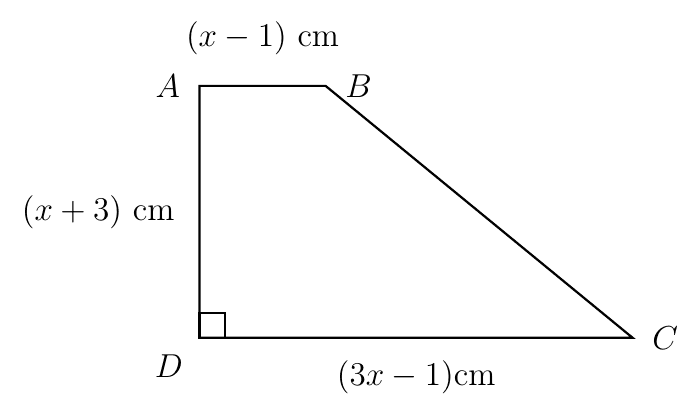
Given that the area of the trapezium is 15 cm, form an equation in and show that it reduces to .
Solve the equation .
Explain why one of the solutions in part (b) must be rejected.
Show worked solution▾
(a)
Area of a trapezium . The parallel sides are and , and the height is :
(b)
(c)
If , then cm, and a length cannot be negative. So is rejected and .
Forming a quadratic from the area of a parallelogram
is a parallelogram. The dimensions are measured in centimetre.
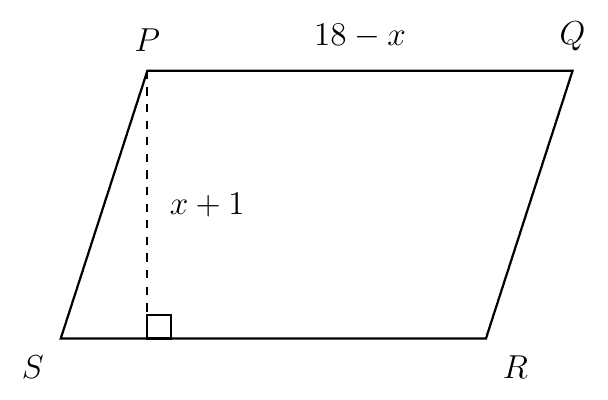
Given that the area of is 78 cm, find an expression in terms of and show that it reduces to .
Hence solve , given that is less than 10.
Show worked solution▾
(a)
Area of a parallelogram :
(b)
Since is less than , is rejected, so .
Forming a quadratic from the surface area of a cuboid
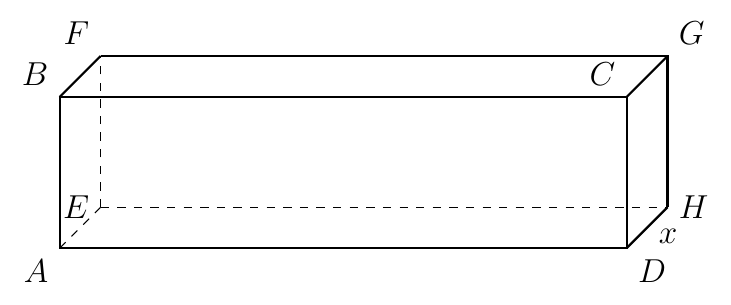
The diagram shows a cuboid with width cm. The width of the cuboid is 2.5 cm less than its height. The length of the cuboid is four times of its height.
Write down an expression, in terms of , for the length of the cuboid.
The total surface area of the cuboid is 325 cm. Form an equation, in terms of , to represent this information and show that it simplifies to .
Solve the equation .
Find the volume of the cuboid.
Show worked solution▾
(a)
The width is cm less than the height, so the height is cm. The length is four times the height:
(b)
A cuboid has three pairs of equal faces. Work out one face of each pair first:
These three add up to , and the total surface area is twice that:
(c)
Two numbers with product and sum are and :
(d)
The width cannot be negative, so . Then the height is cm and the length is cm.
Number grid pattern leading to a quadratic
The diagram shows part of a number grid.
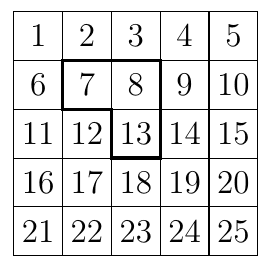
A shape outlining 3 numbers, as shown, is placed on the grid.
The shape is placed in a different position on the grid. Complete the shape below to show the numbers outlined.
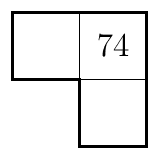
The shape is now placed in another position on the grid. The smallest number on this shape is , as shown below.
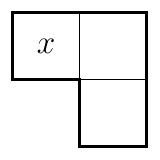
Write down the largest number in this shape in terms of .
The product of the largest and smallest number in this shape is 135. Form an equation, in terms of , and show that it reduces to .
Solve the equation .
Hence, find the total of the three numbers in this shape.
Show worked solution▾
Each row has numbers, so moving one square right adds and moving one square down adds . In the shape, the top-right number is more than the top-left, and the bottom number is more than the top-right.
(a)
Top-left and bottom .
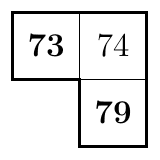
(b)(i)
The three numbers are , and , so the largest is .
(b)(ii)
(b)(iii)
(b)(iv)
The numbers on the grid are positive, so . The three numbers are , and :
Two pipes filling a tank: rates of work leading to a quadratic
Pipe A alone can fill a tank in minutes.
Write down an expression, in terms of , for the fraction of the tank filled by Pipe A in 1 minute.
Pipe B alone can fill the same tank in 8 minutes less than time taken for Pipe A.
Write down an expression, in terms of , for the fraction of the tank filled by Pipe B in 1 minute.
The time taken for Pipe A and Pipe B to fill the tank together is 7.5 minutes.
Write down an equation in to represent this information and show that it reduces to .
Solve the equation .
Hence, calculate the time taken to fill the tank using Pipe B alone.
Show worked solution▾
(a)
Pipe A fills the whole tank in minutes, so in 1 minute it fills
(b)
Pipe B takes minutes, so in 1 minute it fills
(c)
Together they fill the tank in minutes, so together they fill of the tank each minute:
(d)
If , Pipe B would take minutes, which is impossible, so is rejected and .
Petrol used by two cars: algebraic fractions leading to a quadratic
Andre’s car can travel km for every litre of petrol used. Steffi’s car can travel km for every litre of petrol used. Each of them drove 480 km to Malaysia.
Write an expression, in terms of , for the number of litres of petrol Andre used to travel 480 km.
Write an expression, in terms of , for the number of litres of petrol Steffi used to travel 480 km.
Steffi’s car uses 8 litres of petrol more than Andre’s car in this particular journey. Form an equation in and show that it reduces to .
Solve the equation and find the number of litres of petrol used by Steffi.
Show worked solution▾
(a)
Litres used :
(b)
(c)
Steffi uses 8 litres more than Andre:
(d)
A distance per litre cannot be negative, so is rejected and .
Forming a quadratic from speed, distance and time
The distance between Singapore and Kuala Lumpur is 300 km.
James drove from Singapore to Kuala Lumpur and it took him hours.
Write down an expression, in terms of , for James’ average speed in km/h.
Ben took a train from Singapore to Kuala Lumpur. Ben took 2 hours longer than James to cover the same distance.
Write down an expression, in terms of , for Ben’s average speed in km/h.
The train travelled at 40 km/h slower than James’ car.
Form an equation in and show that it reduces to .
Solve the equation .
Find the average speed, in km/h, of the train.
Show worked solution▾
(a)
(b)
(c)
James’ speed minus the train’s speed is km/h:
(d)
(e)
Time cannot be negative, so . The train takes hours:
Forming a quadratic from two stages of a journey
In a race, John walks at an average speed of km/h for hours and cycles at an average speed of km/h for hours.
Write down an expression, in terms of , for the distance he walks.
Write down an expression, in terms of , for the distance he cycles.
Given that John covers a distance of 97 km, write down an equation, in terms of , and show that it reduces to
Solve the equation .
Explain why the negative value of is rejected.
Show worked solution▾
Distance speed time.
(a)
(b)
(c)
(d)
(e)
is the walking time in hours, and a time cannot be negative. So is rejected.
(f)
Total time hours. With :