Free practice / Secondary 2 Maths
Sec 2 Maths: Simultaneous Linear Equations, practice questions & worked solutions
Simultaneous linear equations questions from 2021 to 2025 Singapore Secondary 2 End-of-Year examination papers. They cover solving a pair of equations by substitution and by elimination, reading a solution from a graph, and forming the equations yourself from a word problem, and every question has a full step-by-step worked solution.
About this topic & key methods
In Secondary 2 Mathematics, a pair of simultaneous linear equations in and is solved by finding the one pair of values that makes both equations true. There are two algebraic methods: substitution, where one equation is rearranged to make or the subject and substituted into the other, and elimination, where the equations are multiplied so that one unknown has the same coefficient and then added or subtracted away.
Graphically, each equation is a straight line and the solution is the point of intersection. Two parallel lines never meet, so their equations have no solution. The last questions below ask you to form the two equations from a word problem before solving them. For a structured programme covering this topic, see our Sec 2 Maths tuition.
Key methods
- Label the equations: number them (1), (2), (3) so that every step says which equation is being used.
- Substitution: best when one unknown already has a coefficient of , as in or .
- Elimination: multiply one or both equations so a pair of coefficients match, then subtract if the signs are the same and add if they are different.
- Finish the job: substitute the first value back into one of the original equations to find the second unknown.
- Check: substitute both values into the equation you did not use; it must balance.
- Graphical method: the solution is the point where the lines cross; parallel lines (same gradient, different -intercept) give no solution.
Questions & worked solutions
Solving by elimination with a negative answer
Solve the simultaneous equations and .
Show worked solution▾
Multiply (2) by 3 so that the terms are and :
Add (1) and (3) to eliminate :
Substitute into (2):
So , . Check in (1): .
Elimination after multiplying one equation
Solve the simultaneous equations.
Show worked solution▾
Multiply (2) by 6 so that the terms cancel when added:
Add (1) and (3):
Substitute into (2):
So , . Check in (1): .
Solving by substitution
Solve these simultaneous equations.
Show worked solution▾
From (1), —(3). Substitute (3) into (2):
Substitute into (3):
So , . Check in (2): .
Substitution or elimination
Solve these simultaneous equations.
Show worked solution▾
By substitution
From (1), —(3). Substitute (3) into (2):
Substitute into (3):
By elimination
(1) gives —(4). The terms have opposite signs, so add (4) and (2):
Then , so . Either way, , .
Substitution when the answers are fractions
Solve the pair of simultaneous equations.
Show worked solution▾
From (2), (3). Substitute (3) into (1):
Substitute into (3):
So , . Check in (1): .
Clearing fractions first, then elimination
Solve the pair of simultaneous equations.
Show worked solution▾
Multiply the first equation by 6, the lowest common multiple of 3, 2 and 6:
Both equations now have . Subtract (1) from (2):
Substitute into (2):
So , . Check in the first equation: .
Elimination with decimal constants
Solve the following simultaneous equations.
Show worked solution▾
Make the terms equal: multiply (1) by 3 and (2) by 2.
Subtract (3) from (4):
Substitute into (1):
So , . Check in (2): .
Equations written equal to zero, solved by substitution
Solve the following simultaneous equations.
Show worked solution▾
From (1), (3). Substitute (3) into (2):
Substitute into (3):
So , . Check in (2): .
Solving with a fractional substitution
Solve the following simultaneous equations.
Show worked solution▾
From (1):
Substitute (3) into (2), then multiply through by :
Substitute into (3):
So , . Check in (2): .
Solving by elimination
Solve the simultaneous equations.
Show worked solution▾
Make the coefficients equal: (1) and (2) :
The terms have the same sign, so subtract: (4) (3):
Substitute into (1):
So , . Check in (2): .
Graphical method and parallel lines
The grid shows the graphs of two equations and .
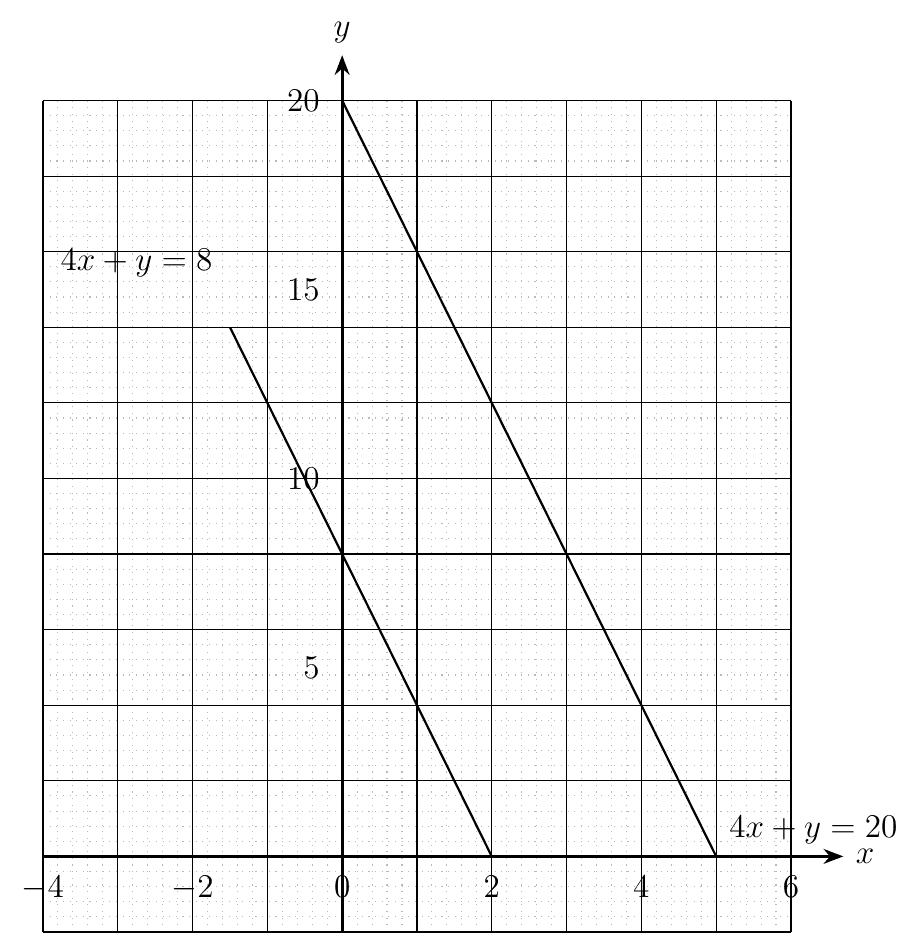
Without solving these two equations, state the number of solutions these equations have. Explain your answer.
Draw and label the line onto the grid.
Hence, write down the coordinates of the point of intersection of the lines and .
Show worked solution▾
(a)
Rewrite both equations in the form :
Both lines have gradient but different -intercepts ( and ), so they are parallel and never meet. The equations have no solution (0 solutions).
(b)
is the horizontal line through on the -axis:
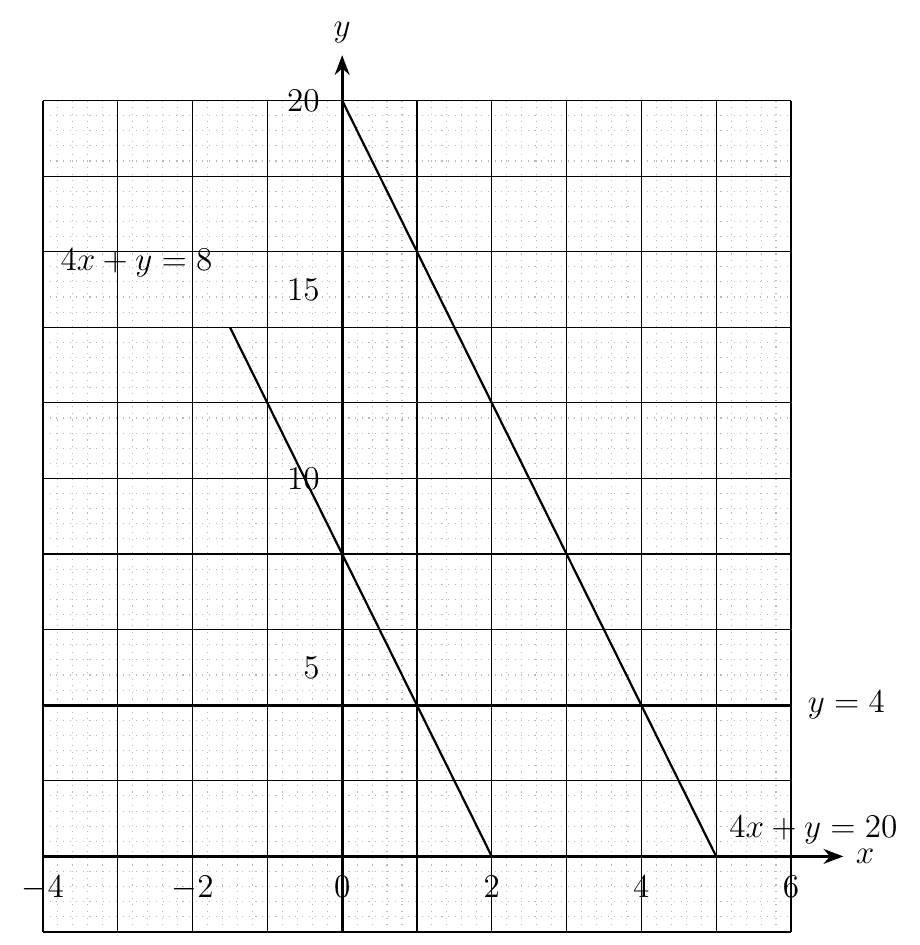
(c)
The line crosses at
Check: .
Forming simultaneous equations from heads and legs
There are some cows and chickens on a farm. The animals have a total of 35 heads and 110 legs. By forming simultaneous equations, calculate how many more cows than chickens there are.
Show worked solution▾
Let be the number of cows and the number of chickens. Each animal has one head; a cow has 4 legs and a chicken has 2.
From (1), (3). Substitute (3) into (2):
There are 20 cows and 15 chickens, so there are more cows than chickens. Check: legs.
Forming simultaneous equations from ticket numbers and sales
At an amusement park, the prices of tickets for adults and children are $5.50 and $3.20 respectively. The number of adult tickets and children tickets sold are represented by and respectively.
The total number of tickets sold is 119. Form an equation connecting and .
The total sales of tickets amount to $486.60. Form an equation connecting and .
Hence, find the number of adult tickets and the number of children tickets sold.
Show worked solution▾
(a)
(b)
Adult tickets bring in dollars and children tickets dollars.
(c)
From (1), (3). Substitute (3) into (2):
46 adult tickets and 73 children tickets were sold. Check: .
Forming simultaneous equations from two purchases, then testing a claim
The total cost of 7 pencils and 4 pens is $9.45. The total cost of 10 pencils and 1 pen is $6.90.
Let the price of 1 pencil be $ and the price of 1 pen be $. Form a pair of simultaneous equations in terms of and .
Hence, find the value of and .
Clarence claims that $50 is sufficient to buy 20 pencils and 20 pens. Do you agree with him? Show your working clearly.
Show worked solution▾
(a)
(b)
From (2), (3). Substitute (3) into (1):
So and : a pencil costs $0.55 and a pen costs $1.40. Check in (1): .
(c)
20 pencils and 20 pens cost $39, which is less than $50. Yes, I agree with Clarence.
Forming simultaneous equations from the digits of a number
Let be the tens digit and be the ones digit of a two-digit number, represented as .
The number is equal to 4 times the sum of its digits. Write down an equation in and to represent this information and show that it simplifies to .
The number formed by reversing its digits, represented as , is 9 more than the original number. Write down an equation in and to represent this information and show that it simplifies to .
Solve these two equations to find the two-digit number.
Show worked solution▾
(a)
(b)
(c)
Subtract (2) from (1):
Substitute into (1): , so . The two-digit number is .
Check: , and reversing the digits gives .
Simultaneous equations from the angles of congruent triangles
Triangle is congruent to triangle .
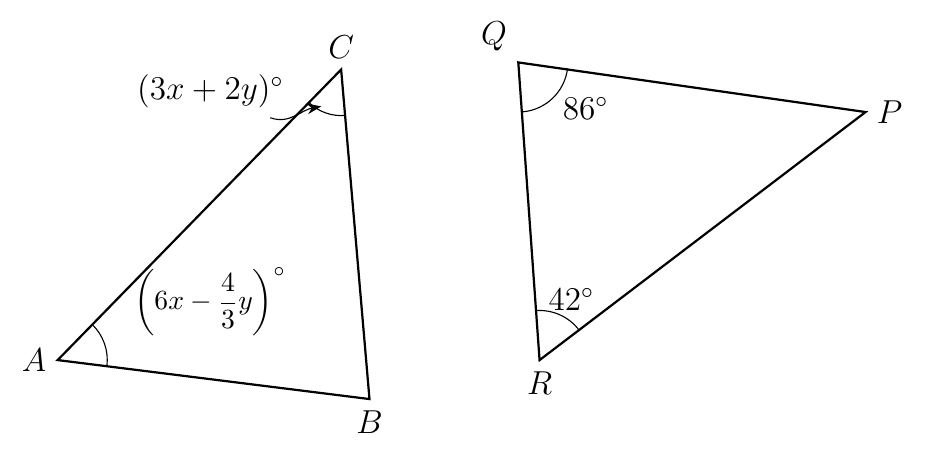
Given that , form another equation relating and .
Solve the simultaneous equations in (a) to find the values of and of .
Show worked solution▾
(a)
From : , and . So , which is the given equation , and . By the angle sum of triangle :
(b)
Multiply (1) by 2 so that the terms match:
Subtract (2) from (3):
Substitute into (1):
So , . Check: .
Simultaneous equations from an isosceles triangle and its perimeter
In the diagram, is an isosceles triangle. cm, cm and cm.
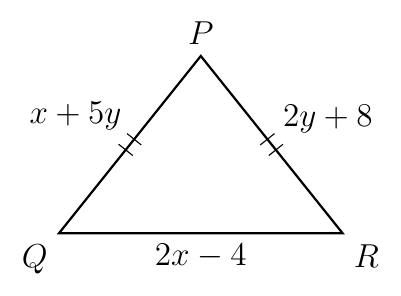
Given that , show that .
Given that the perimeter of triangle is 26 cm, show that .
Solve the simultaneous equations.
Hence, find the length of the shortest side of triangle .
Show worked solution▾
(a)
(b)
Add the three sides:
(c)
Multiply (1) by 3: (3). Subtract (2) from (3):
Substitute into (1): , so .
(d)
The shortest side is cm. Check: cm.
Simultaneous equations from the opposite sides of a parallelogram
The figure shows a parallelogram with its sides as indicated.
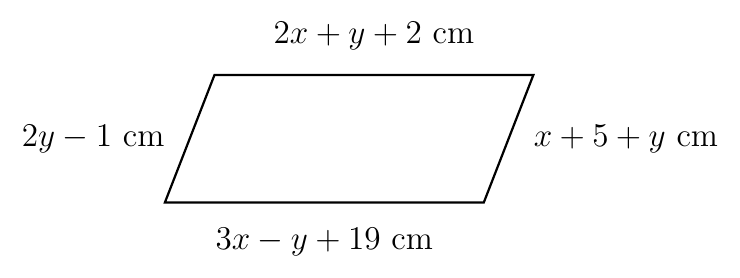
By forming two equations in terms of and , solve them simultaneously to find the values of and of .
Hence, find the perimeter of the parallelogram.
Show worked solution▾
(a)
Opposite sides of a parallelogram are equal. Top and bottom:
Left and right:
Subtract (2) from (1):
Substitute into (2): , so .
(b)
Check the other two sides: and , so the opposite sides agree.
Forming simultaneous equations from a rectangle and a square
The diagram shows one rectangle, and one square, . The dimensions, in centimetres, of the quadrilaterals are shown below.
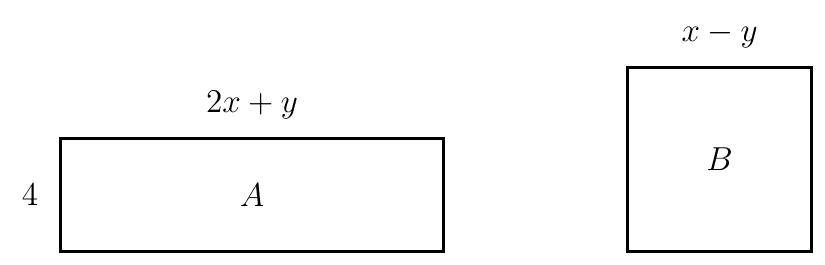
The area of rectangle is 36 cm. Find in terms of . Give your answer in its simplest form.
The length of square is 2 cm more than the breadth of rectangle . Find in terms of . Give your answer in its simplest form.
Solve the simultaneous equations found in (a) and (b).
David cuts the entire rectangle into squares of length 1 cm. He claims that he can use all the 1 cm squares to cover square . Do you agree with him? Explain clearly.
Show worked solution▾
(a)
(b)
The breadth of is cm, so the side of is cm:
(c)
Both expressions equal , so set them equal:
So , . Check: and .
(d)
I agree with David. Rectangle gives squares of side cm, and square has area cm, so the squares fit exactly as a by arrangement covering .
Forming simultaneous equations from a fraction
A fraction is equivalent to if 1 is subtracted from the numerator and 3 is added to its denominator. If 2 is added to the numerator and 5 is subtracted from the denominator of the original fraction, the resulting value is . Find the original fraction.
Show worked solution▾
Let the original fraction be . Cross-multiply each condition:
Substitute (1) into (2):
The original fraction is .
Check: and .