Free practice / Secondary 2 Maths
Sec 2 Maths: Probability of Single Events, practice questions & worked solutions
Probability questions from 2021 to 2025 Singapore Secondary 2 End-of-Year examination papers. They run from finding the probability of drawing a coloured marble to forming an equation when items are added or removed, and every question has a full step-by-step worked solution.
About this topic & key rules
In Secondary 2 Mathematics, probability is introduced through single events with equally likely outcomes, such as drawing one ball from a bag. The questions below practise the basic formula, the complement rule , and a common exam type: some items are added to or removed from the bag, the new probability is given, and you form and solve an equation to find how many.
In those questions, the key step is to write down the new number of favourable outcomes and the new total before setting up the fraction. The worked solutions below do this on one line, then cross-multiply. For a structured programme covering this topic, see our Sec 2 Maths tuition.
Key rules
- Probability of an event: .
- Range: ; an impossible event has probability and a certain event has probability .
- Complement: .
- Adding or removing items: both the favourable count and the total change, for example after adding green marbles.
- Simplify: give probabilities as fractions in their lowest terms unless told otherwise.
Questions & worked solutions
Equally likely outcomes on a spinner, including an impossible event
Ariel spins a fair five-sided spinner with numbers 2, 3, 4, 5 and 6. Write down the probability that the spinner lands on
an even number,
a prime number,
the number 8.
Show worked solution▾
The spinner is fair, so each of the 5 numbers is equally likely.
(a)
The even numbers are , and .
(b)
The prime numbers are , and . ( and are not prime.)
(c)
There is no 8 on the spinner, so landing on 8 is impossible.
Probability of choosing a letter from a word
The word “RESPONSIBILITY” is made up of 14 letters. If a letter from “RESPONSIBILITY” is selected randomly, calculate the probability of
selecting the letter “S”,
selecting the letter “A”.
Show worked solution▾
Each of the 14 letters is equally likely to be selected.
(a)
The letter S appears twice: RESPONSIBILITY.
(b)
There is no A in the word, so this event is impossible.
Single events, the complement, and a new total after adding items
A bag contains 5 red marbles, 6 green marbles and 3 yellow marbles. Matilda draws a marble at random.
Find the probability that a green marble is drawn.
Find the probability that the marble drawn is not red.
If Calos adds 3 blue marbles into the bag, find the probability that Matilda draws out a blue marble.
Show worked solution▾
Total number of marbles .
(a)
(b)
(c)
After 3 blue marbles are added there are marbles, and 3 of them are blue.
Probability from a two-way table
The table gives information about a box of books.
| Hardcover | Paperback | |
|---|---|---|
| Fictional | 14 | 12 |
| Non-fictional | 6 | 18 |
One book is selected at random from the box. Find, as a fraction in its simplest form, the probability that the book is
a hardcover book,
a non-fictional book,
a fictional paperback book.
Show worked solution▾
Total number of books .
(a)
Hardcover books: .
(b)
Non-fictional books: .
(c)
Fictional paperbacks are in one cell of the table: 12 books.
Probability of a single event, its complement, and adding items
A bag contains 10 red marbles, 7 blue marbles, 6 green marbles and 1 white marble. A marble is drawn at random. Find the probability that the marble is
blue,
not red.
more green marbles were added in the bag. Given that the probability of drawing a green marble is after the addition, find the value of .
Show worked solution▾
Total number of marbles .
(a)(i)
(a)(ii)
(b)
After adding green marbles there are green marbles out of .
Check: .
Adding items to reach a given probability
A bag contains 5 blue balls, 8 green balls and 3 yellow balls.
A ball is drawn at random. Find the probability of getting a green ball.
yellow balls are added to the bag. The probability of getting a yellow ball becomes . Find the value of .
Show worked solution▾
Total number of balls .
(a)
(b)
After adding yellow balls there are yellow balls out of .
Check: .
Prime and even numbers on cards, then removing items
A card is drawn at random from a box containing 30 cards numbered 1 to 30.
Find the probability of drawing
a ‘4’,
a prime number,
an even number.
There are 18 identical balls in a bag. 8 of the balls are red and the rest are yellow. After yellow balls are removed from the bag, the probability of getting a yellow ball is . Find the value of .
Show worked solution▾
(a)(i)
Only one of the 30 cards shows 4.
(a)(ii)
The primes from 1 to 30 are : ten of them. (1 is not prime.)
(a)(iii)
The even numbers are : fifteen of them.
(b)
There are yellow balls. After yellow balls are removed there are yellow balls out of .
Check: .
An impossible event, either of two colours, and a new total from a decimal probability
There are 7 red balls, 10 yellow balls, and 8 blue balls in a bag. A ball is chosen at random from the bag.
Find the probability that the chosen ball is black.
Find the probability that the chosen ball is either red or yellow.
Some green balls are added into the bag such that the probability of choosing a yellow ball at random is 0.2. Find the new total number of balls in the bag.
Show worked solution▾
Total number of balls .
(a)
There are no black balls in the bag.
(b)
(c)
Adding green balls does not change the 10 yellow balls. Let the new total be .
The new total is 50 balls (so 25 green balls were added).
Probabilities that add to 1, then counters added to change a probability
A bag contains red counters, blue counters and yellow counters. A counter is picked at random from the bag with 15 counters.
The probability that the counter is blue is .
The probability that the counter is red is .
Find the probability that the counter is yellow.
Some red counters are added to the bag.
The probability of picking a blue counter is now .
Find the number of red counters added to the bag.
Show worked solution▾
(a)
Every counter is red, blue or yellow, so the three probabilities add up to 1.
(b)
Number of blue counters . Let red counters be added, so there are counters and still 9 blue ones.
3 red counters were added. Check: .
Decimal probabilities and finding the total from a difference in counts
A bag contains some red marbles, some blue marbles and some yellow marbles.
The probability of choosing a red marble at random is 0.35.
The probability of choosing a blue marble at random is 0.4.
Find the probability of choosing a yellow marble at random.
In the bag, there are 6 more blue marbles than red marbles.
Find the total number of marbles in the bag.
Show worked solution▾
(a)
(b)
Let the total number of marbles be . Then there are blue marbles and red marbles.
There are 120 marbles. Check: blue and red, a difference of 6.
Probability of either of two outcomes, then adding items
A bag contains 18 coloured balls, of which 6 are red, 4 are yellow and the rest are purple. A ball is chosen at random from the bag.
Find the probability that either a red or yellow ball is chosen.
red balls are added into the bag such that the probability of choosing a red ball becomes .
Find the value of .
Show worked solution▾
(a)
There are balls that are red or yellow.
(b)
After adding red balls there are red balls out of .
Check: .
Removing items to reach a given probability
There are 24 marbles in a jar. 15 of the marbles are blue, and the rest are green. After green marbles are removed from the jar, the probability of picking a green marble is .
By forming an equation in terms of , find the value of .
Show worked solution▾
There are green marbles. After removing of them there are green marbles out of .
Check: .
Finding the total number of items from a given probability
There are balls in a bag. 8 are blue, 4 are green and the rest are yellow. The probability of drawing a yellow ball is .
Find the number of balls in the bag.
Find the probability of getting either a green or yellow ball.
Find the probability of getting a black ball.
Show worked solution▾
(a)
The number of yellow balls is .
(b)
There are yellow balls, so balls are green or yellow.
(c)
There are no black balls in the bag.
The missing probability from the others, then adding items to reach a target
A bag contains red counters, yellow counters and green counters. The probability that the counter is red is . The probability that the counter is yellow is .
A counter is chosen at random from the bag. Find the probability that the counter is
white,
green.
Another bag contains 7 blue counters and 11 pink counters. More pink counters are added to the bag. The probability of choosing a pink counter from this bag at random is now . Find the total number of pink counters in the bag.
Show worked solution▾
(a)(i)
The bag has no white counters, so this event is impossible.
(a)(ii)
Red, yellow and green are the only colours, so their probabilities add up to 1.
(b)
Let pink counters be added. Then there are pink counters out of .
The question asks for the total number of pink counters: . Check: .
An unknown group size from a probability, then more people joining
There are 15 girls and boys in a group. The probability of selecting a boy randomly from the group is .
Find the value of .
How many more boys are needed to join the group so that the probability of selecting a boy randomly is ?
Show worked solution▾
(a)
There are people in the group, and of them are boys.
(b)
Now there are 9 boys in a group of 24. Let more boys join, giving boys out of .
16 more boys are needed. Check: .
Probabilities from a spinning wheel, then the expected number of customers
In a newly opened boutique, a lucky draw wheel with 8 sectors is featured. Customers are allowed to spin the wheel once for every purchase.
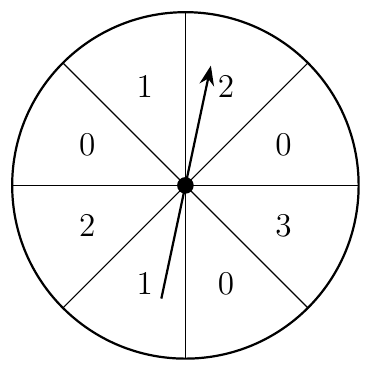
| Pointer landing on | Lucky draw prize |
|---|---|
| 0 | No prize |
| 1 | Soft toy |
| 2 | $20 shopping voucher |
| 3 | Grand prize: A bag worth $80 |
Find the values of , and .
| Number | 0 | 1 | 2 | 3 | 4 |
|---|---|---|---|---|---|
| Probability |
At the end of the day, the total number of customers who took part in the lucky draw was consolidated. Given that 16 customers won the grand prize, find the total number of customers who took part in the lucky draw.
Show worked solution▾
The 8 sectors are equal, so each sector has probability . Count the sectors for each number on the wheel.
(a)
Three sectors show 0, two show 1, and no sector shows 4.
Check: two sectors show 2 and one shows 3, which gives the and in the table. The probabilities add up to 1:
(b)
The grand prize is won by landing on 3, which has probability . So about of the customers win it. Let the total number of customers be .
Two groups added, forming a probability equation
There are 25 adults and 7 children in the theatre room. After another adults and children entered the theatre room, the probability of selecting a child at random becomes . Find the value of .
Show worked solution▾
After the new arrivals there are children and adults, so the total is people.
Check: children out of people, and .
Probability from fractions of two groups
Among a group of 45 students, 30 are girls. of the girls and of the boys passed a recent science test. A student is selected randomly. Find, as a fraction in its lowest terms, the probability that the student
fail the test,
is a boy who passed the test,
is a girl who failed the test.
Show worked solution▾
There are boys. Work out each group first:
(a)
(b)
(c)
An algebraic count of items and a probability equation
A bag contains 30 balls of which balls are red, 8 balls are blue and the rest are white. A ball is drawn at random from the bag.
Find the probability of picking
a blue ball,
a black ball.
If the probability of picking a white ball is , find the number of red balls.
Show worked solution▾
(a)(i)
(a)(ii)
There are no black balls in the bag.
(b)
Number of white balls .
The question asks for the number of red balls, which is . Check: there are white balls, and .
Letters of a word, then two unknown counts linked by a rule
Each letter of the word ‘MISSISSIPPI’ is written on cards. The cards are placed face down and shuffled. A card is drawn at random.
What is the probability of drawing a card with the letter ‘S’?
What is the probability of drawing a card with the letter ‘W’?
A bag contains red and green balls. The number of green balls is 5 more than twice the number of red balls. The probability of drawing a red ball from the bag is . Find the number of green balls in the bag.
Show worked solution▾
(a)(i)
MISSISSIPPI has 11 letters, and 4 of them are S.
(a)(ii)
There is no W in the word.
(b)
Let the number of red balls be . Then there are green balls and balls in total.
Number of green balls . Check: .