Sec 1 Maths in 2027: The First Ten Weeks and How to Prepare in the December Holidays
By the Math Academy teachers, all NUS Mathematics graduates · Updated November 2026
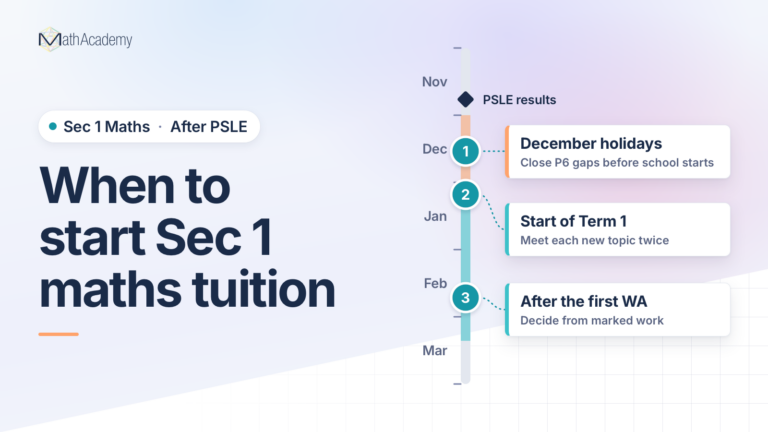
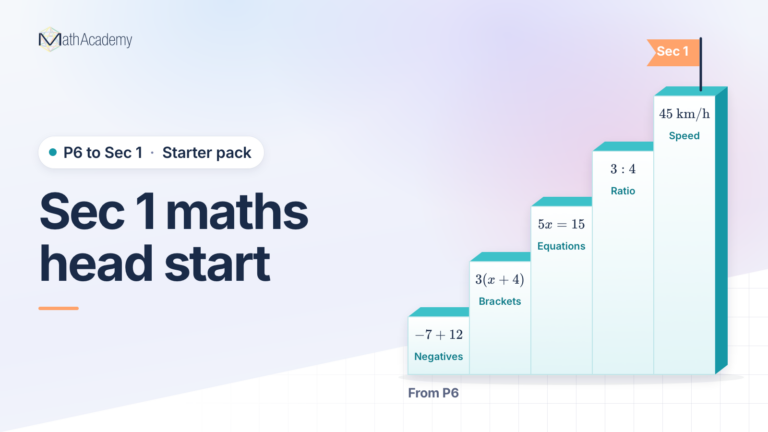
Term 1 of 2027 runs from Monday 4 January to Friday 12 March: exactly ten weeks. Schools set their own order, but MOE’s Sec 1 list opens with number work, and algebra runs through everything after it. Both lean on Primary 6, so the most useful December preparation is light. Shore up Primary 6 fractions, ratio, percentage and algebra, and preview two or three Sec 1 ideas: negative numbers, brackets in algebra and speed. Three short sessions a week is plenty. Racing through the Sec 1 textbook is not the goal.
Key dates for Sec 1 in 2027
| Event | Date | Status as at 11 Nov 2026 |
|---|---|---|
| 2026 PSLE results | Tuesday 24 or Wednesday 25 November 2026 | Tentative window from MOE and SEAB; the exact day is not yet announced |
| Secondary 1 posting results | Friday 18 December 2026, from 9am | Tentative, per MOE’s S1 posting page |
| Term 1 | Monday 4 January to Friday 12 March 2027 | Confirmed in MOE’s 2027 school terms release (14 July 2026) |
| March holidays | Saturday 13 to Sunday 21 March 2027 | Confirmed |
| Schools closed in Term 1 | Monday 8 February (Chinese New Year holiday), Tuesday 9 February (day off in lieu), Wednesday 10 March (Hari Raya Puasa) | Confirmed |
Each secondary school posts its own reporting details, booklist and uniform information after the posting results, so check the posted school’s website from 18 December.
G1, G2 or G3 Mathematics: what the posting result tells you
Under Full Subject-Based Banding, your child’s PSLE score gives a posting group, and the posting group sets the usual starting level for most subjects. Posting Group 3 takes all subjects at G3. Posting Groups 2 and 1 take most subjects at G2 and G1.
Mathematics (like English, Mother Tongue and Science) has its own rule. MOE allows a more demanding level from the start of Sec 1 based on the PSLE Mathematics Achievement Level:
- a pupil whose usual level is G2 can take G3 Mathematics with AL 5 or better;
- a pupil whose usual level is G1 can take G3 or G2 Mathematics with AL 5 or better, or G2 Mathematics with AL 6 (or AL A at foundation level).
Levels can also be raised later, based on how your child does in secondary school. Our article on the difference between G2 and G3 Mathematics explains what each level covers. The rest of this guide is written for G3, the level with the longest Sec 1 list.
One point is new this year. The children who sat the PSLE in 2026 are the first cohort to complete MOE’s 2021 primary mathematics syllabus, and speed is not in it. For many of them, speed will be a new topic in Sec 1.
What changes from Primary 6 to Sec 1 Maths
Most of PSLE Mathematics carries over. Four things are genuinely different, and each is used in almost every later topic.
Negative numbers and the number line
Primary maths stays with numbers from zero upwards. Sec 1 starts with integers and works across zero in all four operations.
Worked example. The temperature is −3 °C. It falls by 5 °C, then rises by 9 °C.
- −3 − 5 = −8
- −8 + 9 = 1, so the temperature ends at 1 °C.
Two rules then do most of the work: subtracting a negative adds, as in −6 − (−2) = −4, and two negatives multiply to a positive, as in (−4) × (−3) = 12.
Algebra as generalised arithmetic
In P6, a letter stands for one unknown number and there are no brackets. In Sec 1, letters describe patterns that hold for every number, and brackets arrive.
Worked example. A child who sees that 3 × 47 + 3 × 53 = 3 × (47 + 53) = 3 × 100 = 300 has already used the rule 3a + 3b = 3(a + b). Sec 1 uses the same rule to remove brackets:
5(x + 2) − 2(x − 4) = 5x + 10 − 2x + 8 = 3x + 18
Check with x = 1: the left side gives 5 × 3 − 2 × (−3) = 15 + 6 = 21, and 3 × 1 + 18 = 21. The sign of −2 × (−4) = +8 is where most slips happen.
Speed, average speed and units
Rate is taught in P5, but speed is not in the primary syllabus. Average speed is total distance divided by total time, not simply the average of the two speeds.
Worked example. A cyclist rides 10 km at 20 km/h, then another 10 km at 10 km/h.
- Time for the first part: 10 ÷ 20 = 0.5 h
- Time for the second part: 10 ÷ 10 = 1 h
- Average speed = 20 ÷ 1.5 = 13.3 km/h (to 3 significant figures), not 15 km/h.
Unit changes come with it: 54 km/h = 54 × 1000 ÷ 3600 = 15 m/s.
Forming an equation and showing working
PSLE word problems are often solved with a model. Sec 1 asks for the same reasoning written as an equation, one step per line, starting with a sentence that says what the letter means.
Worked example. An adult ticket costs $3 more than a child ticket. Two adult tickets and three child tickets cost $41. Find the price of a child ticket.
- Let a child ticket cost $c. Then an adult ticket costs $(c + 3).
- 2(c + 3) + 3c = 41
- 2c + 6 + 3c = 41
- 5c + 6 = 41
- 5c = 35
- c = 7
A child ticket costs $7. Check: 2 × $10 + 3 × $7 = $41. Teachers mark the method, so the “Let” line and the steps matter as much as the answer.
Likely Term 1 topics in Sec 1 Maths, and what each needs from primary school
MOE sets the Sec 1 content for each level but does not fix the order. Each school writes its own scheme of work, so treat the list below as one likely opening, not a timetable. It is the order our 14 Sec 1 practice topics and Sec 1 study guides follow, and like MOE’s own list it starts with numbers and their operations. A school may start elsewhere, for example with angles or data. The school’s scheme of work, or your child’s timetable in the first week, will tell you.
| Sec 1 topic (G3) | What it needs from primary school | Practise and read |
|---|---|---|
| Primes, prime factorisation, HCF and LCM | P4 factors and multiples; quick multiplication tables | Practice · Guide |
| Integers and rational numbers | P5 order of operations with brackets; P5 and P6 fractions | Practice · Guide |
| Approximation and estimation | P4 rounding to the nearest 10, 100 or 1000 and to 1 or 2 decimal places | Practice · Guide |
| Algebraic expressions | P6 algebra: a letter for an unknown, simplifying, substitution | Practice · Guide |
| Linear equations, including simple fractional equations | P6 simple equations with whole-number coefficients; P5 and P6 fractions | Practice · Guide |
In our guides, number patterns, ratio, percentage, and rate and speed come next. Ratio and percentage lean hardest on P6, and speed builds on P5 rate. Our Secondary 1 maths syllabus lists every Sec 1 topic at G1, G2 and G3.
A light December plan, week by week
The aim is to arrive in January with no gaps in the primary topics Sec 1 assumes, and with a first look at two or three new ideas. Keep each session to 20 to 30 minutes, three times a week, and let the first week after results be a rest.
| Week | Focus | What to do |
|---|---|---|
| 30 Nov to 6 Dec | P5 and P6 fractions | Mixed questions on adding, multiplying and dividing fractions, including dividing by a proper fraction, all without a calculator |
| 7 to 13 Dec | P6 ratio and percentage | Finding the whole from a part, percentage increase and decrease, dividing a quantity in a ratio |
| 14 to 20 Dec | P6 algebra | Substitution, simplifying without brackets, and simple equations. Posting results arrive on 18 Dec (tentative): note your child’s Maths level |
| 21 to 27 Dec | Preview 1: negative numbers | A number line, temperatures below zero, then adding and subtracting across zero. Two sessions is enough in Christmas week |
| 28 Dec to 3 Jan | Preview 2 and 3: brackets and speed | Expanding simple brackets such as 3(x + 4), and distance = speed × time with whole numbers. Stop by 1 January |
For the first three weeks, the primary books your child already owns are enough. For the previews, use the integers and rational numbers guide, the basic algebra guide and the rate, speed and time guide, or our Secondary 1 algebra basics article.
For a set order of guides and questions to work through, use our free Sec 1 Maths head start.
What not to do in the December holidays
- Do not race through the whole Sec 1 textbook. Half-learnt methods are harder to correct than new ones, and a child who has “done” every chapter can switch off in January.
- Do not drill hard PSLE problem sums. Accuracy with fractions and signs matters more now.
- Do not ban the model method. Models are still a good way to understand a problem. The new step is to write the equation as well.
- Do not plan long sessions. Three short sessions a week, with the holidays still feeling like holidays, does more than one long one.
- Do not judge from one early test. The first topic test of Sec 1 can surprise children who did well at PSLE. Look at where the marks went before deciding anything.
When to ask for help with Sec 1 Maths in Term 1
Many children settle within a few weeks. Around week 5 of Term 1 (early February), a quick check with the four examples above shows whether the foundations are holding:
- Negative numbers: can your child work out −6 − (−2) and (−4) × (−3) without a number line?
- Brackets: can they simplify 5(x + 2) − 2(x − 4) and get the +8 right?
- Equations: given the ticket question, do they write the “Let” line and an equation, or stop at a model?
- Marked work: in the first marked test or homework, were marks lost on the idea, or on signs and missing steps?
Slips on one item are normal. If the same item goes wrong after corrections, act before the next topic builds on it. Start with the teacher at school. If your child needs more regular support, our Sec 1 Maths tuition classes, taught by Ms Jolyn Ang and Ms Raine Ang, have at most 7 students and meet for 1.5 hours a week at our centre opposite Bukit Gombak MRT. Our tutors personally mark every worksheet. Class times and fees are on the timetable, or WhatsApp us on 8859 1092. For a weekly routine you can set up yourself, read how to study Secondary 1 maths.
Frequently asked questions
Should my child study Sec 1 Maths before school starts?
A light preview helps, but the most useful December work is securing P6 fractions, ratio, percentage and algebra. Previewing negative numbers, brackets and speed is enough. Finishing the Sec 1 textbook early is not.
How much maths should my child do in the December holidays?
About three sessions of 20 to 30 minutes a week, from the week after PSLE results until 1 January.
My child is posted to G2 Maths. Can they take G3?
From the start of Sec 1, a pupil whose usual level is G2 can take G3 Mathematics with PSLE Mathematics AL 5 or better. Levels can also be raised later based on performance in secondary school. The school confirms the level, so ask it directly.
Is speed still taught in primary school?
No. Speed is not in MOE’s 2021 primary mathematics syllabus, which the 2026 PSLE cohort is the first to complete. Rate is still taught in P5. Children starting Sec 1 in 2027 will meet speed and average speed in secondary school.
Is Sec 1 Maths much harder than PSLE Maths?
It is faster and more abstract, not a different subject. See is Secondary 1 maths hard? and Secondary 1 maths vs primary maths.